Research-based product review · 8 min read · Source check: November 4, 2026
StoryShort is relevant when production begins with an idea or script and needs a connected short-video story. Its appeal is the connection between narrative, scenes and narration rather than the finishing of an existing interview. The editorial challenge is that an automatically assembled episode can look complete while its explanation is weak or its recurring character changes identity.
We would judge the product over a small series, not a single impressive output. A consistent narrator, visual world and episode promise are what make a channel recognizable. Automated generation can shorten a production step; it cannot establish audience demand, factual expertise or eligibility for platform monetization.
Table of Contents
The buying decision
| Put it on the shortlist when | Choose another route when |
|---|---|
| A creator with an original educational or narrative concept and a person who can approve scripts and complete episodes. | A plan built around unattended uploads, recycled claims or an assumption that generated output guarantees views and revenue. |
A realistic job for StoryShort
A stationery shop plans a three-part series about choosing a notebook for drawing, planning and journaling. The same fictional guide appears in each episode. A proposed pilot verifies paper descriptions against real product information, then checks that the guide, notebook and scene sequence remain coherent after script revisions.
What the capabilities mean in practice
Narrative production
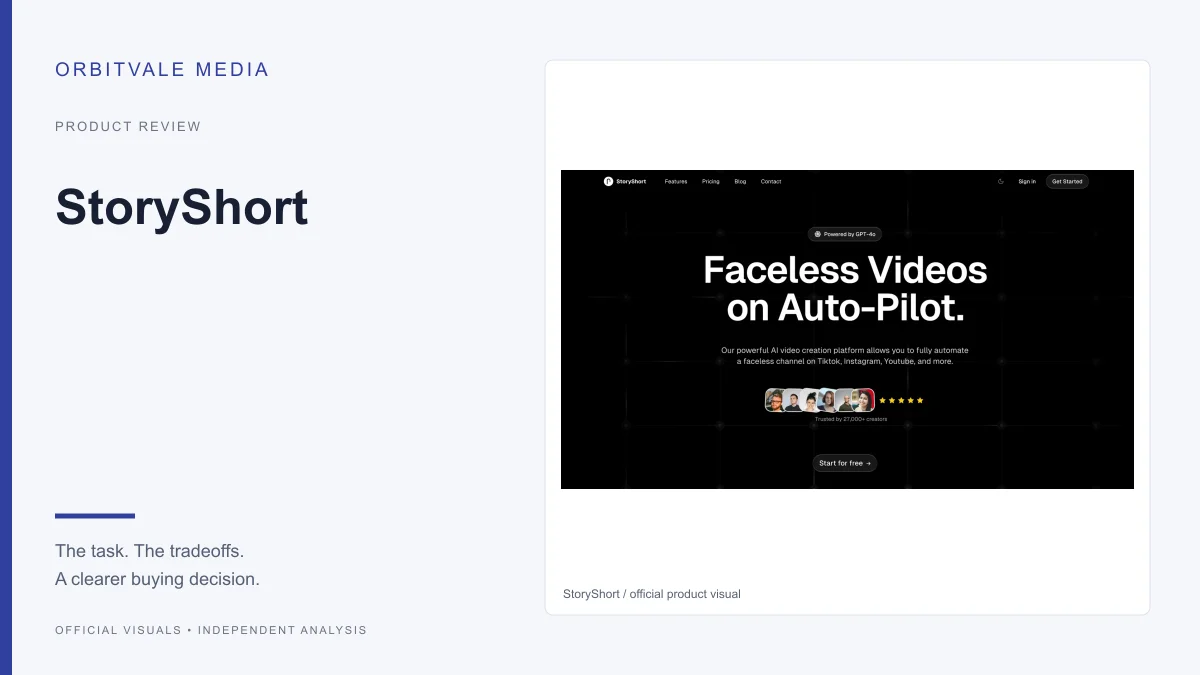
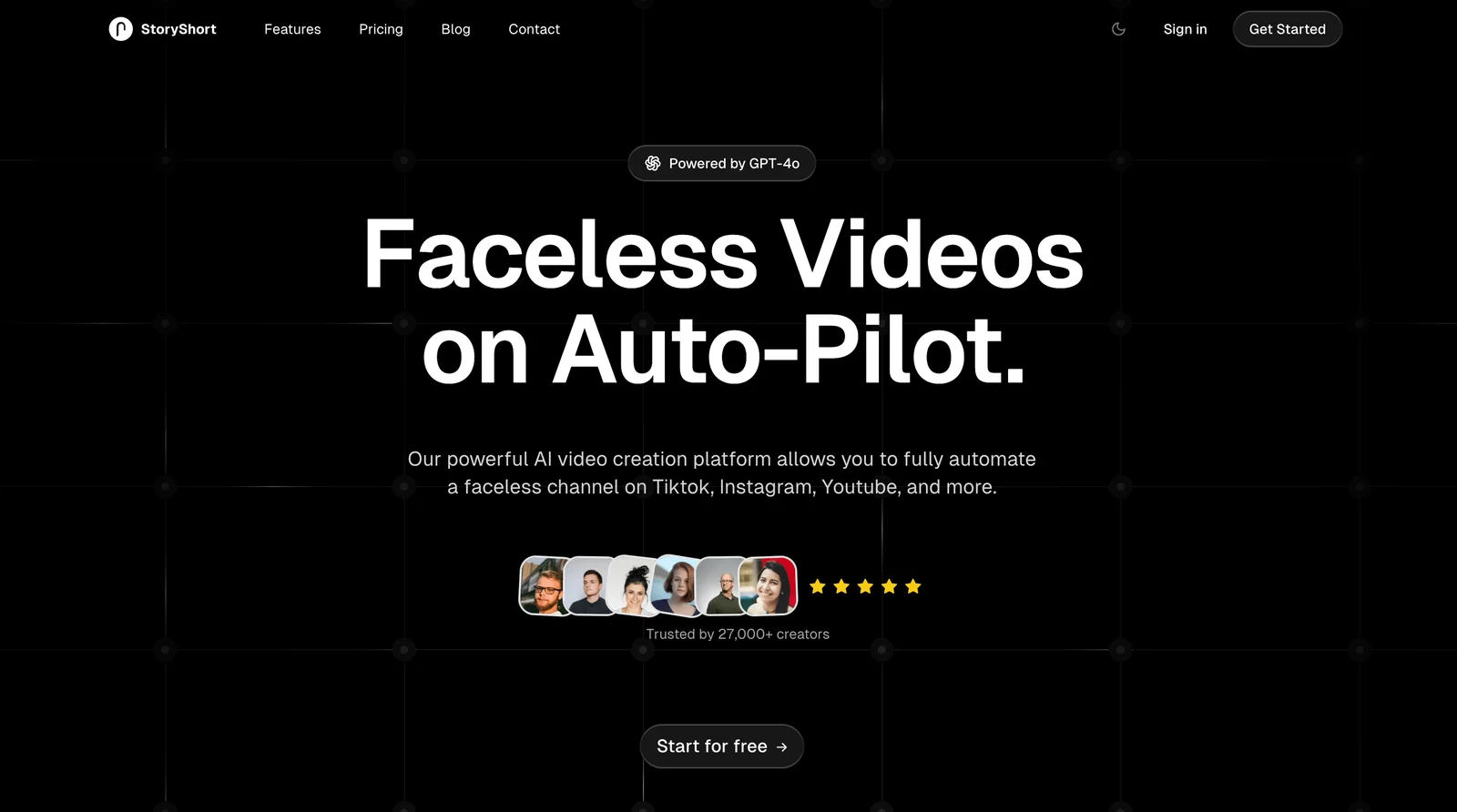
StoryShort markets AI-driven faceless short-video creation. Official product overview.
Start with an episode question and a defensible answer. A sequence of appealing scenes needs a story that rewards the viewer’s time.
Character consistency
The official product discusses recurring characters and connected visual storytelling. Official product overview.
Compare identity across several scenes and episodes. Test a revision that should change the setting while preserving the person.
Voice and captions
Narration and short-form production sit within the advertised workflow. Official product overview.
Review the spoken wording and captions together. A narrator can sound fluent while mispronouncing a material or changing a qualification.
Series and credits
The pricing page describes credits and series-related allowances. Official product overview.
Estimate revised scenes as well as final episodes. A theoretical count of videos assumes a particular length and workflow, not your exact acceptance rate.
Current plan boundaries
Monthly credits, series allowances and video-type-specific generation consumption. Official plan source.
Pricing lists Starter 400, Growth 1,200, Influencer 2,400 and Ultra 5,000 monthly credits, with one to four series respectively.
The official table estimates about 15 credits for a 30-second AI-image video and 25 for a 60-second video; AI movies, UGC and avatars have higher costs.
- Pricing-card bullets mention long-form video across tiers, but the detailed usage table marks long-form unavailable in Starter and Growth. Confirm eligibility in the app.
- Video counts are approximate equivalents, not a guarantee of identical output across every format.
The snapshot above is tied to the review date. Promotions, billing interval, location and account migration can change the payable amount. The decision below uses the cost drivers rather than pretending a headline fee describes every configuration.
A practical evaluation sequence
Use the following as a proposed pilot. Keep source inputs and accepted outputs so another person can review the result. The sequence is designed around the task above; it is not a claim that OrbitVale ran an account test.
1. Write the series promise
Describe who watches, what one episode teaches and the standard structure. A recognizable editorial promise matters more than a daily upload target.
2. Approve a factual outline
For the notebook example, verify materials and distinguish a preference from a product claim. Remove unsupported statistics before generation.
3. Create three connected scenes
Introduce the choice, explain the difference and show a useful next action. Each scene should advance the same question.
4. Keep a continuity sheet
Record character appearance, important objects and voice choices. Use it when evaluating a changed episode rather than relying on memory.
5. Review the complete audio
Check emphasis, unfamiliar words and sentence transitions. Correct the approved script before regenerating every visual scene.
6. Compare three final episodes
Watch them consecutively on a phone. Record repetition, identity changes, editorial corrections and final minutes accepted for publication.
The operating details that decide the fit
Make one episode answer one question
A strong short explanation has a recognizable problem, a mechanism and a useful next step. Attractive visuals should carry that explanation rather than decorate unrelated sentences. Write the answer in plain language before creating the scene list.
For a recurring series, keep the structure consistent but vary the evidence and example. A repeated intro can help recognition; a repeated body with swapped nouns quickly feels generic. The editorial promise is what the viewer learns, not the number of episodes the production tool can generate.
Keep a continuity sheet
Record the recurring narrator, character, important objects, visual treatment and terminology. A scene change should be intentional. If a person’s clothing changes between two moments of the same explanation, or a product has another shape, the viewer spends attention resolving the inconsistency.
Review three episodes together. An individual output can appear coherent while the series drifts. Test a revised scene and check whether it fits the already approved material. Continuity is a production requirement that should appear in the cost estimate, because rejected scenes may still use allowance.
Adapt written material for speech
Remove long clauses, explain technical terms and leave space for the visual. A paragraph that works in an article may be difficult to follow when heard once. Read the script aloud before generation and mark words whose pronunciation matters.
Captions, narration and on-screen labels should make the same claim. If one version loses a qualification, repair it at the script level. A visual showing an inaccurate procedure is not redeemed by correct narration; review the explanation across both channels.
Separate production output from channel economics
A finished episode does not establish that an audience wants it or that a platform will monetize it. Keep production acceptance, publication eligibility and audience performance in distinct records. Evaluate originality and permissions before adding the video to a queue.
Use the first small series to learn where editorial time goes. Research, script revision, scene repair and final review may outweigh initial generation. The decision to expand should follow useful accepted episodes and actual audience evidence, not a theoretical monthly video capacity.
Tradeoffs and reasons to reject the fit
A repeatable format becomes repetitive
Series structure is useful, but every episode needs its own example and insight. Replacing a noun in an identical script weakens the channel.
Plausible instructional errors
Generated scenes can show the wrong technique or object. For educational material, compare them with the factual explanation.
Distribution is a separate job
Publishing automation does not establish platform acceptance, originality or viewer response. Keep those decisions in a separate distribution plan.
Pricing the complete job
Episodes, revisions and editorial review
For 16 monthly episodes, assume each needs 12 minutes of script review and 8 minutes of final review. That is 320 minutes before research and scene corrections. Add the current credit allowance and a revision reserve. If half the episodes require two extra generated scenes, price those 16 scenes explicitly instead of calling them free capacity.
| Cost line | Include in the estimate |
|---|---|
| Required subscription | Use the tier that contains the actual workflow and record currency, billing interval and team size. |
| Variable services | Count the real billing unit and separately priced carrier, payment, communication or model services. |
| Setup and change | Include source cleanup, integration, training and the first meaningful revision. |
| Review and exceptions | Budget the people who approve outputs, investigate discrepancies and complete customer follow-up. |
| What disappears | Only count a saving when the old subscription or manual task can actually be retired. |
Keep a normal-month estimate and a busy-month estimate. Use the same accepted outcome in both. If the tool produces an intermediate draft, alert, record or label, include the remaining work needed to complete the customer or publishing task. Replace the example assumptions with your own observed figures after the pilot.
Alternatives and the boundary between jobs
Pictory
Read the Pictory review. A small publisher adapting verified scripts or articles into explainers with human visual and editorial review.
Pictory is worth investigating when a publisher has written material and wants a more approachable video version. Script-to-video and repurposing are useful only if the adaptation respects how people watch: an article paragraph is often too dense to narrate unchanged, and a stock clip can imply a specific event that never happened.
invideo
Read the invideo review. A marketer creating repeatable campaign or explainer variants from an approved brief and real source material.
invideo offers a broad AI video production proposition: start with a brief and assemble a finished communication using generative and editing capabilities. Breadth can be helpful to a small team that otherwise moves between several tools. It also makes the selected workflow, model and usage rules central to the purchase.
Submagic
Read the Submagic review. A creator or small marketing team publishing recurring short videos from footage it owns and can review.
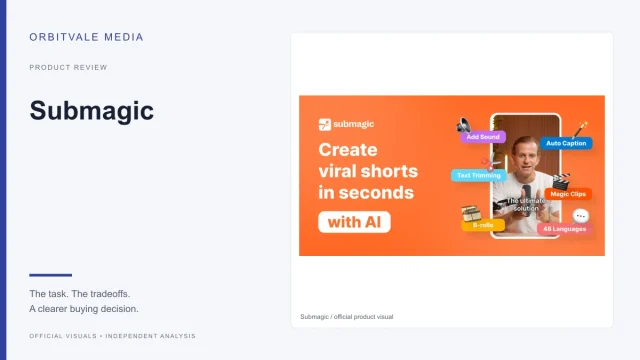
Submagic is a strong candidate when footage already exists and the bottleneck is making short clips clear and ready for publication. Caption styling, pacing and supporting visual edits sit close to the daily work of social video teams. The purchasing mistake is to treat an attractive caption preset as proof that the final clip explains the product accurately.
A decision record to keep
For StoryShort, record the selected account and plan, the specific job, the accepted output and the unresolved limitation. The acceptance decision should explain whether “a repeatable format becomes repetitive” is manageable for this business. Name the owner of the next review and preserve the result of the changed-case exercise, not only the easiest first pass.
Our recommendation
StoryShort is worth a deliberate trial when this describes your business: A creator with an original educational or narrative concept and a person who can approve scripts and complete episodes. The case is weaker when this remains true: A plan built around unattended uploads, recycled claims or an assumption that generated output guarantees views and revenue. Start with the bounded scenario, price the complete job and expand after the team can explain the exceptions. Open the official StoryShort website.
Sources, image credits and scope
OrbitVale’s analysis combines official product information with proposed operating exercises. We have not represented these exercises as hands-on tests, measured vendor results or customer case studies. Calculations use stated assumptions. Product and plan sources were reviewed on November 4, 2026.
StoryShort: Official overview · Current pricing.
Official visuals are credited beside each figure; they are vendor-published material, not independent test screenshots. Interactive plan displays and account-specific terms can differ. Confirm checkout, region and required entitlements before purchasing. See our editorial method and commercial disclosure.