Research-based comparison · 7 min read · Source check: November 4, 2026
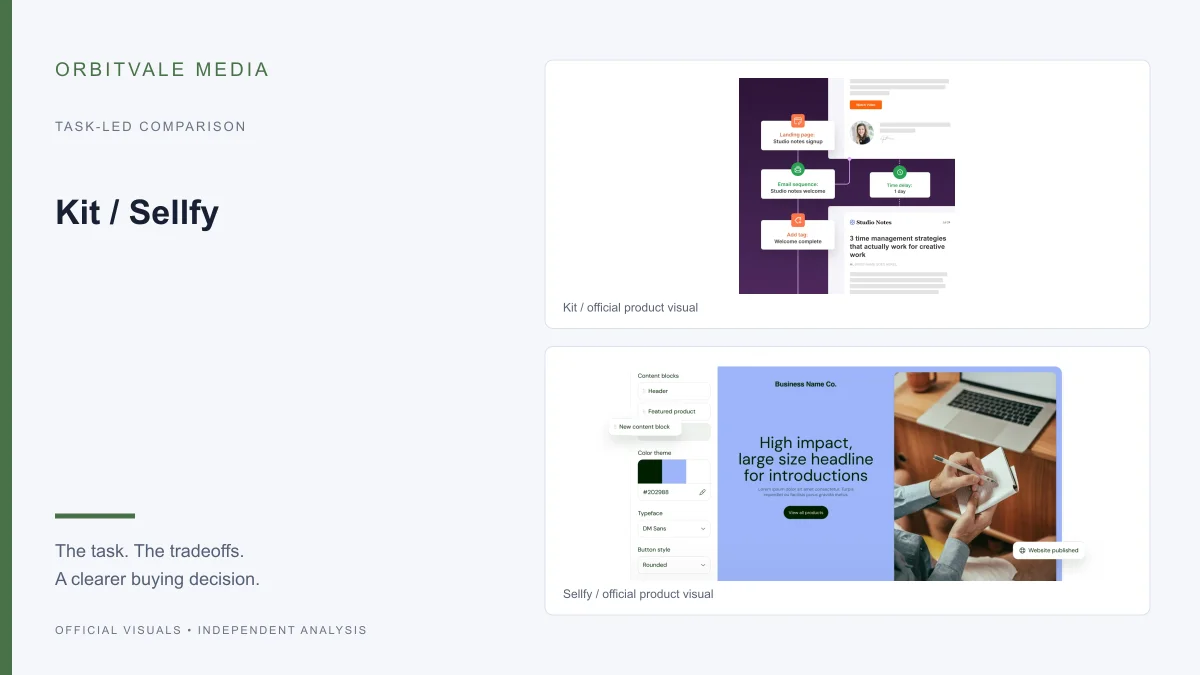
Kit and Sellfy can both appear in a creator business, but the purchase should begin with the central job. Kit is worth investigating when the email audience relationship drives the offer. Sellfy is relevant when a focused storefront and product delivery are the immediate need. The right architecture may connect them rather than force one to cover everything.
Table of Contents
The common task
Deliver a free photography guide, sell an editing pack and provide an update to existing buyers. Include a lost delivery email, marketing opt-out and a product refund.
This is a proposed comparison, not a report of controlled product tests. Use the same source material, required outcome and review standard for every candidate. When products solve different stages, compare the complete architecture instead of forcing an artificial winner.
The decision in one view
| Dimension | What to compare |
|---|---|
| Primary job | Separate reader communication from checkout and delivery. |
| Product access | Test formats, versions and returning-customer recovery. |
| Audience | Connect a purchase to the relevant email state. |
| Fees | Include subscriber bands, sales thresholds and payment costs. |
| Maintenance | Keep source files, buyer eligibility and approved messages linked. |
Where each candidate earns a place
Kit
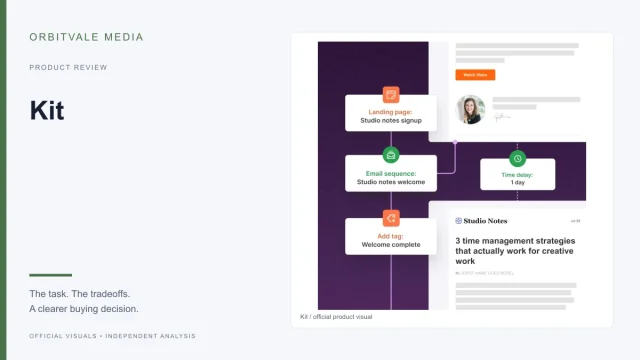
Kit is a useful shortlist for creators whose email relationship sits close to their product business. A subscriber may move from an educational sequence to a digital product, paid content or recurring offer. The workflow benefits from clear audience interests and a sensible distinction between a reader and a paying customer.
Strong-fit brief: A creator building a permission-based audience around knowledge, content or digital products.
Weak-fit brief: A business whose main requirement is complex sales pipeline management or one assuming every paid automation is included in a free newsletter plan.
Full Kit analysis · Official website.
Sellfy
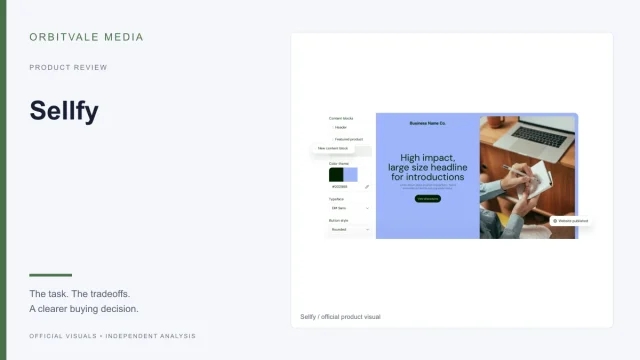
Sellfy is relevant to creators and small brands selling digital products, subscriptions or selected physical goods without building a large custom storefront. A simpler selling environment can reduce setup work. The commercial decision still includes payment processing, product access, refunds, taxes and the plan’s sales thresholds.
Strong-fit brief: A creator or brand selling a focused catalogue and valuing a straightforward store and delivery workflow.
Weak-fit brief: A complex marketplace or highly customized commerce operation without verifying feature scope and integration needs.
Full Sellfy analysis · Official website.
Run the evaluation through six checkpoints
1. Define the source and ownership
| Candidate | Product-specific task |
|---|---|
| Kit | Write the reader promise: Describe the immediate resource and future communication in plain language. |
| Sellfy | Define the deliverable: Specify file format, included versions, access period and support boundary. |
2. Prepare the representative case
| Candidate | Product-specific task |
|---|---|
| Kit | Choose useful interests: Use a small number of topics that will change content decisions. Avoid dozens of speculative labels. |
| Sellfy | Create one real product: Use a representative file size and a clear instruction sheet. Test the customer’s required software. |
3. Inspect the first accepted result
| Candidate | Product-specific task |
|---|---|
| Kit | Deliver the resource: Test access on mobile and a delayed confirmation. The promised value should arrive before the sales sequence. |
| Sellfy | Complete a safe purchase test: Inspect payment confirmation, delivery and the customer record using the supported test process. |
4. Introduce an ordinary exception
| Candidate | Product-specific task |
|---|---|
| Kit | Connect a purchase: Stop the irrelevant pitch and begin useful product education. Check a refunded purchase separately. |
| Sellfy | Rehearse recovery: Use the buyer’s normal access problem: a lost email, changed device or incorrect download. |
5. Ask another operator
| Candidate | Product-specific task |
|---|---|
| Kit | Review the paid offer: Confirm what the customer receives, renewal or cancellation where relevant and support ownership. |
| Sellfy | Update the product: Identify who receives the new file and how older versions are distinguished. |
6. Price and document the result
| Candidate | Product-specific task |
|---|---|
| Kit | Evaluate audience quality: Look at relevant replies, product interest and retained paying customers rather than subscriber count alone. |
| Sellfy | Check the commercial ledger: Compare gross sales, processing, refunds and plan eligibility before estimating profit. |
Operating questions behind the comparison
Define what the buyer receives
A digital product needs a format, version, access expectation and clear support boundary. State required software and whether updates are included. A vague promise creates avoidable refunds and customer questions.
Test the delivered file on the device or application the customer is expected to use. A successful download is not the same as a usable product.
Follow payment through access
Use a supported test route to inspect payment confirmation, product delivery and the customer record. Include a lost email and a returning buyer on another device.
For recurring products, verify renewal, failed payment, cancellation and the resulting access state. Keep these behaviours aligned with the offer language rather than assuming the payment gateway decides the customer promise.
Maintain product versions
Identify the authoritative file and the buyers eligible for updates. Keep release notes for material changes. A returning customer should understand whether they are opening a current or older version.
Store the editable source separately from the delivery file. If the platform changes, the business should still be able to maintain the product and explain past purchases.
Budget support and processing
Digital delivery removes some physical handling but not all operating work. Payment charges, refunds, taxes, access questions and product updates remain part of contribution.
Estimate a reasonable support case mix and replace assumptions with observed data after launch. Compare sales thresholds and the next plan band before treating the entry subscription as a permanent cost.
Compare the same complete cost
Kit cost drivers
A creator sending to 7,500 readers should model the feature tier needed today and at the next audience band. Add payment-related charges and time spent maintaining the promised content. A hypothetical 100 new subscribers is useful only if their interests and expectations match the creator’s actual offer.
Sellfy cost drivers
At an illustrative $25 price and 80 sales, gross revenue is $2,000 before processing, refunds, taxes and support. If 10% require 12 minutes of help, support adds 96 minutes. Model that work and the applicable plan threshold rather than treating digital goods as costless after creation.
| Shared cost line | Comparable assumption |
|---|---|
| Required subscription | Use the tier that contains the actual workflow and record currency, billing interval and team size. |
| Variable services | Count the real billing unit and separately priced carrier, payment, communication or model services. |
| Setup and change | Include source cleanup, integration, training and the first meaningful revision. |
| Review and exceptions | Budget the people who approve outputs, investigate discrepancies and complete customer follow-up. |
| What disappears | Only count a saving when the old subscription or manual task can actually be retired. |
Reasons to reject a candidate
Kit limits for this task
- Audience vanity: A large list with weak interest can cost more to maintain without improving the business.
- Tag accumulation: Old campaign labels can silently shape future messages. Maintain a small field dictionary.
- Free-plan overreach: Subscriber capacity does not establish that every required automation or commerce feature is included.
Sellfy limits for this task
- Ambiguous licence: Buyers need to understand permitted use and whether updates are included.
- Access confusion: Successful payment is not the end of fulfilment if the buyer cannot use the file.
- Threshold surprise: Revenue growth can require a different plan. Include the next band in the budget.
These are evaluation questions, not assertions that a product always fails. When a limitation creates another handoff, assign an owner and price that work. If neither candidate meets the essential requirement, revise the shortlist rather than quietly weakening the requirement after seeing a polished demo.
The comparison mistake to avoid
A free audience allowance is not a complete store, and successful payment is not complete fulfilment when the customer cannot use or recover the product.
Our conditional recommendation
Choose the tool whose primary workflow matches the current bottleneck. Verify the exact commerce scope in Kit and the email requirements around Sellfy. If connecting them, test customer identity and suppression so a buyer is not repeatedly sold the same item.
What to retain after deciding
Keep the original brief, selected account configuration, accepted output and changed-case result. Record which assumption would reverse the recommendation: volume, team ownership, output format or the cost of an exception. This makes the comparison useful again when the business changes. A decision to postpone a purchase is also a valid result when the process or source data is not ready.
Sources, image credits and scope
OrbitVale’s analysis combines official product information with proposed operating exercises. We have not represented these exercises as hands-on tests, measured vendor results or customer case studies. Calculations use stated assumptions. Product and plan sources were reviewed on November 4, 2026.
Kit: Official overview · Current pricing.
Sellfy: Official overview · Current pricing.
Official visuals are credited beside each figure; they are vendor-published material, not independent test screenshots. Interactive plan displays and account-specific terms can differ. Confirm checkout, region and required entitlements before purchasing. See our editorial method and commercial disclosure.