Research-based product review · 9 min read · Source check: November 4, 2026
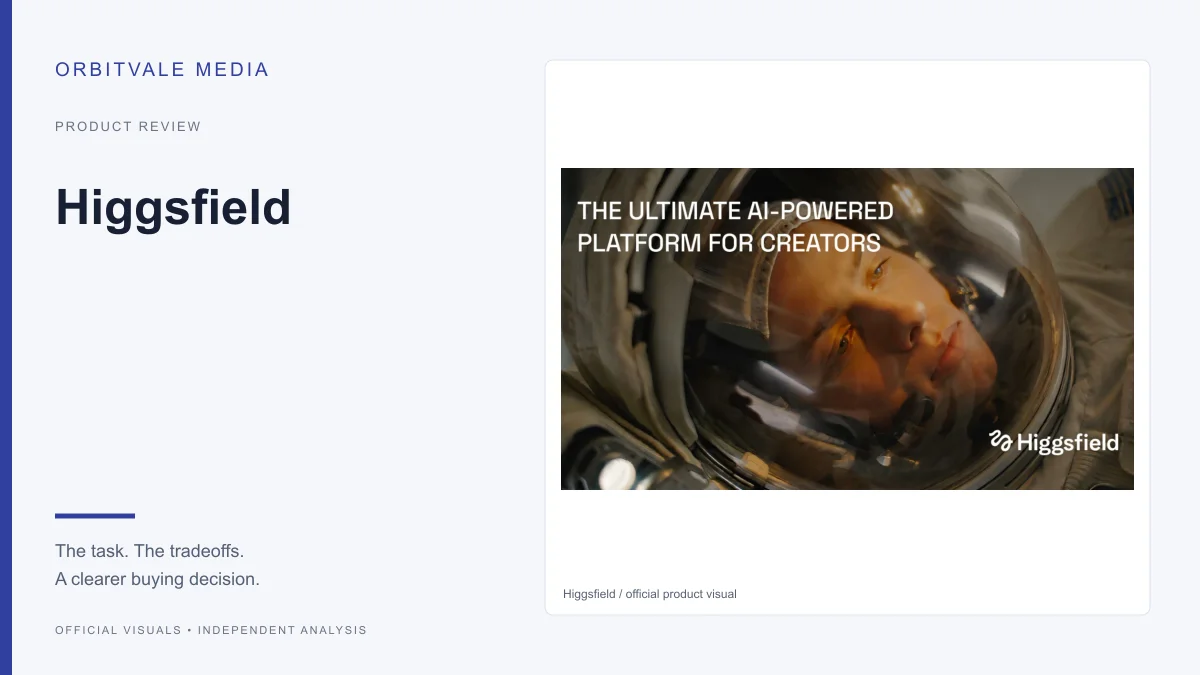
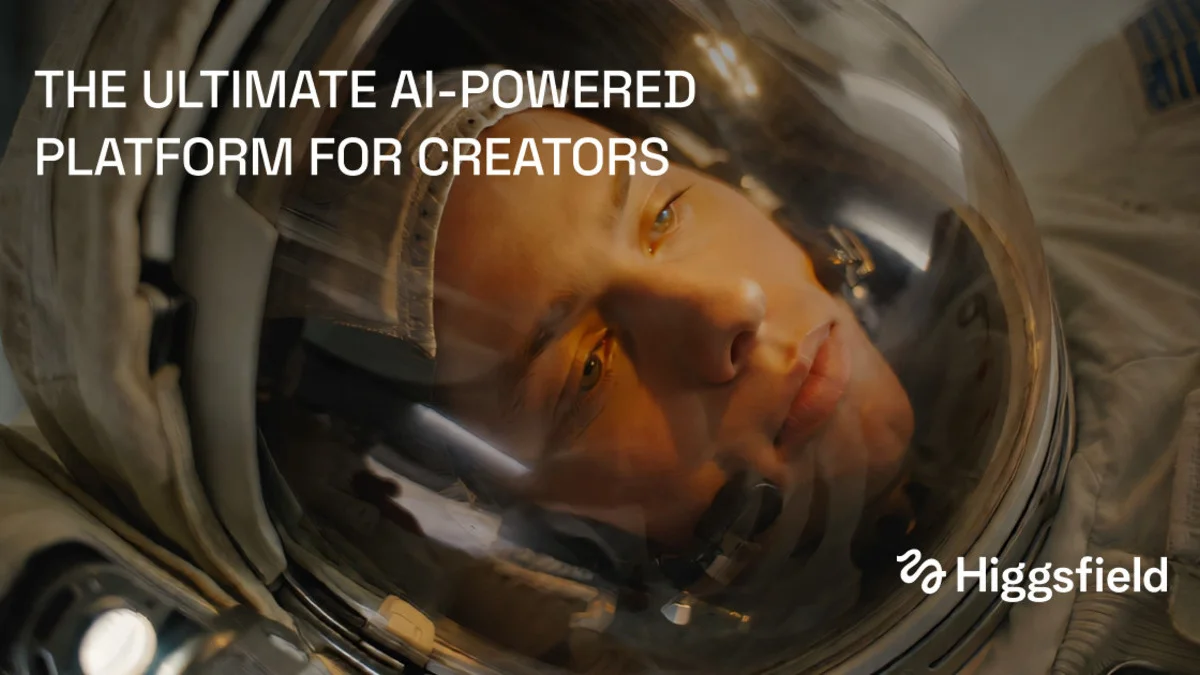
Higgsfield is worth investigating for image and video concept work where camera treatment, visual motion and rapid variation are central to the brief. The site brings several creation routes into one creative environment. That breadth makes it especially important to identify the exact model and workflow being assessed instead of assigning one quality claim to the whole platform.
For a brand, the most valuable output may be an atmospheric opener or a conceptual transition. An exact physical demonstration asks much more of generated footage: the label, geometry and behaviour must stay true across motion. We would separate creative expression from factual product evidence at the brief stage and budget for rejected attempts.
Table of Contents
The buying decision
| Put it on the shortlist when | Choose another route when |
|---|---|
| A creative operator exploring synthetic campaign scenes, visual directions or storyboards with an editor responsible for the final sequence. | A merchant needing unquestioned documentary evidence, precise product mechanics in every frame, or a predictable per-shot cost without accounting for rejected generations. |
A realistic job for Higgsfield
A ceramic tableware brand wants an imaginative dining-room opener before cutting to real product footage. The generated scene may establish mood, but the number of pieces, glaze finish and dishwasher claim come from the actual product material. The evaluation asks whether three short shots share a coherent visual identity without reshaping the featured plate.
What the capabilities mean in practice
Creation routes
Higgsfield presents an evolving suite of image and video tools. Official product overview.
Record the chosen route and model. Access to a suite does not mean every route has the same controls, limits or output rights.
Camera direction
The product emphasizes cinema-oriented motion and creative treatments. Official product overview.
Write a framing and movement brief before generation. “More cinematic” is too vague to explain why one attempt improved.
Reference inputs
Official workflows include reference-led creation. Official product overview.
Use owned or appropriately licensed source assets and inspect whether identity survives the resulting motion. A correct first frame is insufficient.
Consumption and availability
Plans and model-specific allowances can change. Official product overview.
Confirm the credit cost of the selected action, resolution and duration in the account. Do not transfer an allowance from a different model or promotional offer.
Current plan boundaries
Subscription/seat credit pool plus model-dependent generation credits, concurrency and any top-ups. Official plan source.
The current pricing page is client-rendered and its exact plan prices were not available in the browser text extraction; link readers to the live plan picker.
Official help says generation cost varies by model, resolution and duration and is shown before confirmation.
- Unlimited eligibility has model and time-window conditions; check the active models on the actual account.
- Official plan/help pages contain evolving wording about whether every model is available on every tier. Verify the chosen model in the plan picker before purchase.
- Do not claim hands-on image quality, physical accuracy or reliable product identity from this research.
The snapshot above is tied to the review date. Promotions, billing interval, location and account migration can change the payable amount. The decision below uses the cost drivers rather than pretending a headline fee describes every configuration.
A practical evaluation sequence
Use the following as a proposed pilot. Keep source inputs and accepted outputs so another person can review the result. The sequence is designed around the task above; it is not a claim that OrbitVale ran an account test.
1. Define three acceptance rules
For the plate example: stable rim geometry, no invented brand text and a usable five-second camera movement. Define rejection before choosing a favourite image.
2. Build a controlled reference
Use the same product image, aspect ratio and lighting direction in the first comparison. Change one creative variable so the team learns from the result.
3. Log each attempt
Keep prompt, model, settings, generation cost and rejection reason. An accepted shot without its recipe is hard to revise for the next campaign.
4. Review temporal consistency
Scrub through the export. Look at contact with the table, reflections, changing object counts and background people rather than selecting only the strongest frame.
5. Cut beside real footage
Match colour, motion and scale in the actual editing project. An isolated beautiful shot may be impossible to connect to the product demonstration.
6. Cost the accepted sequence
Count the attempts that produced no usable footage and the time spent selecting and repairing. Archive the approved final export separately from the generation history.
The operating details that decide the fit
Write acceptance before seeing a beautiful frame
A production brief should state what must remain stable: the object’s identity, the action, duration, framing and forbidden details. Separate a mood reference from a factual product reference. A scene can be aesthetically successful yet commercially unusable because the logo, count or mechanism changes.
Use explicit rejection codes such as identity drift, temporal artefact, unsuitable movement or unsupported claim. This makes an attempt log useful for learning. Without a rule, teams often choose the most attractive frame and discover only in the edit that the shot cannot perform its intended role.
Use an attempt budget and a stopping rule
Decide how many experiments the brief justifies and what each will vary. Keeping the reference and changing one control gives more useful information than rewriting the entire prompt after every result. The aim is to narrow uncertainty, not to continue until a favourite appears.
Set a fallback before spending the full allowance. A simpler real shot, static graphic or shorter transition may serve the audience better than a complex generation that consumes the week. A useful stopping rule says when the team will simplify the concept or change the production method.
Inspect the final sequence, not isolated clips
Motion continuity, colour, scale and rhythm become visible when shots sit together. A generated insert may look excellent alone but pull attention away from the real product demonstration. Test the cut with the intended titles, narration and music.
Review the exported file at normal speed and on pause. Look at contact with surfaces, repeated objects, small lettering and changes near the clip boundary. If a shot is only acceptable when viewed quickly at low resolution, it may not be robust enough for a campaign that customers will replay.
Maintain a production recipe
Keep the accepted file, source assets, permission record, model, settings, prompt and selection notes. Different tools expose different parts of this history, so retain what the team can reasonably capture. A vendor update can change the behaviour of the same prompt.
The archive should support a real revision: change the colour direction, replace a product or adapt the ratio. If the exact result cannot be regenerated, the retained export is still useful. Do not confuse a saved prompt with a guaranteed reproducible source project.
Tradeoffs and reasons to reject the fit
Reference drift
A supplied product photo guides generation but does not guarantee every detail. Reject shots that alter a commercially significant feature.
Model-specific assumptions
Features shown in a showcase may belong to a specific route, model or paid entitlement. Check the account used for the actual pilot.
Synthetic evidence
A generated scene can accidentally become an implied product claim. Keep factual use and performance tied to demonstrable source material.
Pricing the complete job
Cost per accepted shot
Suppose six approved shots require 24 attempts, with a stated average planning cost of $1.20 per attempt. Creation spend would be $28.80, or $4.80 per accepted shot, before subscription allocation, editing and review. If only three shots pass, that same spend is $9.60 each. These are hypothetical figures illustrating acceptance-rate sensitivity, not Higgsfield prices or test results.
| Cost line | Include in the estimate |
|---|---|
| Required subscription | Use the tier that contains the actual workflow and record currency, billing interval and team size. |
| Variable services | Count the real billing unit and separately priced carrier, payment, communication or model services. |
| Setup and change | Include source cleanup, integration, training and the first meaningful revision. |
| Review and exceptions | Budget the people who approve outputs, investigate discrepancies and complete customer follow-up. |
| What disappears | Only count a saving when the old subscription or manual task can actually be retired. |
Keep a normal-month estimate and a busy-month estimate. Use the same accepted outcome in both. If the tool produces an intermediate draft, alert, record or label, include the remaining work needed to complete the customer or publishing task. Replace the example assumptions with your own observed figures after the pilot.
Alternatives and the boundary between jobs
Runway
Read the Runway review. An agency or brand team creating synthetic inserts, visual concepts or stylized media within an existing production workflow.
Runway belongs on a generative-media shortlist when the team can describe the shot it needs and has an editor ready to use the result. The product’s changing models and creative surfaces make version-specific evaluation essential. A useful result comes from the selected model, reference, settings and downstream edit; a general statement that “AI video looks good” is not a buying decision.
invideo
Read the invideo review. A marketer creating repeatable campaign or explainer variants from an approved brief and real source material.
invideo offers a broad AI video production proposition: start with a brief and assemble a finished communication using generative and editing capabilities. Breadth can be helpful to a small team that otherwise moves between several tools. It also makes the selected workflow, model and usage rules central to the purchase.
StoryShort
Read the StoryShort review. A creator with an original educational or narrative concept and a person who can approve scripts and complete episodes.
StoryShort is relevant when production begins with an idea or script and needs a connected short-video story. Its appeal is the connection between narrative, scenes and narration rather than the finishing of an existing interview. The editorial challenge is that an automatically assembled episode can look complete while its explanation is weak or its recurring character changes identity.
A decision record to keep
For Higgsfield, record the selected account and plan, the specific job, the accepted output and the unresolved limitation. The acceptance decision should explain whether “reference drift” is manageable for this business. Name the owner of the next review and preserve the result of the changed-case exercise, not only the easiest first pass.
Our recommendation
Higgsfield is worth a deliberate trial when this describes your business: A creative operator exploring synthetic campaign scenes, visual directions or storyboards with an editor responsible for the final sequence. The case is weaker when this remains true: A merchant needing unquestioned documentary evidence, precise product mechanics in every frame, or a predictable per-shot cost without accounting for rejected generations. Start with the bounded scenario, price the complete job and expand after the team can explain the exceptions. Open the official Higgsfield website.
Sources, image credits and scope
OrbitVale’s analysis combines official product information with proposed operating exercises. We have not represented these exercises as hands-on tests, measured vendor results or customer case studies. Calculations use stated assumptions. Product and plan sources were reviewed on November 4, 2026.
Higgsfield: Official overview · Current pricing · Supporting official source 1 · Supporting official source 2 · Supporting official source 3.
Official visuals are credited beside each figure; they are vendor-published material, not independent test screenshots. Interactive plan displays and account-specific terms can differ. Confirm checkout, region and required entitlements before purchasing. See our editorial method and commercial disclosure.