Research-based product review · 8 min read · Source check: November 4, 2026
Canva AI is most interesting as part of a broad design workflow: marketing teams can move between generated ideas, templates and familiar publishing formats in one environment. That can reduce handoffs for recurring campaign assets. Its breadth also requires restraint, because every generated variation can become another inconsistent brand file if the team has no approved template.
We would start with a controlled campaign set using actual product photography and a verified offer. Test whether another colleague can update a price and resize the work without damaging hierarchy or creating a new visual identity. The maintained design system is often more valuable than the first AI draft.
Table of Contents
The buying decision
| Put it on the shortlist when | Choose another route when |
|---|---|
| A small marketing team creating recurring social, email, presentation and print assets with shared brand rules. | A specialised print or editing workflow with untested export requirements, or a brand using generated imagery as factual product photography. |

A realistic job for Canva AI
A coffee brand refreshes a campaign across a square post, email header and shop counter card. The offer and actual package image stay fixed. The proposed pilot generates directions, selects one and asks a colleague to change the expiry date consistently across all three outputs.
What the capabilities mean in practice
Broad design environment
Canva combines a design platform with AI creative tools. Official product overview.
Choose the formats actually used by the team. A long feature catalogue is not a reason to expand the content calendar.
Creative assistance
Canva AI supports generative and design tasks. Official product overview.
Use a precise brief and real source material. Inspect generated text, logos and object geometry.
Brand collaboration
The platform offers brand and team capabilities on selected plans. Official product overview.
Verify which controls keep approved fonts, colours and templates reusable by ordinary editors.
Output formats
Canva supports a variety of sharing and export routes. Official product overview.
Test dimensions, resolution, font handling and the actual file needed by the printer or next editor.
Current plan boundaries
Person/plan plus shared AI allowance and optional paid AI add-ons. Official plan source.
Observed US annual display: Pro USD144/year for one person; Business USD250/year/person, excluding applicable tax.
Pro lists five Brand Kits and social scheduling; Business lists 100 Brand Kits and approvals.
- The tool matrix and AI allowance footnotes must be read together; 10x/20x labels do not provide a universal fixed generation quota.
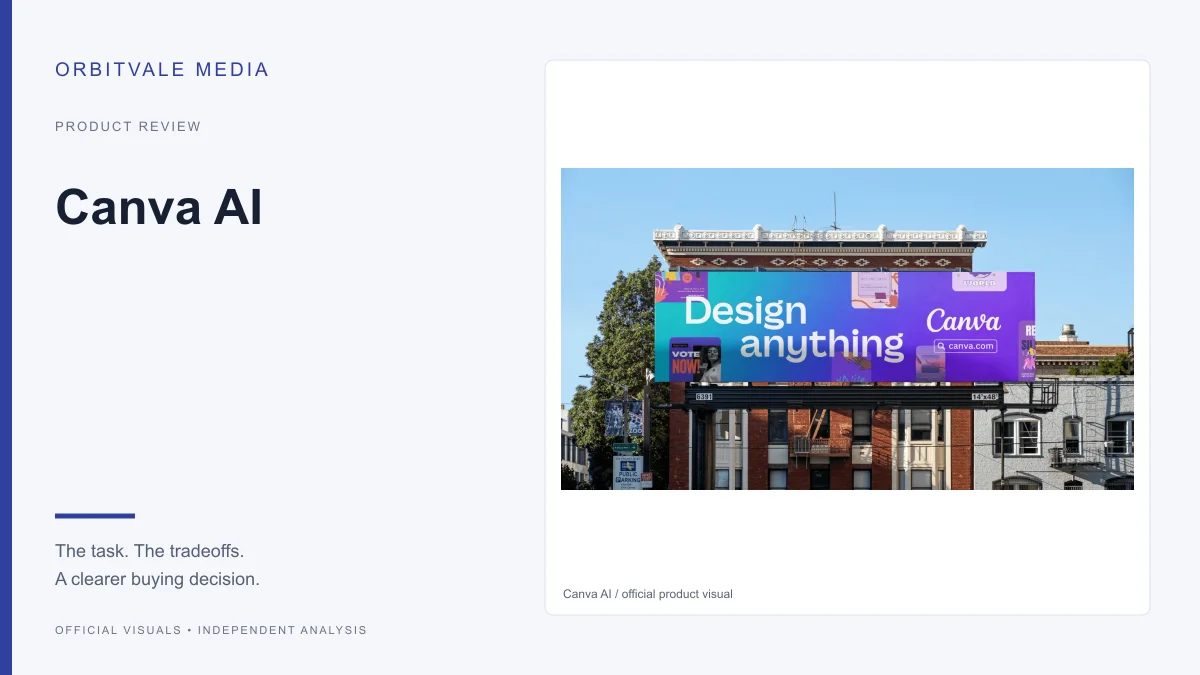
- The image below is an official pricing-page illustration, not an interface screenshot or a recommended product-review cover.
The snapshot above is tied to the review date. Promotions, billing interval, location and account migration can change the payable amount. The decision below uses the cost drivers rather than pretending a headline fee describes every configuration.
A practical evaluation sequence
Use the following as a proposed pilot. Keep source inputs and accepted outputs so another person can review the result. The sequence is designed around the task above; it is not a claim that OrbitVale ran an account test.
1. Collect brand facts
Use an approved offer, product image, palette and type reference. Identify the person who owns the campaign copy.
2. Create a reference asset
Fix the important hierarchy and safe areas. Use it as the comparison point for generated alternatives.
3. Explore a small set
Change one visual direction at a time. Keep the chosen rationale rather than retaining dozens of unexplained drafts.
4. Verify the generated details
Check spelling, prices, dates and product representation. A plausible package may contain invented branding.
5. Rehearse reuse
Ask another teammate to update the date and resize the asset. The template should make that ordinary work reliable.
6. Inspect destination files
Check phone readability and the print provider’s requirements. Keep the accepted editable source and final export linked.
The operating details that decide the fit
Build from an approved campaign source
Keep the offer, product image, expiry date and qualification in one maintained brief. Several formats should draw from the same facts. Without that source, resizing a campaign can turn into rewriting it inconsistently.
Use generated visuals for the role they can honestly serve. A mood illustration is different from a photograph of the item being sold. Inspect packaging, lettering and physical details before any asset implies a factual product promise.
Design for ordinary reuse
A template should help the next colleague make a routine change. Test a longer product name, another price and a new ratio. Hierarchy and safe areas should survive without a complete redesign.
Limit near-duplicate templates and identify the approved master. A shared design environment can make inconsistency spread faster when everyone starts from a different copy. Keep the design decision and intended audience with the asset.
Check the destination file
A social post, email header and printed card need different dimensions and legibility. Inspect the final output in context. Small text that looks sharp on a large monitor can be unreadable on a phone or physically tiny in print.
Confirm the printer or receiving editor’s actual requirements for resolution, colour and editability. Export convenience is useful only when the next person can use the result without preventable repair.
Count accepted assets and maintenance
Keep drafts, approved assets and published assets separate. A large generation batch can create a review backlog without improving the campaign. Judge reusable accepted work and the time another person needs to update it.
Include brand-source maintenance and asset licensing in the operating model. The subscription is only one part of a dependable design process.
Tradeoffs and reasons to reject the fit
Template proliferation
A shared account can fill with inconsistent near-duplicates. Establish one approved source per campaign asset.
Licensing variation
Stock, fonts and generated media have different terms. Review the asset’s intended use and current entitlement.
Synthetic product errors
Use actual photography where the customer needs an accurate representation of what is sold.
Pricing the complete job
Seats, allowances and reuse
A team updating 40 recurring assets could save 160 minutes if a maintained template removes four minutes per update. That is an assumption to test. Deduct the time spent maintaining the template, reviewing generated details and repairing destination files, then compare the selected team plan.
| Cost line | Include in the estimate |
|---|---|
| Required subscription | Use the tier that contains the actual workflow and record currency, billing interval and team size. |
| Variable services | Count the real billing unit and separately priced carrier, payment, communication or model services. |
| Setup and change | Include source cleanup, integration, training and the first meaningful revision. |
| Review and exceptions | Budget the people who approve outputs, investigate discrepancies and complete customer follow-up. |
| What disappears | Only count a saving when the old subscription or manual task can actually be retired. |
Keep a normal-month estimate and a busy-month estimate. Use the same accepted outcome in both. If the tool produces an intermediate draft, alert, record or label, include the remaining work needed to complete the customer or publishing task. Replace the example assumptions with your own observed figures after the pilot.
Alternatives and the boundary between jobs
Gamma
Read the Gamma review. A founder, consultant or marketer creating proposals and explainers from verified source material.
Gamma is appealing when a business wants to move from an outline to a shareable visual explanation quickly. The web-oriented format can suit proposals, training and product narratives. The real purchasing test comes after the first draft: can the author correct facts, reorganize the argument and deliver a usable result to the recipient’s actual software?
Beautiful.ai
Read the Beautiful.ai review. A business team producing recurring presentations with common layouts and an owner for the underlying argument.
Beautiful.ai makes a clear proposition to business presenters: structured slide design can reduce the time spent aligning objects and maintaining consistency. The useful constraint is one that helps the author express the necessary evidence. A difficult pricing table or long qualification is a better evaluation than another clean headline slide.
Jasper
Read the Jasper review. A marketing team with recurring campaigns, maintained source material and an editor accountable for the final claims.
Jasper is relevant when marketing production is a repeatable team process rather than an occasional request for text. Brand context and coordinated drafting can help a team keep several assets aligned. The buying question is whether that environment reduces factual corrections and editorial rework enough to justify a dedicated platform.
A decision record to keep
For Canva AI, record the selected account and plan, the specific job, the accepted output and the unresolved limitation. The acceptance decision should explain whether “template proliferation” is manageable for this business. Name the owner of the next review and preserve the result of the changed-case exercise, not only the easiest first pass.
Our recommendation
Canva AI is worth a deliberate trial when this describes your business: A small marketing team creating recurring social, email, presentation and print assets with shared brand rules. The case is weaker when this remains true: A specialised print or editing workflow with untested export requirements, or a brand using generated imagery as factual product photography. Start with the bounded scenario, price the complete job and expand after the team can explain the exceptions. Open the official Canva AI website.
Sources, image credits and scope
OrbitVale’s analysis combines official product information with proposed operating exercises. We have not represented these exercises as hands-on tests, measured vendor results or customer case studies. Calculations use stated assumptions. Product and plan sources were reviewed on November 4, 2026.
Canva AI: Official overview · Current pricing.
Official visuals are credited beside each figure; they are vendor-published material, not independent test screenshots. Interactive plan displays and account-specific terms can differ. Confirm checkout, region and required entitlements before purchasing. See our editorial method and commercial disclosure.