Practical guide · Proposed workflow · November 4, 2026
An ecommerce lifecycle map connects customer intent, store facts and the next useful message. It should be small enough for a marketer and an operator to explain together. Adding channels before agreeing on identity and state usually increases inconsistency.
Consider a hypothetical refill-products store. A reader downloads a care guide, buys a starter product and later needs a refill. The business also has stockouts. Email, SMS and availability alerts can each help, but only if the customer receives an honest and relevant promise.
Table of Contents
A completed event map
| Event | Source of truth | Useful next action |
|---|---|---|
| Guide requested | Form and permission record | Deliver the promised guide |
| First purchase accepted | Store order record | Stop the prospect pitch; begin product education |
| Item unavailable | Maintained variant stock | Offer a clear variant-specific alert |
| Refill window reached | Purchase and product assumptions | Consider a relevant permissioned reminder |
| Marketing opt-out | Preference record | Suppress the appropriate future promotion |
| Return received | Returns inspection | Resolve service before a routine replenishment pitch |
Where the tools fit
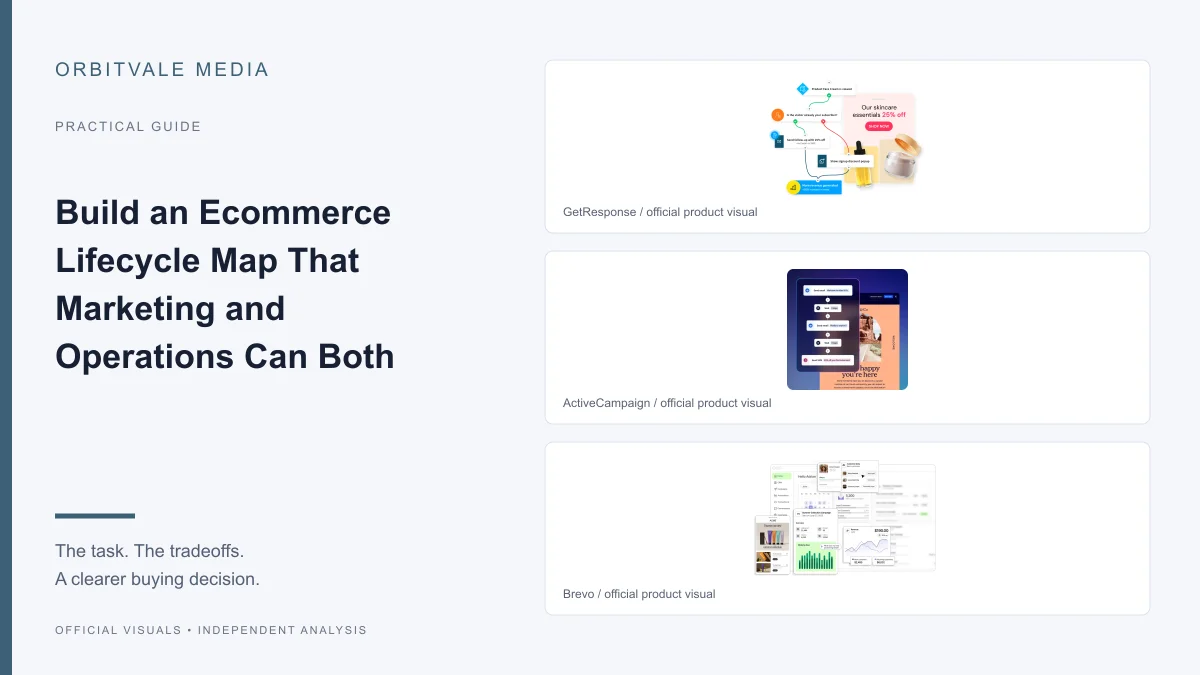
GetResponse, ActiveCampaign and Brevo belong in the email and lifecycle shortlist, with different current packaging and operating models to evaluate. Notify Me! belongs near the stock-interest event. Postscript belongs in a deliberately permissioned SMS workflow. A stock system still owns physical availability; marketing software should not invent it.
Use a durable identity to connect the person and order. Decide what happens when a customer uses another email, changes a preference or buys before a delayed event arrives. These ordinary exceptions are more informative than the ideal flow.
Define the customer state before the message
A useful lifecycle programme needs a small set of states that change the next action: prospect, first buyer, repeat buyer or inactive customer, for example. Each state should come from a maintained source. A click is an engagement signal, while a completed purchase belongs to the order system.
Write the transition and exit conditions. A customer who buys should not continue receiving a first-order pitch simply because the automation started earlier. A returned order may need another treatment. Keep late events and changed email addresses in the evaluation.
Review the combined contact calendar
Individual flows can look reasonable while the customer receives too many messages overall. Inspect one representative customer’s scheduled campaigns, automations and service communication together. Decide which message has priority when several purposes compete.
Use explicit suppression and preference rules. Unsubscribing should affect the appropriate future communication, including queued automated sends. Required order communication and promotional contact have different purposes; keep the system and the customer explanation clear.
Use metrics with an honest denominator
A sent email is not an accepted business outcome. Keep delivery, relevant engagement and downstream action separate. Opens can be affected by privacy and automated activity, while clicks can also include non-human behaviour. Interpret them with replies, purchases or qualified leads where appropriate.
When possible, compare an appropriate holdout or stable period rather than crediting every later order to the message. Label observational results as such. The aim is to learn what helps customers, not maximize the apparent revenue assigned to one tool.
Keep a maintainable template and event map
Record sender identity, audience source, event names, plan requirements and the person who owns each flow. A second operator should be able to change an offer and trace why a customer entered a sequence.
Review seasonal campaigns and inactive automations. An old discount or obsolete resource can remain live long after the original project ends. The subscription comparison should include this routine maintenance as well as writing and design.
Keep expressed interest separate from committed demand
An alert or wishlist is a useful signal, but customers can change their mind or buy elsewhere. Use sign-ups alongside past conversion, seasonality and the available replenishment quantity. Do not place a purchase order solely from the waiting-list count.
Variant identity matters. A customer requesting one size or colour should not receive a generic promise when another variant arrives. Test an intentionally mismatched replenishment event.
Make the availability promise understandable
An alert, preorder and normal order are different customer commitments. Explain when payment happens, what date is estimated and how a change will be communicated. Keep the storefront and confirmation consistent.
Assign one owner for the expected stock date. Marketing should not continue using an old launch promise after purchasing learns that a supplier is late.
Test scarce stock and simultaneous interest
A small replenishment can be exhausted quickly. Decide how notifications and any waiting-list priorities behave with limited quantity. A notification should not imply a reservation unless the system and offer actually provide one.
Inspect customer service consequences when notified shoppers arrive after stock sells out. The programme needs a clear explanation and a useful next step rather than repeated disappointment.
Evaluate the fulfilled result
Track notified shoppers, purchases during a defined stock window, cancellations and service questions. Compare by variant and available quantity. A high click count with no stock to fulfil is not a successful availability programme.
Start with a controlled product set. Expand after staff can explain date changes, permission records and the relationship between alerts and the broader marketing calendar.
Define a channel purpose
SMS should have a reason to interrupt the customer. A relevant availability or replenishment message can be useful; repeating every email promotion can quickly create fatigue. Review contact pressure across channels.
Keep permission sources and preference changes maintained. Do not infer SMS permission from an email subscription or an unrelated checkout field. Use the current rules applicable to the audience and provider.
Price the rendered message
Message composition, destination, channel and carrier charges can affect the bill. Inspect the actual text and linked content rather than multiplying recipients by a remembered headline rate.
Model normal and busy months, including required minimums. A free platform fee does not mean communication is free. Separate fixed and variable costs so the team can understand the marginal campaign.
Make opt-out and help part of the workflow
Test preference changes and the route for replies using appropriate test contacts. The customer needs a clear sender and an accountable service route. A campaign creator may not be the person who can resolve the response.
Check queued messages after a preference change. The policy should affect the future communication path, not merely update a visible profile field.
Use contribution and cautious attribution
Discounts, returns, shipping support and messaging costs all affect campaign economics. Compare contribution rather than order value alone. A customer who buys after several messages cannot automatically be credited wholly to the last text.
Use a suitable holdout when feasible and keep observational claims modest. The goal is to learn whether the channel adds useful customer value at an acceptable cost.
Pilot a customer, not a campaign
Build a test history for one person: sign-up, resource delivery, purchase, opt-out and a later stock question. Review the combined message calendar from that person’s perspective. A set of individually reasonable campaigns can still become an unreasonable contact pattern.
Keep accepted purchase and service states distinct from engagement signals. An email open does not verify intent, and a delivered message does not verify understanding. Review actual replies and correctly completed customer actions before expanding the programme.
Sources, image credits and scope
OrbitVale’s analysis combines official product information with proposed operating exercises. We have not represented these exercises as hands-on tests, measured vendor results or customer case studies. Calculations use stated assumptions. Product and plan sources were reviewed on November 4, 2026.
GetResponse: Official overview · Current pricing.
ActiveCampaign: Official overview · Current pricing.
Brevo: Official overview · Current pricing · Supporting official source 1.
Notify Me!: Official overview · Current pricing · Supporting official source 1.
Postscript: Official overview · Current pricing.
Official visuals are credited beside each figure; they are vendor-published material, not independent test screenshots. Interactive plan displays and account-specific terms can differ. Confirm checkout, region and required entitlements before purchasing. See our editorial method and commercial disclosure.