Research-based comparison · 7 min read · Source check: November 4, 2026
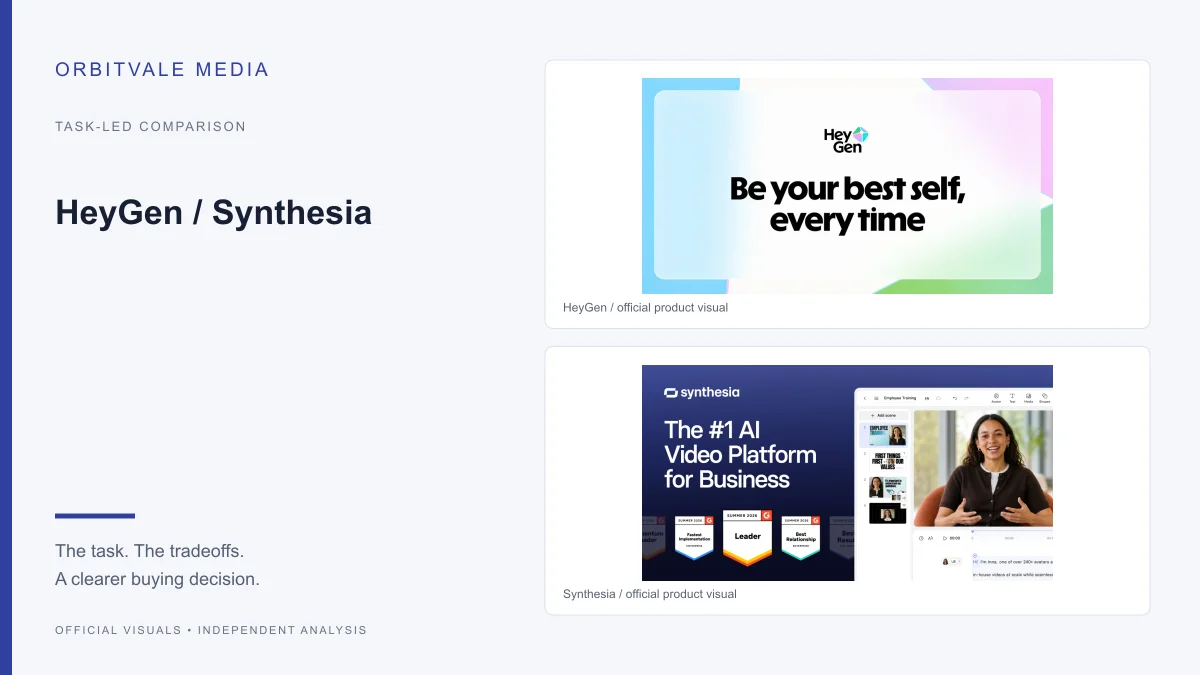
HeyGen and Synthesia should be compared through the actual communication programme: presenter style, script revision, localization and ownership of approved modules. The most realistic avatar sample does not settle whether a training department can maintain thirty instructions over a year.
Table of Contents
The common task
Create a two-minute receiving lesson in two languages, including one difficult product term and a screenshot. Ask a learner to route a damaged delivery, then change the process and update both language versions.
This is a proposed comparison, not a report of controlled product tests. Use the same source material, required outcome and review standard for every candidate. When products solve different stages, compare the complete architecture instead of forcing an artificial winner.
The decision in one view
| Dimension | What to compare |
|---|---|
| Recipient outcome | Judge whether the learner can perform the intended task. |
| Identity | Use an authorized presenter and document access and removal. |
| Language | Review narration, captions and on-screen labels together. |
| Maintenance | Change one step after approval and record the full update work. |
| Plan | Compare the current credit and team entitlements required for the same programme. |
Where each candidate earns a place
HeyGen
HeyGen is useful to investigate when a team needs presenter-led explanations without organizing a fresh recording for every script update. Avatar creation and translation can help maintain a recurring video programme. The strongest evaluation follows a video through factual review, pronunciation correction, localization and withdrawal of an obsolete version.
Strong-fit brief: A team producing onboarding, product explainers or localized presenter material with accountable script and language reviewers.
Weak-fit brief: A project relying on invented endorsements, unapproved likenesses, or translation with no competent reviewer.
Full HeyGen analysis · Official website.
Synthesia
Synthesia deserves consideration for structured business communication and training where the same material needs repeated updates. The important unit is an approved module, not simply a generated presenter. Teams should evaluate collaboration, terminology, localization and the process for finding old instructions after a policy changes.
Strong-fit brief: A training or enablement team maintaining repeatable instructional videos with approved scripts and defined reviewers.
Weak-fit brief: A brand that needs unscripted authentic testimony, highly expressive dramatic performance or unattended instructional publishing.
Full Synthesia analysis · Official website.
Run the evaluation through six checkpoints
1. Define the source and ownership
| Candidate | Product-specific task |
|---|---|
| HeyGen | Approve identity use: Record the permitted channels, audience and period of use. Keep the permission with the project, not in an individual employee’s inbox. |
| Synthesia | Write the learner outcome: Use a concrete action: route a damaged delivery, find the approved policy or complete one safe procedure. |
2. Prepare the representative case
| Candidate | Product-specific task |
|---|---|
| HeyGen | Freeze the source script: Verify every product step and qualification. Script corrections are cheaper before generating multiple language versions. |
| Synthesia | Build a source register: Assign an owner and review date to each instruction. Keep screenshots and policy references beside the script. |
3. Inspect the first accepted result
| Candidate | Product-specific task |
|---|---|
| HeyGen | Prepare difficult terms: Include brand names, measurements and technical phrases. Ask the reviewer to evaluate the actual audio, not just written subtitles. |
| Synthesia | Create a compact module: Use one objective and a short sequence. Leave room to replace the step most likely to change. |
4. Introduce an ordinary exception
| Candidate | Product-specific task |
|---|---|
| HeyGen | Create one short module: Check delivery and screen timing before creating a long course. A two-minute module makes revision easier to inspect. |
| Synthesia | Check multilingual consistency: Review narration, captions and on-screen material together. Use a fluent reviewer for each language. |
5. Ask another operator
| Candidate | Product-specific task |
|---|---|
| HeyGen | Localize with ownership: Assign a language reviewer and keep their corrections. Adapt examples where a direct translation would confuse the audience. |
| Synthesia | Ask a learner to act: Use an unfamiliar participant and the actual task. Record where clarification is needed without turning the exercise into a test of prior knowledge. |
6. Price and document the result
| Candidate | Product-specific task |
|---|---|
| HeyGen | Withdraw an old version: Change one instruction, locate shared copies and replace the publishing references. Confirm viewers reach the approved version. |
| Synthesia | Rehearse maintenance: Change one process step and find every affected module. Update the approved version and retire the previous distribution link. |
Operating questions behind the comparison
Make the script the maintained source
Record the owner and source for each factual instruction. Video production is easier to maintain when modules have one objective and can be updated independently. A ten-minute monolith can be expensive to revise after a single policy change.
Keep a script version with every approved export. A polished presenter should never make an old instruction harder to challenge. The viewer’s ability to complete the task matters more than whether the avatar looks impressive in a short sample.
Localize the complete module
Translation includes terminology, screenshots, units, dates and examples. A translated narrator can contradict an unchanged screen or use a term the audience would not recognize. Assign a competent reviewer for each language.
Test one difficult sentence before producing the entire course. Names, abbreviations and measurements can expose pronunciation problems early. After a script update, identify which language versions need another review rather than assuming the change is automatically harmless.
Keep identity permission with the project
A voice or likeness can be tied to a real person whose relationship with the organization changes. Record the permitted use and the person authorized to approve it. An asset remaining in an account does not explain whether its use is still appropriate.
Plan access and removal. A business should know which projects use a presenter, where exports are published and how obsolete versions are withdrawn. This is a practical asset-management task, not something visual realism can resolve.
Measure learner or recipient success
For training, ask an unfamiliar person to perform the intended action using the module. For a product explanation, ask them to describe the offer and limitation. Record confusion without blaming the participant.
Production speed is valuable when the communication remains useful. Include script review, language review, revision and publishing in the estimate. A tool that generates minutes quickly can still be poor value if every module needs extensive clarification.
Compare the same complete cost
HeyGen cost drivers
Six three-minute modules in four languages produce 72 final minutes before any revisions. If a quarter need one complete regeneration, the planning workload rises to 90 minutes. Confirm current generation rules, premium avatar features and limits, then add translation review and version-management time.
Synthesia cost drivers
Ten four-minute lessons across three languages create 120 final minutes. If two lessons change every quarter, budget those updates and language reviews over a year. Compare the full programme cost with the existing recording method, including the time learners lose when an instruction is unclear.
Check current Synthesia pricing.
| Shared cost line | Comparable assumption |
|---|---|
| Required subscription | Use the tier that contains the actual workflow and record currency, billing interval and team size. |
| Variable services | Count the real billing unit and separately priced carrier, payment, communication or model services. |
| Setup and change | Include source cleanup, integration, training and the first meaningful revision. |
| Review and exceptions | Budget the people who approve outputs, investigate discrepancies and complete customer follow-up. |
| What disappears | Only count a saving when the old subscription or manual task can actually be retired. |
Reasons to reject a candidate
HeyGen limits for this task
- Confident errors: Natural speech can make an incorrect instruction more persuasive. Review the facts independently of delivery quality.
- Identity continuity: Account ownership and permission can outlast an employee’s role. Make removal and access responsibilities explicit.
- Localization multiplication: Every additional language adds review and future maintenance, even if initial generation is fast.
Synthesia limits for this task
- Polish without comprehension: A clean video can conceal an overlong or unclear script. Judge successful learner actions, not presentation quality alone.
- Outdated instructions: Training is a maintained asset. An owner must know when the underlying process changes.
- Plan mismatch: Collaboration, security and distribution needs can drive the actual tier. Confirm each required entitlement.
These are evaluation questions, not assertions that a product always fails. When a limitation creates another handoff, assign an owner and price that work. If neither candidate meets the essential requirement, revise the shortlist rather than quietly weakening the requirement after seeing a polished demo.
The comparison mistake to avoid
Do not add every “up to” duration on a pricing page as if each were a separate allowance. Confirm whether generation, dubbing and premium features consume a shared credit pool.
Our conditional recommendation
Choose the product whose presenter, editing and team workflow fit the real programme and whose required tier is economical over the update cycle. Use modular lessons and qualified language review with either route. Keep actual testimonial or personal-experience material grounded in real authorship.
What to retain after deciding
Keep the original brief, selected account configuration, accepted output and changed-case result. Record which assumption would reverse the recommendation: volume, team ownership, output format or the cost of an exception. This makes the comparison useful again when the business changes. A decision to postpone a purchase is also a valid result when the process or source data is not ready.
Sources, image credits and scope
OrbitVale’s analysis combines official product information with proposed operating exercises. We have not represented these exercises as hands-on tests, measured vendor results or customer case studies. Calculations use stated assumptions. Product and plan sources were reviewed on November 4, 2026.
HeyGen: Official overview · Current pricing.
Synthesia: Official overview · Current pricing.
Official visuals are credited beside each figure; they are vendor-published material, not independent test screenshots. Interactive plan displays and account-specific terms can differ. Confirm checkout, region and required entitlements before purchasing. See our editorial method and commercial disclosure.