Research-based comparison · 7 min read · Source check: November 4, 2026
Quo and Aircall should be compared through the actual team, numbers and customer intents. A smaller shared-conversation workflow and a more structured calling operation can place different demands on routing, integrations and administration. The useful comparison follows an unanswered or transferred call all the way to completion.
Table of Contents
The common task
Use an order-status question, a trade inquiry, an after-hours call and an unavailable colleague. Connect the remaining work to the actual CRM or service queue and include one question the AI knowledge source cannot answer.
This is a proposed comparison, not a report of controlled product tests. Use the same source material, required outcome and review standard for every candidate. When products solve different stages, compare the complete architecture instead of forcing an artificial winner.
The decision in one view
| Dimension | What to compare |
|---|---|
| Telecom fit | Confirm countries, number types, destinations and migration requirements. |
| Ownership | Check missed calls, transfers and duplicate callback prevention. |
| Integration | Inspect the receiving record and assigned task. |
| AI | Separate natural answering from authorized commitments and verified resolution. |
| Cost | Compare required seats, numbers, usage and AI entitlements together. |
Where each candidate earns a place
Quo
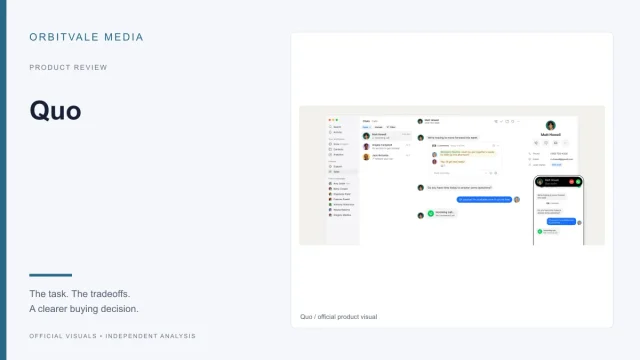
Quo, formerly OpenPhone, is worth considering when business calls and texts have become too important to live inside one person’s mobile number. Shared conversation context can make a small team more dependable, especially when another colleague must continue a request. The central buying question is whether the phone workflow produces a clear owner and an honest customer promise.
Strong-fit brief: A small sales or service team wanting shared business conversations and a practical route from missed contact to owned follow-up.
Weak-fit brief: A buyer assuming every country, number type or contact-centre requirement is supported without checking, or expecting AI to make unrestricted customer commitments.
Full Quo analysis · Official website.
Aircall
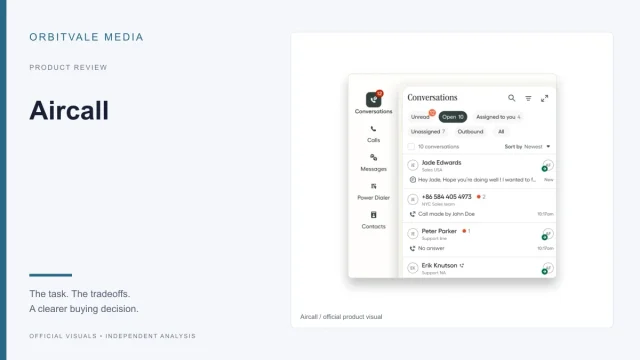
Aircall belongs on a shortlist when a business phone operation needs shared handling, routing and connections to sales or service records. The core buying problem is coordination: who answers, what context they see and who owns the next action when the first person cannot resolve the request. A phone integration should be evaluated through a complete customer conversation.
Strong-fit brief: A sales or support team needing a more coordinated phone operation and connected customer context.
Weak-fit brief: A buyer who has not checked required countries, number types, minimum seats and the actual support or CRM integration.
Full Aircall analysis · Official website.
Run the evaluation through six checkpoints
1. Define the source and ownership
| Candidate | Product-specific task |
|---|---|
| Quo | Map why customers call: Use order status, product fit, returns and trade inquiries. Identify the information and authority needed for each. |
| Aircall | Map customer intents: Use the common sales and service reasons for calling. Keep the menu short enough for customers to understand. |
2. Prepare the representative case
| Candidate | Product-specific task |
|---|---|
| Quo | Set ownership rules: Define who answers, who handles a missed call and who owns the next action after transfer. |
| Aircall | Define queue ownership: Name the person responsible for unanswered calls, transfers and opening the next day’s backlog. |
3. Inspect the first accepted result
| Candidate | Product-specific task |
|---|---|
| Quo | Test real devices: Use the actual headsets, mobile phones and home networks. Review audio and notifications with ordinary staff. |
| Aircall | Test the real endpoint: Use the team’s headset, browser, network and mobile environment. Review audio in both directions. |
4. Introduce an ordinary exception
| Candidate | Product-specific task |
|---|---|
| Quo | Limit AI knowledge: Use approved business facts with a review owner. For uncertain stock or exceptions, collect context and escalate. |
| Aircall | Transfer with context: Confirm the receiving colleague sees the customer identity, reason and promise already made. |
5. Ask another operator
| Candidate | Product-specific task |
|---|---|
| Quo | Rehearse a difficult handoff: Have the first operator become unavailable after promising a callback. The second should find and complete the promise. |
| Aircall | Break the normal route: Make one operator unavailable and inspect the fallback. Avoid a loop that keeps returning the caller to the same unanswered place. |
6. Price and document the result
| Candidate | Product-specific task |
|---|---|
| Quo | Plan migration and recovery: Confirm number eligibility, porting steps and fallback communication before changing the public customer route. |
| Aircall | Reconcile call and task: A completed call log should lead to the right next action when work remains. Check the receiving CRM or helpdesk. |
Operating questions behind the comparison
Define ownership after the ring stops
Answering, transferring and resolving are different events. For each common intent, identify who owns the next action and where it is recorded. A shared call history helps only when a specific person remains accountable.
Use the missed-call route as a practical test. The next operator should know whether to call back, wait for information or route the case elsewhere. Avoid several people making duplicate callbacks.
Test difficult real-world conditions
Use the actual headset, browser, mobile device and network. Include a noisy environment, unavailable colleague and after-hours call. The smoothest vendor demonstration cannot establish performance on a staff member’s home connection.
Review the caller experience as well as the operator’s screen. A routing rule can look correct internally while leaving a customer in a loop.
Limit automated authority
An assistant can collect a question or explain approved information without being authorized to grant every exception. Keep pricing, refund and delivery commitments within explicit boundaries.
Test uncertainty using a question absent from the knowledge source. The useful response is an honest escalation with context, not a plausible invented answer. Review apparent resolutions until the team understands the real case mix.
Plan the public-number transition
Confirm eligibility, porting, registration and fallback arrangements before changing a customer-facing number. Coordinate staffing and device readiness with the migration rather than treating it as a separate technical task.
Price seats, numbers, destinations, integrations and selected AI usage together. Count the human completion that remains after automated handling. A faster initial answer can still leave a substantial callback workload.
Compare the same complete cost
Quo cost drivers
For 300 monthly calls, suppose 90 reach an AI or after-hours route and 60 of those still need a five-minute callback. That leaves 300 minutes of human completion, even when the initial answer is automated. Add the actual plan, numbers, calling routes and Sona usage. The example is a capacity model, not a Quo performance claim.
Aircall cost drivers
Model the current team configuration, number requirements, communication mix and relevant AI features. If ten missed calls a week require five minutes each of administrative chasing, that is an illustrative 200 minutes monthly. Measure the portion routing actually removes and keep customer-resolution work separate.
Check current Aircall pricing.
| Shared cost line | Comparable assumption |
|---|---|
| Required subscription | Use the tier that contains the actual workflow and record currency, billing interval and team size. |
| Variable services | Count the real billing unit and separately priced carrier, payment, communication or model services. |
| Setup and change | Include source cleanup, integration, training and the first meaningful revision. |
| Review and exceptions | Budget the people who approve outputs, investigate discrepancies and complete customer follow-up. |
| What disappears | Only count a saving when the old subscription or manual task can actually be retired. |
Reasons to reject a candidate
Quo limits for this task
- Answer rate mistaken for resolution: A call may be answered while the customer still needs a person. Measure the owned next action.
- AI overcommitment: Keep commercial authority separate from an assistant’s ability to speak naturally.
- Migration assumptions: Number transfer, messaging registration and device readiness can affect launch. Verify the actual requirements.
Aircall limits for this task
- Queue ambiguity: Several people seeing a call does not mean one owns it.
- Integration gaps: A record can sync without creating a useful follow-up. Inspect the destination.
- Connectivity assumptions: Remote audio depends on real networks and devices. Test the environment used by staff.
These are evaluation questions, not assertions that a product always fails. When a limitation creates another handoff, assign an owner and price that work. If neither candidate meets the essential requirement, revise the shortlist rather than quietly weakening the requirement after seeing a polished demo.
The comparison mistake to avoid
An answered call is not automatically a resolved customer issue. Keep callback work and human authority in the capacity and cost model.
Our conditional recommendation
Choose after staff complete the difficult calls on their real devices. Quo is a useful route to investigate for shared business conversations; Aircall deserves investigation where coordinated team calling and integrations are central. Let the required workflow and verified current plan decide, not an unsupported universal ranking.
What to retain after deciding
Keep the original brief, selected account configuration, accepted output and changed-case result. Record which assumption would reverse the recommendation: volume, team ownership, output format or the cost of an exception. This makes the comparison useful again when the business changes. A decision to postpone a purchase is also a valid result when the process or source data is not ready.
Sources, image credits and scope
OrbitVale’s analysis combines official product information with proposed operating exercises. We have not represented these exercises as hands-on tests, measured vendor results or customer case studies. Calculations use stated assumptions. Product and plan sources were reviewed on November 4, 2026.
Quo: Official overview · Current pricing · Supporting official source 1 · Supporting official source 2.
Aircall: Official overview · Current pricing.
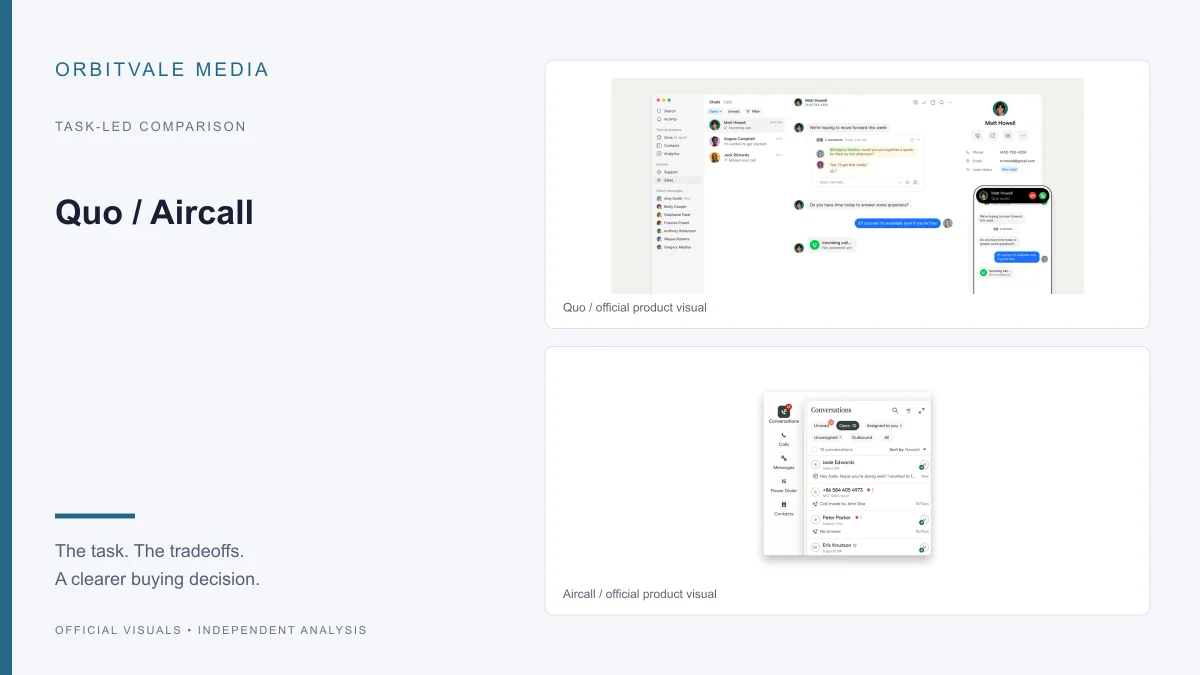
Official visuals are credited beside each figure; they are vendor-published material, not independent test screenshots. Interactive plan displays and account-specific terms can differ. Confirm checkout, region and required entitlements before purchasing. See our editorial method and commercial disclosure.