Research-based comparison · 10 min read · Source check: November 4, 2026
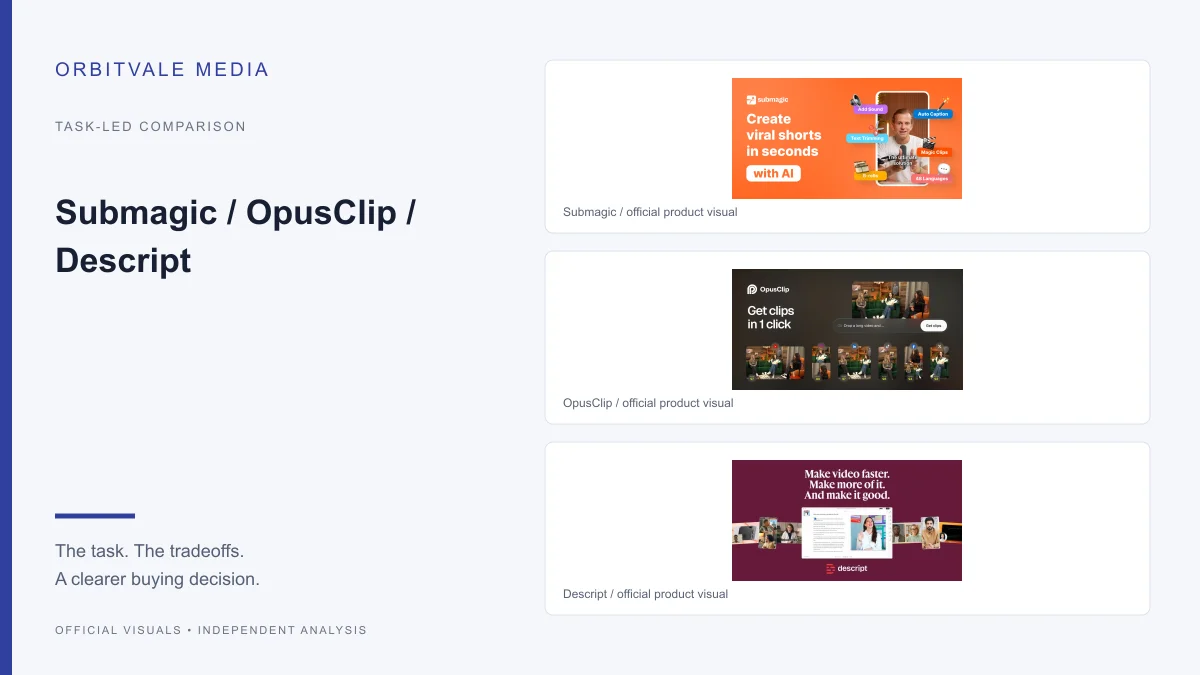
These tools overlap around video but begin at different editorial bottlenecks. Submagic deserves attention for finishing short footage and captions. OpusClip is relevant when a long archive needs candidate excerpts. Descript is particularly useful to investigate when shaping a longer spoken narrative is the main task. The right tool can be a sequence of stages rather than one universal winner.
Table of Contents
The common task
Use a 30-minute founder interview to produce a coherent main explanation and two accurate social excerpts. Include a product qualification, a screen demonstration and a long brand name. Judge the final outputs with the same factual and visual rules.
This is a proposed comparison, not a report of controlled product tests. Use the same source material, required outcome and review standard for every candidate. When products solve different stages, compare the complete architecture instead of forcing an artificial winner.
The decision in one view
| Dimension | What to compare |
|---|---|
| Starting material | Separate a ready short clip from a long recording whose useful moments are still unknown. |
| Narrative control | Review how the main explanation is restructured and whether the speaker’s meaning survives. |
| Caption quality | Check product names, units, negations and safe areas before comparing animation. |
| Source context | Read or watch around every excerpt boundary and preserve the condition that makes the claim true. |
| Revision path | Change one product detail and locate every affected output. |
Where each candidate earns a place
Submagic
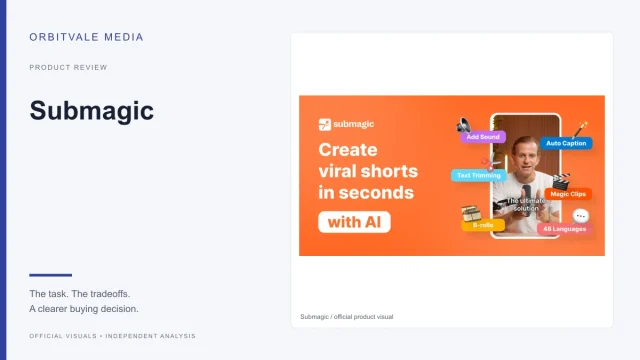
Submagic is a strong candidate when footage already exists and the bottleneck is making short clips clear and ready for publication. Caption styling, pacing and supporting visual edits sit close to the daily work of social video teams. The purchasing mistake is to treat an attractive caption preset as proof that the final clip explains the product accurately.
Strong-fit brief: A creator or small marketing team publishing recurring short videos from footage it owns and can review.
Weak-fit brief: A brief that begins with no footage and needs a coherent generated story, or a complex film edit requiring extensive timeline and finishing control.
Full Submagic analysis · Official website.
OpusClip
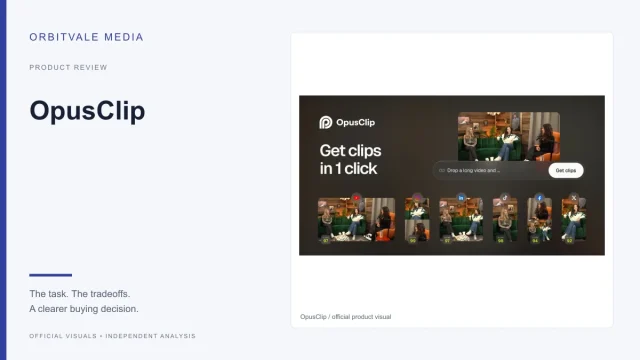
OpusClip fits a content library problem: a business has long recordings and wants help finding smaller segments worth publishing. Segment discovery and reframing can remove part of the first editing pass. The final decision remains editorial, because the most energetic sentence may not be a complete or accurate answer.
Strong-fit brief: A webinar, podcast or interview team with owned source material and a reviewer who understands the subject.
Weak-fit brief: A channel with no usable source recordings or one that expects a clipping score to replace editorial selection and distribution analysis.
Full OpusClip analysis · Official website.
Descript
Descript is particularly relevant to speech-heavy production: interviews, founder explainers, tutorials and podcasts. Working through a transcript can make navigation and restructuring easier than searching a long timeline for every sentence. The transcript is a map, however, and the audio performance still determines whether the edit sounds natural.
Strong-fit brief: A publisher editing recurring spoken material who wants transcript-led navigation and AI-assisted production tools.
Weak-fit brief: A project whose essential requirement is specialist visual finishing, or an editor who cannot listen across every material cut.
Full Descript analysis · Official website.
Run the evaluation through six checkpoints
1. Define the source and ownership
| Candidate | Product-specific task |
|---|---|
| Submagic | Prepare the master transcript: Write the correct product name, measurement and warning. Keep this reference alongside the source clip so every caption revision has a factual baseline. |
| OpusClip | Choose a difficult source: Include a slide, a speaker change and a qualification. A clean monologue does not reveal the most important failure modes. |
| Descript | Keep a source master: Retain the untouched recording, speaker permission and intended outputs. Treat the master as the reference when an edit changes meaning. |
2. Prepare the representative case
| Candidate | Product-specific task |
|---|---|
| Submagic | Reserve safe areas: Mark the product feature, face and platform interface zones. A caption can fit the frame yet still hide the action the viewer came to understand. |
| OpusClip | Define a useful clip: Specify the viewer question, length range and one complete idea. Reject a segment that only makes sense after watching the full recording. |
| Descript | Correct the transcript: Fix measurements, names and speaker attribution. A wrong term in the transcript can influence both the cut and every derived caption. |
3. Inspect the first accepted result
| Candidate | Product-specific task |
|---|---|
| Submagic | Apply one caption treatment: Begin with readable contrast and controlled line lengths. Add animation only where it supports emphasis or the rhythm of the speech. |
| OpusClip | Read around the suggestion: Inspect the minute before and after each candidate. Restore a condition or supporting explanation that changes the meaning. |
| Descript | Shape one clear narrative: Choose the order that answers the viewer’s question. Preserve uncertainty and relevant qualifications rather than constructing artificial confidence. |
4. Introduce an ordinary exception
| Candidate | Product-specific task |
|---|---|
| Submagic | Inspect every factual word: Pause on prices, dates, negations and model identifiers. Read the caption against the audio; do not assume a spelling correction preserves the timing. |
| OpusClip | Repair the visual frame: Follow the important action through the whole clip. Manually review transitions between a person, product and slide. |
| Descript | Listen through every join: Review the breath, pitch and visual transition around removed speech. A grammatically complete sentence may still sound cut apart. |
5. Ask another operator
| Candidate | Product-specific task |
|---|---|
| Submagic | Compare the exported clip: Watch with sound, then muted, on the intended phone size. Check the opening frame, closing instruction and any shift in crop. |
| OpusClip | Approve the publishing copy: Treat the title, hook, captions and description as one message. They should not promise more than the source supports. |
| Descript | Check a short derivative: Inspect the excerpt against the full answer. Include the condition that makes the statement accurate in a new context. |
6. Price and document the result
| Candidate | Product-specific task |
|---|---|
| Submagic | Measure finishing effort: Record the minutes spent correcting the transcript, styling, reviewing and exporting. Save the accepted preset only after the difficult clip passes. |
| OpusClip | Calculate usable yield: Record final clips, correction minutes and source duration. Compare two recordings with different complexity before estimating a recurring schedule. |
| Descript | Rehearse a factual update: Change one compatibility detail and locate every output it affects. Export the revised version and withdraw the old one from the publishing queue. |
Operating questions behind the comparison
Build a caption quality hierarchy
Review factual accuracy first, timing second and visual styling third. A caption that changes “does not fit” into “does fit” is a more serious failure than a slightly awkward line break. Product names, quantities, prices and qualifications deserve deliberate inspection. The transcript should remain connected to the source recording so a later correction has a reference.
Next, check reading time and placement. A viewer needs enough time to read and see the action. Place the demonstration, face and platform interface in the frame before choosing a text zone. A preset that works for a talking head may hide the important part of an assembly video.
Judge the beginning and ending separately
Clipping errors often sit at the boundaries. A segment may begin after the subject was named or end before a condition was explained. Watch the original context around the proposed cut. A standalone short should communicate one complete idea without inviting a broader inference than the source supports.
Review the publishing title and hook as part of the same message. If the title promises a guaranteed result and the speaker described a conditional example, the clip is misleading even when the captions are exact. Editing needs an owner for meaning as well as timing.
Measure useful yield from the source
Create three counts: candidates, editor-approved clips and published clips. Candidate volume reflects the tool’s suggestions; approved yield reflects actual production usefulness; publication adds channel scheduling and audience judgment. Keep those denominators separate.
For a hypothetical source hour yielding four approved clips, record how much correction each needs. A second recording may yield only one complete idea. The difference may come from source quality rather than software performance. A fair trial uses more than one type of recording and reports the limitation instead of presenting the best source as typical.
Keep the correction path short
A late price or compatibility update should be traceable from the source statement to every affected output. Maintain a simple register containing source, clip ID, approved title, export and publication destination. This is especially useful when several editors work on derivatives.
Save the approved caption text and an editable project where available. A final compressed file is useful for publishing but can be expensive to repair. Before adopting a new tool, test one ordinary revision and estimate the time it would take across a month’s clips.
Compare the same complete cost
Submagic cost drivers
For 30 monthly clips, seven minutes of correction and four minutes of final review total 330 minutes. If a new visual treatment adds three minutes per clip, another 90 minutes enters the workload. Compare the selected subscription with the complete 420-minute example rather than assuming automation removes review.
Check current Submagic pricing.
OpusClip cost drivers
A 90-minute webinar yielding six approved clips after 14 minutes of correction each requires 84 minutes of finishing. If a second webinar yields only two clips, its effective source cost is higher even with the same subscription. Record both cases; do not build a forecast from the easiest source alone.
Check current OpusClip pricing.
Descript cost drivers
For four interviews a month, a hypothetical saving of 18 editing minutes each produces 72 minutes of gross time benefit. If transcript correction and derivative checks add 12 minutes per interview, the net example is only 24 minutes. Price the selected plan against the net workflow, including the actual output formats and number of editors.
Check current Descript pricing.
| Shared cost line | Comparable assumption |
|---|---|
| Required subscription | Use the tier that contains the actual workflow and record currency, billing interval and team size. |
| Variable services | Count the real billing unit and separately priced carrier, payment, communication or model services. |
| Setup and change | Include source cleanup, integration, training and the first meaningful revision. |
| Review and exceptions | Budget the people who approve outputs, investigate discrepancies and complete customer follow-up. |
| What disappears | Only count a saving when the old subscription or manual task can actually be retired. |
Reasons to reject a candidate
Submagic limits for this task
- Captions compete with evidence: Large animated text can obscure a demonstration. The product action should remain visible throughout the relevant sentence.
- A hook changes the promise: A stronger opening must still match the clip. Remove language that implies a result the footage does not support.
- Fast output hides revision work: A batch of drafts is not a finished publishing calendar. Count only clips that survive factual, audio and visual review.
OpusClip limits for this task
- Lost qualifications: A short extract can turn a conditional answer into a general promise. The original recording remains the reference.
- Misleading scores: An engagement heuristic does not know your full audience or commercial objective. Validate publishing decisions with actual channel data.
- Rights and permissions: A public source video is not automatically yours to republish. Use material whose reuse and speaker permissions are established.
Descript limits for this task
- Transcript illusion: Readable text can hide a strained audio join or a mismatched reaction shot. Review sound and picture together.
- Over-cleaned speech: Aggressive processing can make a speaker sound artificial. Choose a passage with quiet and emphatic speech for the comparison.
- Detached derivatives: A corrected main video does not automatically mean every published excerpt was corrected. Maintain a relationship between outputs.
These are evaluation questions, not assertions that a product always fails. When a limitation creates another handoff, assign an owner and price that work. If neither candidate meets the essential requirement, revise the shortlist rather than quietly weakening the requirement after seeing a polished demo.
The comparison mistake to avoid
A more animated caption is not evidence of a better clip, and a high predicted engagement score is not a forecast of actual views. Evaluate accepted editorial work before channel performance.
Our conditional recommendation
Choose Submagic when short-video finishing is the measured bottleneck, OpusClip when segment discovery dominates, and Descript when transcript-led narrative editing is central. Combining tools can be sensible if the handoff preserves source context and the total correction work is lower. Avoid paying three subscriptions simply because all can export a vertical video.
What to retain after deciding
Keep the original brief, selected account configuration, accepted output and changed-case result. Record which assumption would reverse the recommendation: volume, team ownership, output format or the cost of an exception. This makes the comparison useful again when the business changes. A decision to postpone a purchase is also a valid result when the process or source data is not ready.
Sources, image credits and scope
OrbitVale’s analysis combines official product information with proposed operating exercises. We have not represented these exercises as hands-on tests, measured vendor results or customer case studies. Calculations use stated assumptions. Product and plan sources were reviewed on November 4, 2026.
Submagic: Official overview · Current pricing.
OpusClip: Official overview · Current pricing.
Descript: Official overview · Current pricing.
Official visuals are credited beside each figure; they are vendor-published material, not independent test screenshots. Interactive plan displays and account-specific terms can differ. Confirm checkout, region and required entitlements before purchasing. See our editorial method and commercial disclosure.