Research-based comparison · 7 min read · Source check: November 4, 2026
Pipedrive and Close deserve a comparison based on the representative’s actual day. Pipedrive is a useful route for clear opportunity and activity management. Close is worth investigating when frequent calls and emails make a communication-centred CRM attractive. Both still require clean account identities and evidence-based stages.
Table of Contents
The common task
Follow a wholesale inquiry through qualification, sample discussion and a commercial decision. A second representative takes over after an email and call, and must find the promise already made.
This is a proposed comparison, not a report of controlled product tests. Use the same source material, required outcome and review standard for every candidate. When products solve different stages, compare the complete architecture instead of forcing an artificial winner.
The decision in one view
| Dimension | What to compare |
|---|---|
| Daily work | Compare the number of application handoffs and useful context available to the representative. |
| Account model | Test several people at one company and an existing customer inquiry. |
| Automation | Verify the exact assignment or sequence on the required tier. |
| Communication bill | Include calling and other usage as applicable. |
| Management | Use stalled opportunities and next actions rather than activity count alone. |
Where each candidate earns a place
Pipedrive
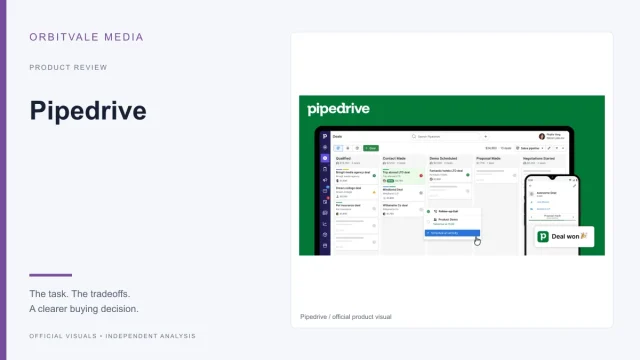
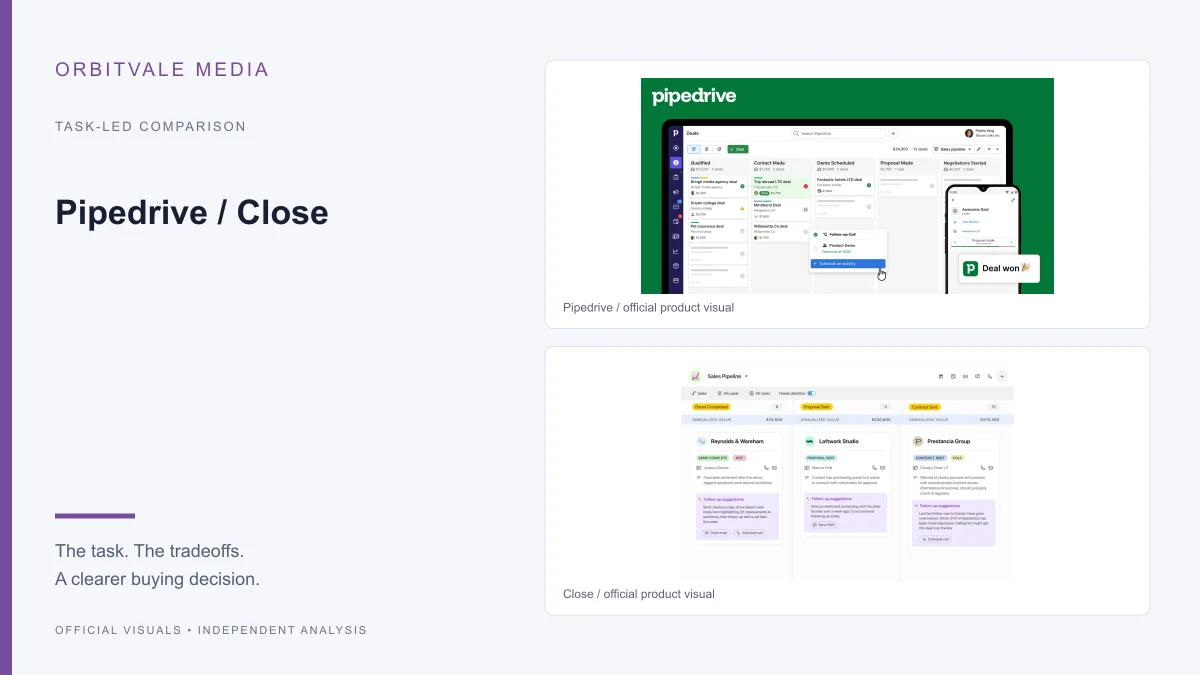
Pipedrive fits a business that knows it needs a reliable sales process but does not want opportunity follow-up scattered across inboxes and memory. A visual pipeline is useful when stages describe evidence about a deal and every active opportunity has an owner and next action. Moving cards is not progress unless the customer relationship changes.
Strong-fit brief: A small sales team managing opportunities, activities and customer context with explicit ownership.
Weak-fit brief: A team expecting a CRM subscription to supply a prospecting strategy or wanting many stages without agreed qualification criteria.
Full Pipedrive analysis · Official website.
Close
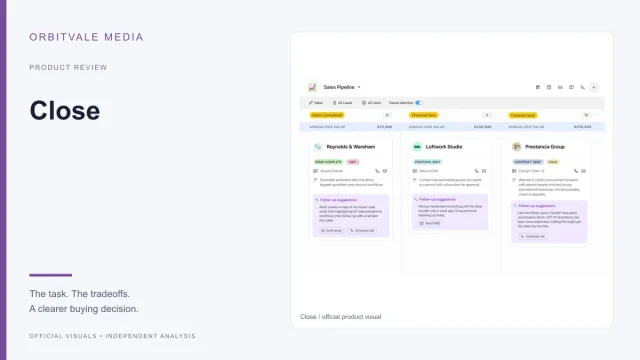
Close deserves consideration when representatives spend much of their day contacting prospects and updating the same opportunity context. Combining CRM and communication can reduce movement between applications. The important test is whether the next representative can understand what happened and make the right next move.
Strong-fit brief: A sales team with frequent calls and emails that wants opportunity context close to daily communication.
Weak-fit brief: A team choosing on a seat price without modelling communication usage, or one requiring a specialist non-sales case-management process.
Full Close analysis · Official website.
Run the evaluation through six checkpoints
1. Define the source and ownership
| Candidate | Product-specific task |
|---|---|
| Pipedrive | Define qualification: For wholesale, record fit, territory, order potential and a real buying conversation. Avoid judging intent from a download alone. |
| Close | Map the sales day: List the calls, emails and CRM updates actually performed. Identify where the current handoff loses context. |
2. Prepare the representative case
| Candidate | Product-specific task |
|---|---|
| Pipedrive | Create a short pipeline: Use stages with evidence-based entry and exit conditions. Write one example for each. |
| Close | Create representative accounts: Include several contacts at one company and a pre-existing customer relationship. |
3. Inspect the first accepted result
| Candidate | Product-specific task |
|---|---|
| Pipedrive | Import a clean sample: Deduplicate companies and contacts. Keep existing customer relationships distinct from new prospects. |
| Close | Run a complete follow-up: Record the communication and the customer’s stated next step. Use the tools the representative expects to operate daily. |
4. Introduce an ordinary exception
| Candidate | Product-specific task |
|---|---|
| Pipedrive | Assign the next action: Use a concrete customer-facing step with a due date. Internal research may support the action but is not the sale itself. |
| Close | Stop a sequence on reply: Test an interested reply, a wrong person and a request for no further contact. |
5. Ask another operator
| Candidate | Product-specific task |
|---|---|
| Pipedrive | Rehearse ownership change: Move an opportunity to another representative and confirm the conversation history remains usable. |
| Close | Hand over the relationship: Ask another representative to find the promise made and the next action without an oral briefing. |
6. Price and document the result
| Candidate | Product-specific task |
|---|---|
| Pipedrive | Review stalled work: Find deals with no meaningful next step and decide whether to act, pause or close them. |
| Close | Model the team bill: Use the required tier, seats and communication destinations, including the busy period. |
Operating questions behind the comparison
Make stages describe evidence
A useful stage explains what is known about a customer decision. “Sample requested” can be meaningful; “hot” is subjective unless the team agrees what it means. Define entry and exit conditions with a real example.
Keep a short pipeline initially. More stages can create administrative movement without improving the sales conversation. Add detail when it changes an action or forecast.
Give every active opportunity a next action
An owner, action and date are the minimum useful follow-up record. The action should describe a real next step, not simply “follow up” repeated forever. If the customer has no reason to continue, close or pause the opportunity honestly.
Review overdue work and missing owners. A CRM can make gaps visible, but a manager still needs to resolve capacity and priorities.
Preserve account context through handoff
Several people can belong to one buying organization. Keep their roles, messages and promises understandable. Deduplicate carefully so one account does not receive unrelated outreach from several representatives.
Test a colleague taking over without an oral briefing. They should find the customer’s actual request, the latest commitment and the next action.
Separate activity from commercial progress
Calls, emails and completed tasks describe effort. Qualification, accepted next steps and a decision describe customer progress. Use both kinds of measures without pretending they are interchangeable.
Price the actual seats, communication and automation requirements. A smaller maintained CRM can be more useful than a broad stack whose records nobody trusts.
Compare the same complete cost
Pipedrive cost drivers
For four representatives, compare the exact seat tier and required integrations. If each recovers an assumed 20 minutes daily from searching for context, a 20-day month yields roughly 26.7 hours of gross benefit. Validate that in a pilot and subtract data maintenance and administration.
Check current Pipedrive pricing.
Close cost drivers
A three-person team should price the plan containing its actual automation, then add calling and messaging usage. If the integrated routine saves twelve minutes per representative each workday, the illustrative gross benefit is twelve hours in a 20-day month. Include the work needed to maintain clean account records.
| Shared cost line | Comparable assumption |
|---|---|
| Required subscription | Use the tier that contains the actual workflow and record currency, billing interval and team size. |
| Variable services | Count the real billing unit and separately priced carrier, payment, communication or model services. |
| Setup and change | Include source cleanup, integration, training and the first meaningful revision. |
| Review and exceptions | Budget the people who approve outputs, investigate discrepancies and complete customer follow-up. |
| What disappears | Only count a saving when the old subscription or manual task can actually be retired. |
Reasons to reject a candidate
Pipedrive limits for this task
- Decorative stages: A stage without evidence becomes a subjective status label.
- Duplicate identities: Several records for one company can split context and create repeated outreach.
- Activity inflation: More completed tasks do not necessarily mean better opportunities. Review customer progress.
Close limits for this task
- Usage surprises: Calls, messages and related services may add variable costs. Use the actual destination mix.
- Sequence overreach: Automation should stop when the customer changes the conversation.
- Wrong account model: A fast daily interface is less useful if the business relationship cannot be represented clearly.
These are evaluation questions, not assertions that a product always fails. When a limitation creates another handoff, assign an owner and price that work. If neither candidate meets the essential requirement, revise the shortlist rather than quietly weakening the requirement after seeing a polished demo.
The comparison mistake to avoid
Do not select a CRM from a clean demo dataset alone. Existing duplicates, several contacts per account and incomplete next actions reveal the real operating fit.
Our conditional recommendation
Choose Pipedrive when its pipeline and activity routine fits the team’s central need. Investigate Close when integrated communication removes substantial daily work and its account model fits. Have the ordinary representative complete the trial; a manager’s dashboard preference is not enough.
What to retain after deciding
Keep the original brief, selected account configuration, accepted output and changed-case result. Record which assumption would reverse the recommendation: volume, team ownership, output format or the cost of an exception. This makes the comparison useful again when the business changes. A decision to postpone a purchase is also a valid result when the process or source data is not ready.
Sources, image credits and scope
OrbitVale’s analysis combines official product information with proposed operating exercises. We have not represented these exercises as hands-on tests, measured vendor results or customer case studies. Calculations use stated assumptions. Product and plan sources were reviewed on November 4, 2026.
Pipedrive: Official overview · Current pricing.
Close: Official overview · Current pricing.
Official visuals are credited beside each figure; they are vendor-published material, not independent test screenshots. Interactive plan displays and account-specific terms can differ. Confirm checkout, region and required entitlements before purchasing. See our editorial method and commercial disclosure.