Research-based product review · 35 min read · Source check: November 4, 2026
Quo, formerly OpenPhone, is worth considering when business calls and texts have become too important to live inside one person’s mobile number. Shared conversation context can make a small team more dependable, especially when another colleague must continue a request. The central buying question is whether the phone workflow produces a clear owner and an honest customer promise.
We would assess Quo through actual call intents, devices and follow-up tasks. Sona adds an AI-handling option, but an answered call is not necessarily a resolved customer issue. Test what the assistant knows, when it should defer and how a person sees the remaining work. Number eligibility, porting and current plan features also need to match the business.
Table of Contents
The buying decision
| Put it on the shortlist when | Choose another route when |
|---|---|
| A small sales or service team wanting shared business conversations and a practical route from missed contact to owned follow-up. | A buyer assuming every country, number type or contact-centre requirement is supported without checking, or expecting AI to make unrestricted customer commitments. |
A realistic job for Quo
A specialty homewares store handles consumer order questions and trade inquiries through one public number. The proposed evaluation includes a known buyer, a new retailer, a call after hours and a request about a stock date that is not yet confirmed. The system should preserve context without inventing a promise.
What the capabilities mean in practice
Business calling and texting
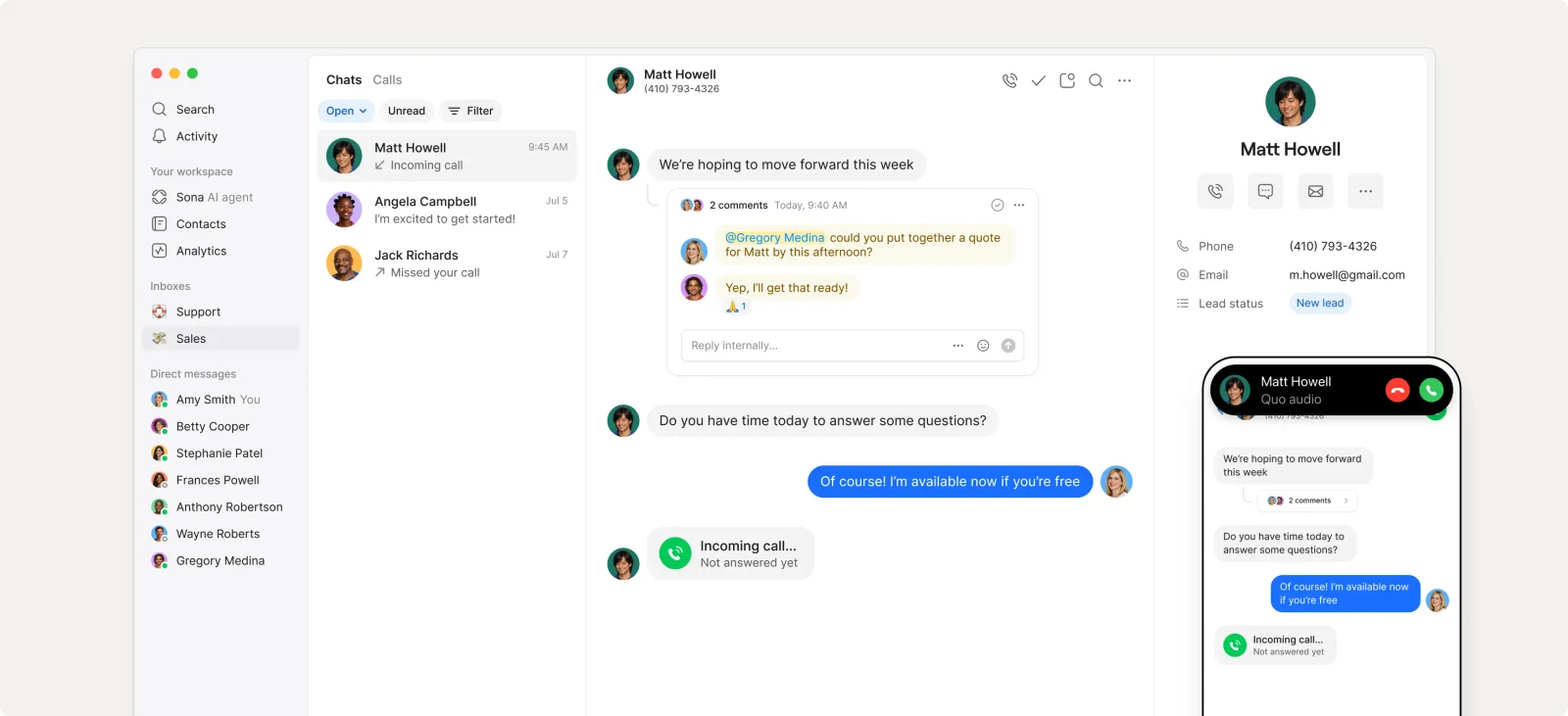
Quo offers business phone numbers with calling, messaging and team conversation workflows. Official product overview.
Test the intended numbers, countries and traffic. A shared inbox is useful only when the team agrees who handles an unresolved request.
Team context
The product supports shared communication and collaboration. Official product overview.
Have a second colleague continue a conversation. They should see the important promise, not just a long transcript.
Sona
Quo offers the Sona AI agent with plan and usage rules. Official product overview.
Give it a narrow factual scope and an explicit escalation route. A fluent response must not become an unsupported refund, delivery or pricing commitment.
Plans and usage
Pricing distinguishes seats, selected features and AI-related usage. Official product overview.
Check billing interval, numbers, communication routes and Sona allowances separately. Do not infer all advanced handling from the entry seat price.
Current plan boundaries
Per-user Starter, Business and Scale subscriptions, with monthly/annual billing. Current monthly base rates shown are $19/$33/$47 per user; annual equivalents are $15/$23/$35. Additional numbers, international usage, applicable messaging registration/fees and Sona usage can add costs. Official plan source.
- The current pricing page includes Sona on every base plan with 1,000 monthly automation credits, approximately ten Sona calls. Higher Sona tiers/overages are additional; included AI is not unlimited AI usage.
- AI summaries/transcripts of ordinary team calls are a Business feature, and AI call tags are a Scale feature. Sona-handled calls have their own recordings/summaries/transcripts; do not confuse this with ordinary human-call entitlement.
- Base-plan calling/messaging has a US/Canada scope and asterisked conditions. Shared-number access does not remove the need for each teammate's own user account.
The snapshot above is tied to the review date. Promotions, billing interval, location and account migration can change the payable amount. The decision below uses the cost drivers rather than pretending a headline fee describes every configuration.
A practical evaluation sequence
Use the following as a proposed pilot. Keep source inputs and accepted outputs so another person can review the result. The sequence is designed around the task above; it is not a claim that OrbitVale ran an account test.
1. Map why customers call
Use order status, product fit, returns and trade inquiries. Identify the information and authority needed for each.
2. Set ownership rules
Define who answers, who handles a missed call and who owns the next action after transfer.
3. Test real devices
Use the actual headsets, mobile phones and home networks. Review audio and notifications with ordinary staff.
4. Limit AI knowledge
Use approved business facts with a review owner. For uncertain stock or exceptions, collect context and escalate.
5. Rehearse a difficult handoff
Have the first operator become unavailable after promising a callback. The second should find and complete the promise.
6. Plan migration and recovery
Confirm number eligibility, porting steps and fallback communication before changing the public customer route.
The operating details that decide the fit
Define ownership after the ring stops
Answering, transferring and resolving are different events. For each common intent, identify who owns the next action and where it is recorded. A shared call history helps only when a specific person remains accountable.
Use the missed-call route as a practical test. The next operator should know whether to call back, wait for information or route the case elsewhere. Avoid several people making duplicate callbacks.
Test difficult real-world conditions
Use the actual headset, browser, mobile device and network. Include a noisy environment, unavailable colleague and after-hours call. The smoothest vendor demonstration cannot establish performance on a staff member’s home connection.
Review the caller experience as well as the operator’s screen. A routing rule can look correct internally while leaving a customer in a loop.
Limit automated authority
An assistant can collect a question or explain approved information without being authorized to grant every exception. Keep pricing, refund and delivery commitments within explicit boundaries.
Test uncertainty using a question absent from the knowledge source. The useful response is an honest escalation with context, not a plausible invented answer. Review apparent resolutions until the team understands the real case mix.
Plan the public-number transition
Confirm eligibility, porting, registration and fallback arrangements before changing a customer-facing number. Coordinate staffing and device readiness with the migration rather than treating it as a separate technical task.
Price seats, numbers, destinations, integrations and selected AI usage together. Count the human completion that remains after automated handling. A faster initial answer can still leave a substantial callback workload.
Tradeoffs and reasons to reject the fit
Answer rate mistaken for resolution
A call may be answered while the customer still needs a person. Measure the owned next action.
AI overcommitment
Keep commercial authority separate from an assistant’s ability to speak naturally.
Migration assumptions
Number transfer, messaging registration and device readiness can affect launch. Verify the actual requirements.
Pricing the complete job
Seats, AI handling and human completion
For 300 monthly calls, suppose 90 reach an AI or after-hours route and 60 of those still need a five-minute callback. That leaves 300 minutes of human completion, even when the initial answer is automated. Add the actual plan, numbers, calling routes and Sona usage. The example is a capacity model, not a Quo performance claim.
| Cost line | Include in the estimate |
|---|---|
| Required subscription | Use the tier that contains the actual workflow and record currency, billing interval and team size. |
| Variable services | Count the real billing unit and separately priced carrier, payment, communication or model services. |
| Setup and change | Include source cleanup, integration, training and the first meaningful revision. |
| Review and exceptions | Budget the people who approve outputs, investigate discrepancies and complete customer follow-up. |
| What disappears | Only count a saving when the old subscription or manual task can actually be retired. |
Keep a normal-month estimate and a busy-month estimate. Use the same accepted outcome in both. If the tool produces an intermediate draft, alert, record or label, include the remaining work needed to complete the customer or publishing task. Replace the example assumptions with your own observed figures after the pilot.
Alternatives and the boundary between jobs
Aircall
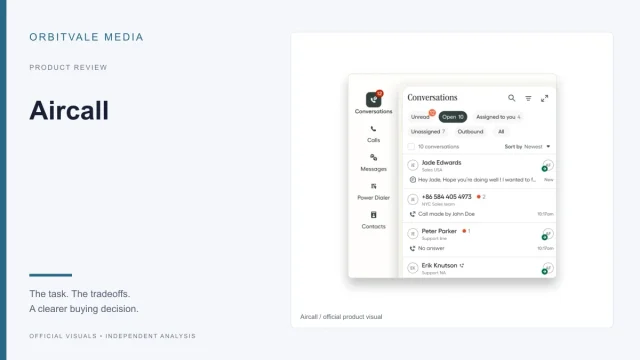
Read the Aircall review. A sales or support team needing a more coordinated phone operation and connected customer context.
Aircall belongs on a shortlist when a business phone operation needs shared handling, routing and connections to sales or service records. The core buying problem is coordination: who answers, what context they see and who owns the next action when the first person cannot resolve the request. A phone integration should be evaluated through a complete customer conversation.
Close
Read the Close review. A sales team with frequent calls and emails that wants opportunity context close to daily communication.
Close deserves consideration when representatives spend much of their day contacting prospects and updating the same opportunity context. Combining CRM and communication can reduce movement between applications. The important test is whether the next representative can understand what happened and make the right next move.
Tidio
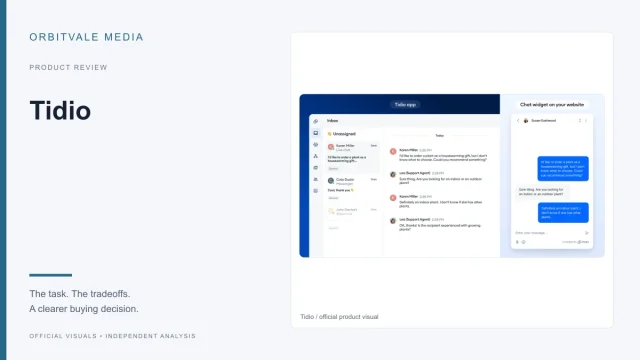
Read the Tidio review. An ecommerce team with maintained help material and a staffed route for exceptions and customer-specific issues.
Tidio is relevant when a store needs a clearer way to handle website questions and selected automated answers. The most useful assistant can answer a supported question, recognize uncertainty and preserve context for a human. It should not turn an incomplete policy into a confident promise about returns, stock or delivery.
A decision record to keep
For Quo, record the selected account and plan, the specific job, the accepted output and the unresolved limitation. The acceptance decision should explain whether “answer rate mistaken for resolution” is manageable for this business. Name the owner of the next review and preserve the result of the changed-case exercise, not only the easiest first pass.
Our recommendation
Quo is worth a deliberate trial when this describes your business: A small sales or service team wanting shared business conversations and a practical route from missed contact to owned follow-up. The case is weaker when this remains true: A buyer assuming every country, number type or contact-centre requirement is supported without checking, or expecting AI to make unrestricted customer commitments. Start with the bounded scenario, price the complete job and expand after the team can explain the exceptions. Open the official Quo website.
Build a call inventory before choosing a tier
Start with why customers call. A useful inventory separates a new sales question, an existing order, product suitability, a return, a supplier call and a wrong number. Each intent has different information and authority requirements. A product question may be answerable from approved public material; a changed shipping address may require identity checks and access to an order system.
For a hypothetical homewares store, collect a small representative period of call reasons from the existing process. Do not assume a few memorable difficult calls describe the whole workload. Record the requested outcome, what the first person could answer and what had to be handed over. Keep the record proportionate and avoid gathering unnecessary personal details.
This inventory helps identify what Quo needs to do and what another system must still handle. Shared phone context can improve continuity, while the order platform remains the source for order facts. A CRM can own a trade opportunity. The phone system should make those boundaries easier to navigate rather than become an unofficial copy of every business record.
Use the inventory to define the pilot cohort. Include the common straightforward case and a commercially important exception. A trial consisting only of friendly test calls proves basic connectivity; it does not establish fit for the business’s customer work. Keep the selected plan with the evidence so the same feature assumptions survive the buying decision.
Represent the customer without pretending a number is an identity
A phone number can belong to a household, shared business line or person whose details changed. It is a useful matching signal, not always a complete customer identity. Decide how the operator confirms the relevant order or account before acting. Do not let a plausible contact match automatically authorize a change.
For the hypothetical store, an existing customer might call from a work phone about an order placed with a personal email. Another caller might represent a retailer with several buyers. The operator needs a clear route to the correct record without creating duplicates for every number. Record the confirmed relationship where the authoritative business system belongs.
Test an unknown number, a shared company number and an existing contact with outdated details. Ask a second operator to continue the conversation using the retained context. They should understand which identity was confirmed and which remains uncertain. A call history containing the same digits does not settle the relationship by itself.
Keep contact-field ownership clear across integrations. If a CRM contains a verified company name and imported phone enrichment suggests another, do not overwrite the verified record silently. The purpose of connected communication is a usable customer history. It should reduce guessing without converting every matching suggestion into a fact.
Write business hours as an operating policy
Business hours are a customer expectation, not just a routing schedule. Define what happens when someone calls just before closing, during a holiday or while the only available operator is already handling another request. The message should describe the next realistic action rather than imply constant personal availability.
Use the actual time zones of the team and customers. A distributed business can have several clocks in play: the public opening hours, the operator’s location and the customer’s callback preference. Keep the customer-facing promise simple and record the relevant time zone when arranging a follow-up. Avoid an ambiguous “tomorrow morning” in a shared task.
For the pilot, place calls around a boundary and inspect the complete caller experience. Confirm that the busy, unanswered and closed routes are the intended ones. A correct schedule in an administrator screen is incomplete evidence if the caller hears a confusing message or reaches a loop.
Assign an owner for holiday changes and temporary closures. A saved schedule can become stale after staffing changes. Review the public message alongside the actual coverage and callback capacity. An automated answer can acknowledge a request after hours, but the business still needs to say when a person can complete it.
Give missed calls a state and a named owner
An unanswered call should enter a small, understandable workflow. Useful states might be new, assigned, callback attempted, waiting for the customer and completed. The team should know what each means and who changes it. A visible call log is not the same as an owned task.
For a small shared line, define how one person claims the callback and how another can see that claim. This reduces duplicate calls and the awkward experience of a customer receiving two different explanations. If the first owner becomes unavailable, there should be a documented reassignment route rather than silent abandonment.
Test the case where a caller leaves limited information and then contacts the business through another channel. The next operator should be able to link the useful context where appropriate without assuming the two interactions are definitely the same person. Keep uncertainty explicit until the customer confirms the relevant identity.
Review the queue at a defined operational point, such as opening or shift change. Count unresolved customer requests rather than merely missed rings. One customer may call several times about the same issue. The useful denominator is the case that still needs action, with a specific next step and a realistic due time.
Use shared visibility without shared ambiguity
Several colleagues can see a conversation and still assume someone else is handling it. Define the difference between observing, owning and assisting. The owner is responsible for the next customer commitment; another colleague can provide internal information without taking over the whole case.
Keep internal notes factual and action-oriented. A useful note identifies the customer’s request, the relevant source and the promise made. A long commentary about how difficult the call felt is less useful to the next operator. Avoid writing sensitive information that is unnecessary for the work simply because a shared history makes it convenient.
For the pilot, have an operator begin a request, ask a colleague for stock context and then become unavailable. The second person should find the open promise and understand whether they are authorized to answer. They should not need to reconstruct the conversation from an oral briefing.
Review how assignment and notifications behave in the actual plan and devices. A person believing they own a case is not enough if the next update reaches someone else. Test ordinary handover and absence rather than only a same-day conversation between two staff members sitting together.
Keep routing understandable to the caller
Write a routing map using customer intents rather than internal department names alone. A caller may understand “an existing order” more readily than the business’s chosen team label. Keep choices short and provide a sensible route when the person is unsure.
Every branch needs a busy and unanswered outcome. Avoid a transfer that returns to the original menu indefinitely. Decide how much information the caller must repeat and whether the receiving operator can see the reason for the route. A technically correct transfer can still create an exhausting customer experience.
Use a pilot caller who did not design the flow. Ask them to explain which option they would choose for several ordinary questions. Their confusion is evidence about the route, not proof that they failed to listen. Simplify labels and remove branches that do not change the handling decision.
Confirm the required routing features in the selected Quo plan. Current packaging can place advanced handling above the entry tier. The buying estimate should use the configuration that performs the intended map, including fallback behaviour. Do not choose a cheaper seat and assume a demonstration feature will remain available.
Transfer a promise, not just a live connection
A useful transfer gives the next person the reason for the call, what has already been confirmed and what remains unresolved. The caller should not have to repeat a long explanation because the first operator merely moved the connection. At the same time, the receiving colleague should verify the details that matter to the action.
Use a hypothetical trade inquiry that begins as a product question. The first operator learns the retailer’s location and desired range, then routes to sales. The sales representative needs those facts and the customer’s requested next step. They do not need an invented qualification score based on how enthusiastic the conversation sounded.
Test an unavailable recipient. Decide whether the original operator retains ownership, another queue accepts it or a callback is created. Tell the caller what happens next. A transfer attempt should not leave the customer disconnected with no retained request.
After the exercise, ask the receiving person to summarize the promise and source of the information. If they cannot, improve the note and handoff convention. A product’s collaboration capability is valuable when the team turns it into a reliable operating routine.
Design Sona’s knowledge around maintained facts
Sona should begin with approved business information whose owner and review date are clear. Opening hours, product categories and standard process descriptions are easier to maintain than a large collection of informal notes. A broad knowledge dump can contain contradictions the team did not notice when each document lived separately.
Separate stable public information from live or account-specific facts. A published return policy can be explained within its scope; an individual refund decision may require order context and authority. A supplier’s expected restock date should not become a guaranteed customer dispatch date merely because it appears in a source note.
For the pilot, choose a small set of questions with known answers and another set deliberately absent from the source. Include an ambiguous product term. The useful outcome is not always an immediate answer: asking a clarifying question or preserving context for a person can be the correct result.
Keep knowledge changes traceable. If the store changes its opening hours or a product is withdrawn, identify the material that needs updating and test the resulting answer. The maintenance owner should understand the customer promise rather than only know how to edit an AI instruction field.
Define an authority boundary for the AI route
The ability to answer naturally is separate from permission to make a commitment. Write what the assistant may explain, collect and route, and what requires a person. Refund exceptions, unconfirmed stock dates and bespoke pricing are useful examples of boundaries to discuss with the business owner.
Use explicit uncertainty in the pilot. Ask a question that sounds ordinary but requires information the source does not contain. The desired result is an honest next step with sufficient context. Do not reward a fluent invented answer simply because it keeps the call short.
Review the complete conversation, including the customer’s likely interpretation. A phrase such as “that should be fine” can sound like approval even when the system intended only a suggestion. The team’s language should preserve the distinction between information and authorization.
Assign a person to the remaining work. An AI handoff that collects a request but sends it to an unmonitored queue has not completed the job. Include expected response timing and the route for a caller who cannot use the proposed channel. The authority boundary is useful when it leads to a dependable human continuation.
Use a call matrix that includes changed circumstances
A pilot matrix should contain the common sales question, a known customer, an unknown number, an unavailable colleague, an after-hours call and a question outside the knowledge source. Add an ordinary change after the first successful pass: the stock date moves or the intended owner is absent.
For each case, define the accepted result before placing the call. The order-status case may require the right record and an honest next step. The trade case may require an assigned opportunity. The unsupported question may require escalation rather than a direct answer. Avoid one universal success label for different jobs.
Record the device, network, account plan and route used. Keep test information appropriate and clearly separate from customer records. The purpose is to learn how the system and team behave, not to create misleading operational data.
Ask a second reviewer to assess the result. They should be able to explain why the case passed and what remains uncertain. A small matrix does not prove reliability for every situation, but it is more informative than a handful of happy-path calls. Preserve failures and their corrections rather than deleting them from the buying record.
Distinguish AI handling from verified resolution
An AI route can answer, collect details or provide an initial explanation while a person still needs to complete the request. Keep those stages separate. A count of handled calls should not automatically become a count of resolved customer issues or hours eliminated.
For a hypothetical month, imagine 100 calls enter the automated route. Thirty receive a correct complete informational answer, fifty need a later person and twenty remain unclear after review. The initial handling count is 100; the verified informational resolution count is thirty. These numbers are an illustration of measurement, not a Sona result.
Review a sample of apparently completed calls and identify repeat contact about the same problem where reasonably possible. A customer who calls again because the first answer was confusing should influence the quality assessment. Do not rely only on a closed status or the absence of an immediate complaint.
Use the findings to narrow or improve the source and routing. The right response may be better product information or clearer authority, not a more elaborate AI prompt. Quo’s AI option should be evaluated as one part of the customer operation, with human completion visible in the capacity model.
Translate Sona allowances into the actual case mix
The current official material describes Sona through automation credits and estimated call quantities, with paid usage options. Confirm the exact current rules for the selected account. A displayed approximate call count is useful planning information, but it should not be treated as a permanent guarantee for every conversation pattern.
Separate the ordinary phone subscription from the selected AI handling budget. Review what happens when included usage is exhausted, whether a cap applies and which fallback the customer reaches. A budget cap that silently removes the only staffed-looking route can change the customer promise.
Use the pilot case mix to estimate normal and busy periods. A seasonal product launch may bring more repeated informational questions, while an operational disruption may create more complex exceptions. Do not assume an identical cost or resolution rate across both periods.
Keep human follow-up in the estimate. If an automated call creates a five-minute task, that task remains work even if the initial answer was immediate. The value may still be substantial through faster capture and continuity. Describe that benefit accurately instead of assigning the entire original call duration as eliminated labour.
Compare the required seat configuration with regular pricing
Build the quote from the people and capabilities needed to operate the route. Identify who requires access, which number arrangement is intended and which routing, integration or AI features are essential. Verify current monthly versus annual billing and separate introductory offers from regular cost.
Do not infer that every ordinary call has the same AI summaries and transcription entitlement on every plan. The official current structure distinguishes those features, and Sona-handled conversations have their own behaviour. Check the precise use case rather than using the general phrase “includes AI” as a complete specification.
Include communication destinations and registration or number-related requirements where applicable. A general seat price does not establish availability or cost for every country and traffic type. Confirm the intended business geography before treating the product as eligible.
Keep the payable total and assumptions with the decision. A team can rationally choose a higher tier when it removes a real handoff, or a lower tier when simpler handling is sufficient. The important point is that the selected configuration performs the required work without hidden reliance on a trial-only feature.
Model staffing with the work that remains
Consider a hypothetical four-person team receiving 400 monthly calls. Suppose 240 are handled directly and 160 reach another route. Of those 160, assume 70 need a six-minute callback, thirty need twelve minutes of investigation and sixty need no further person after verified review. The remaining human work in those two follow-up groups is 780 minutes, or thirteen hours.
The model does not establish how Quo or Sona will perform. It shows why the team should measure case outcomes rather than equate an automated initial answer with zero labour. Add review time, missed-call management and the ordinary tasks completed during direct calls.
Plan capacity by the busiest useful interval, not only the monthly average. A promotion can concentrate inquiries into two days. Thirteen hours spread evenly across a month is different from ten hours arriving after one product announcement. The callback promise should reflect the actual staffing window.
Use the pilot to replace assumptions with observed case types and durations. Keep a backup owner for absence. The phone system can make work easier to see and assign, but it cannot create staff capacity that the business has not allocated.
Choose metrics that explain the customer experience
Use several complementary measures: correct routing, time to a useful response, retained context, owned follow-up and verified completion. Call volume and answer rate explain activity, but they do not describe whether the customer’s problem was handled well.
Define the denominator. Several calls from the same customer about one unresolved order can inflate activity while quality declines. A short call can mean quick resolution or a disconnected customer. Interpret duration alongside the outcome rather than treating shorter as universally better.
Review a small set of conversations with an agreed rubric. Was the relevant fact correct? Was uncertainty stated? Was the next action owned? Did the customer receive an understandable expectation? A reviewer should be able to identify the evidence supporting each judgment.
Keep operational measurement proportionate. The aim is to improve handling and discover a repeated source problem, not to create a scoreboard that rewards premature closure. A useful weekly review ends with a specific change to information, routing, staffing or follow-up and a way to check whether that change helped.
Treat recordings and transcripts as working material
A recording or transcript can help reconstruct a promise and review quality, but it can also retain unnecessary information. Decide what the business needs, who may access it and how it is handled under the applicable requirements. Use the provider’s current documentation and the business’s actual policy rather than copying a generic statement from another company.
Check the relevant feature entitlement and configuration for the kind of call being reviewed. Do not assume that a general AI label means every recording, transcript and summary behaves the same way. Inspect the output for the actual route used.
Use appropriate test information when evaluating the system. A transcript may mishear names, quantities or qualifications. The operator should verify the important facts before turning a summary into an order change or commercial commitment. A concise summary is a navigation aid, not an independent source of truth.
Keep the operational purpose clear. If a reviewer only needs to verify whether a callback promise was retained, they may not need unrestricted access to every historical conversation. Access and retention should follow the real purpose and current requirements, with an accountable owner.
Rehearse number migration before changing the public route
Number migration should begin with eligibility and the provider’s current process for the actual number. Verify ownership information, required records and expected coordination. Do not assume another business’s transfer time or number type applies to yours.
Keep the old route available until the appropriate migration conditions are confirmed. Coordinate staff devices, account access and customer-facing messages with the change. A successful number transfer is only one part of readiness; the right people must receive calls and know how to handle them.
Use a written cutover checklist with the person responsible for each step. Include ordinary inbound and outbound calls, messaging where intended, caller identification, after-hours behaviour and the fallback. Confirm relevant registration or messaging requirements using current official information for the actual use case.
After the change, test from an external device and inspect the business record. The administrator’s internal view is not enough. Keep a way for customers to reach a person if the primary route has trouble, and make sure staff know when and how that fallback is used. Avoid publishing an optimistic migration promise before the relevant eligibility and process are established.
Test devices and networks used by ordinary staff
A cloud phone workflow depends on endpoints and connectivity as well as the application. Use the headsets, browsers, mobile devices and networks staff actually use. Test audio in both directions and observe notifications while another ordinary task is open.
Include a remote worker, a busy office and a device change where relevant. A call that sounds clear on a quiet wired connection may not represent the team’s normal environment. Record the conditions of the exercise so a later problem can be compared meaningfully.
Ask staff to perform their full task: find context, answer, consult a colleague, record the next action and continue work. An interface can be easy to demonstrate and awkward when several windows compete for attention. The people doing the work should influence the buying conclusion.
Create a simple endpoint troubleshooting route. Staff should know when to check a headset or local connection and when to escalate a broader service issue. Avoid improvised changes to routing while the actual problem is one device. A clear distinction reduces unnecessary disruption to everyone else.
Inspect the CRM or service integration at the destination
An integration is useful when the receiving person can continue the job. Check the actual record type, identity mapping, timestamps and ownership. A synchronized call entry may still lack the customer request or the task that remains.
For a trade inquiry, define what creates an opportunity and what merely adds context to an existing account. A consumer order question should not automatically become a sales lead. Keep the authoritative system for each decision explicit.
Test a duplicate or retried event where the configuration allows it safely. The integration should not create several identical tasks after a temporary error. Use durable source identifiers and inspect the destination before replaying. If the integration is configured through another automation product, include that product’s operating owner and cost.
Have the receiving representative find the customer’s promise without opening several unrelated records. If they cannot, improve the mapping or note convention. The relevant evidence is a usable next action, not simply a connector status showing that the systems are linked.
Use two sample call records to evaluate handover quality
A useful hypothetical order record might say: customer asks whether the delayed item will arrive before an event; order identity confirmed through the approved process; current carrier status does not establish the requested date; support owner will investigate and respond through the agreed channel by the stated time. The note preserves uncertainty and the next action.
A trade record might say: retailer requests the current range and minimum order information; company and market confirmed; no bespoke discount promised; sales owner will send approved material and arrange a qualification conversation. Interest is recorded without pretending the order is already likely to close.
Compare those records with a vague note such as “customer called, please follow up.” The vague version transfers administrative burden without enough context. A complete transcript can help, but the next operator still benefits from an accurate short summary of the work.
Use the examples as a format guide, not a script to copy into real records regardless of the conversation. The facts must come from the actual call and source system. A system-generated note should be reviewed for commercially important details before it authorizes another action.
Prepare callback language that preserves uncertainty
A callback should begin with the relevant context and the purpose of the contact. The operator can explain what was confirmed and what still needs investigation. Avoid vague reassurance that sounds like a guarantee when the source is uncertain.
For the hypothetical delayed parcel, a useful structure is: acknowledge the requested deadline, state the current verified status, explain the next check and agree the next update. The content depends on the actual record. The operator should not invent a carrier estimate simply to make the call feel resolved.
For a trade inquiry, confirm the buyer’s request before sending a broad catalogue or starting another sequence. A qualified next step can be a specific sample discussion or clarification of fit. It should reflect what the caller asked for rather than a generic sales workflow.
Keep language guidance short and practical. Staff need a way to communicate honestly, not a rigid script that makes every caller repeat irrelevant details. Review difficult calls to improve the underlying information and authority boundary. The best callback routine reduces uncertainty for the customer and produces an owned next step when the answer is not yet available.
Plan for an unavailable system without inventing continuity
Define what staff can do when a phone app, local connection or connected business system is unavailable. Distinguish the scope before changing anything. A single workstation problem may need an endpoint check; a wider interruption may require a different customer route.
Keep the fallback appropriate to the actual service and current provider capabilities. Do not assume automatic forwarding or another recovery feature exists on every plan. Verify the route in advance using a safe exercise and document who may activate it.
Preserve work created during the interruption. A temporary note should later be reconciled with the authoritative customer record so the next operator knows what was promised. Avoid recreating orders or opportunities blindly when systems return.
Set a customer expectation the team can keep. If the business cannot verify order status during the interruption, collect the relevant context and agree a later update rather than guessing. A recovery plan is useful when it preserves honest communication and a manageable queue, not merely when another number rings.
Roll out to a bounded team and call set
Start with a manageable group and defined call purposes. Keep a named launch owner and backup. Confirm access, devices, routing, public messages and the destination for unresolved work before exposing the new route broadly.
Use a short review period to inspect the actual case mix. Record what the team could answer, what needed another person and where context was lost. Correct the source or route before expanding to more intents. A pilot is a learning stage, not a reason to label every early outcome successful.
Avoid introducing several major process changes at once without keeping their boundaries visible. New phone software, another CRM and revised service policy can all affect the result. The combined rollout may be necessary, but its interpretation should reflect that scope.
After the bounded launch, ask ordinary operators and a manager to review the same difficult examples. The manager may see a cleaner report while staff still struggle with a handoff. A complete acceptance decision should incorporate both the customer experience and the everyday work required to deliver it.
Review the knowledge and routing when the business changes
A new product, another warehouse or changed staffing can make an old phone route misleading. Assign a routine review of public facts, hours, owners and integrations. A calendar reminder is useful only when someone has the authority and context to make the change.
Use the earlier call inventory to spot a new intent. If customers repeatedly ask something absent from the approved material, decide whether the answer belongs on the website, in the AI knowledge or with a specialist. Do not solve every new issue by extending the same automated route.
Retest the boundary cases after a material change. A new colleague or number can affect notifications and ownership. An updated return policy can change what an assistant should explain. Keep the previous accepted state and the reason for the change in the operating record.
Review cost at the same time. Usage, team size and required entitlements can change as the business grows. The original product choice may remain sound, but it should be supported by the present workflow rather than loyalty to the launch configuration.
Decide between Quo, Aircall and the existing process
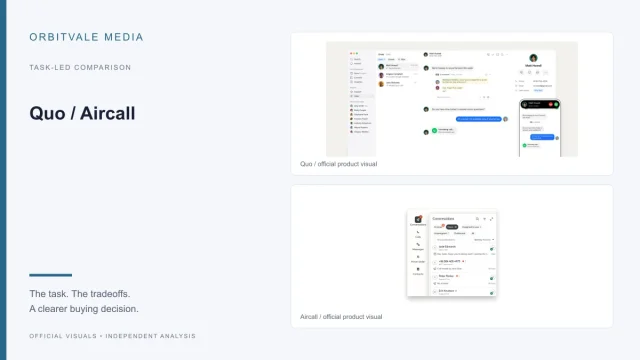
Use the difficult-call evidence to compare the required configuration. Quo is a useful candidate for shared business conversations with a practical small-team workflow. Aircall deserves investigation where coordinated team calling and connected records are central. The existing process may remain adequate when the real problem is unclear ownership rather than missing software.
Keep the comparison task stable: the same customer intents, devices, number needs, handoffs and complete cost. Do not compare a broad trial of one product with an entry plan of another. Confirm geographic and feature eligibility before interpreting interface preferences.
Write a conditional recommendation. For example, choose the candidate that preserves context and ownership at the required scope, provided the team can maintain the source information and callback capacity. State what would change the decision: another country, more specialized routing or a different CRM requirement.
The final buying record should contain the accepted cases, remaining limits, payable configuration and operating owner. A successful phone purchase makes customer work more dependable. It does not need to promise that every call is automated, every question resolved immediately or every administrative task removed.
Worked customer journey: a delayed parcel
Use a hypothetical customer who needs an order before a family event. The first call reaches the shared business number. The operator confirms the relevant identity through the business’s approved process and finds the order in the store system. The carrier record shows a delay, but it does not confirm delivery before the event.
The correct first outcome is an honest explanation and an owned investigation. Record the requested deadline, verified status and agreed next update. Do not mark the case complete simply because the first call ended politely. A later colleague should see both the customer’s need and the uncertainty.
Next, make the first operator unavailable. The second person should find the case, check the authoritative record and complete the promised update. If another solution is authorized, record who approved it. If no reliable new information exists, explain that fact and the next step rather than manufacturing reassurance.
This exercise assesses shared context, ownership and customer communication. It is not a test of whether the phone platform can control carrier performance. Keep the difference clear when judging value: better continuity can matter even when the underlying delivery issue remains outside the software’s control.
Worked customer journey: a new stockist
A retailer calls after seeing a product range online. The first operator learns the company, market and information requested. They provide approved public facts and avoid promising a bespoke discount. The case then goes to the person responsible for trade qualification.
The receiving representative should see the caller’s request and the source of the verified details. A completed call log without that context is an incomplete handoff. The next action might be sending the current range and arranging a short fit discussion, not automatically creating a large forecast opportunity.
Change one fact during the exercise: the retailer’s market is already covered by another arrangement, or the desired product is not available for the intended period. The route should preserve that limit and give the buyer an understandable response. An AI or scripted operator should not erase the exception to keep the conversation moving.
At the end, inspect the CRM or trade record. It should contain one coherent account, the actual request, owner and next action. This case makes the relationship between phone handling and sales qualification concrete. It also reveals whether an additional integration is useful or whether a clearer internal note convention solves the immediate problem.
Worked customer journey: an unsupported product question
A caller asks whether a product fits a use the approved material does not cover. The question sounds similar to a common supported use, which makes it a useful uncertainty test. A fluent assistant might be tempted to generalize. The desired response is to acknowledge the gap and route the question with enough detail for a qualified person.
Keep the relevant product and requested use in the handoff without collecting unnecessary information. The receiving person should know why the existing source was insufficient. They may need to consult a product owner rather than another general service agent.
After the answer is established, decide whether it belongs in maintained public material. If so, assign an owner and review the wording before adding it to the knowledge source. If the answer remains customer-specific, preserve that boundary instead of turning one exception into a general rule.
This journey evaluates the business’s learning process. A good result can be a clear escalation and later source improvement. It does not require the assistant to answer every question immediately. Use that distinction when assessing AI usefulness and the remaining human workload.
Keep a change log for call handling
Record a material routing, knowledge or ownership change with its reason and effective time. The team should be able to explain why a caller received one route yesterday and another today. A short change log is especially useful when several administrators can edit the configuration.
Before applying a change, identify the customer promise it affects and the cases to retest. A new after-hours instruction needs an after-hours call, not only a review of a settings screen. A knowledge update needs a question using the changed fact and another nearby question that should remain unchanged.
Keep a practical recovery route for an unsuccessful change. Use the provider’s supported configuration mechanisms and preserve the previous accepted state where possible. The objective is a controlled correction, not a complicated release process for every minor wording edit.
Review changes with the people handling calls. They may notice a repeated exception before a manager sees it in reporting. A maintained phone operation should turn those observations into specific source, staffing or routing improvements and check whether the change helped.
Use a retention and portability question in procurement
Ask which business records and accepted outputs the team can retain if the phone configuration changes later. Review the provider’s current export and access options for the actual plan. Do not assume that a readable history in the application is equivalent to a usable archive outside it.
Identify what the business truly needs: important customer promises, open tasks, account relationships and relevant evidence. Keep those facts in the appropriate authoritative system where practical. A CRM or order platform can preserve the customer action even when the phone service is replaced.
Test access with another authorized administrator rather than leaving the entire operating history dependent on one employee’s account. Document how ownership changes when staff leave. This is ordinary continuity work for a shared customer channel.
Include the likely transition effort in the buying discussion. Portability does not have to decide the purchase, but it should be an understood limit. A strong current workflow with a clear exit route is easier to maintain than a configuration nobody dares change because its records and responsibilities are unclear.
Review the combined channel journey
Customers can call, email and use website chat about the same request. The phone record is one view of that journey. Decide how staff recognize relevant related contact without assuming every similar name or number belongs to the same person.
Use a test customer who calls after sending a website question. The next operator should find the useful context or know where to look. Avoid a second independent promise that conflicts with the first response. The system integration may help, but clear case ownership remains necessary.
Keep channel-specific preferences and availability understandable. A person agreeing to a callback has not necessarily asked for ongoing promotional messages. A staff member should know which route was agreed for the next update and what to do if it fails.
This exercise can reveal that the biggest improvement lies in the service process rather than another phone feature. Quo should be judged on the part it can play in a coherent customer operation. The complete result is an accurate, owned continuation across the channels the business actually uses.
Sources, image credits and scope
OrbitVale’s analysis combines official product information with proposed operating exercises. We have not represented these exercises as hands-on tests, measured vendor results or customer case studies. Calculations use stated assumptions. Product and plan sources were reviewed on November 4, 2026.
Quo: Official overview · Current pricing · Supporting official source 1 · Supporting official source 2.
Official visuals are credited beside each figure; they are vendor-published material, not independent test screenshots. Interactive plan displays and account-specific terms can differ. Confirm checkout, region and required entitlements before purchasing. See our editorial method and commercial disclosure.