Practical guide · Proposed operations exercise · November 4, 2026
A customer promise passes through stock, orders and shipping. Each stage needs its own definition of completion. An item appearing on a shelf does not necessarily mean it is available; a label being printed does not mean it was dispatched; a returned parcel does not mean its contents can be resold.
This guide maps a hypothetical multichannel seller receiving products and sending parcels. Manufacturing adds a material-planning layer, which should be included only when the business actually makes or assembles goods.
Table of Contents
A completed handoff map
| Step | Accepted evidence | Owner question |
|---|---|---|
| Receiving | Expected, received and inspected quantity | Who resolves a partial or damaged delivery? |
| Inventory | Correct SKU, location and sellable state | Which system may publish availability? |
| Order | Accepted lines and reservation | How are simultaneous channel purchases handled? |
| Packing | Actual packed dimensions and weight | Who checks the parcel profile? |
| Label | Correct service and readable barcode | What happens after an address correction? |
| Dispatch | Carrier handover evidence | When may the customer be told it shipped? |
| Return | Inspection and commercial decision | When is stock restored and a refund authorized? |
Choose a system by the missing explanation
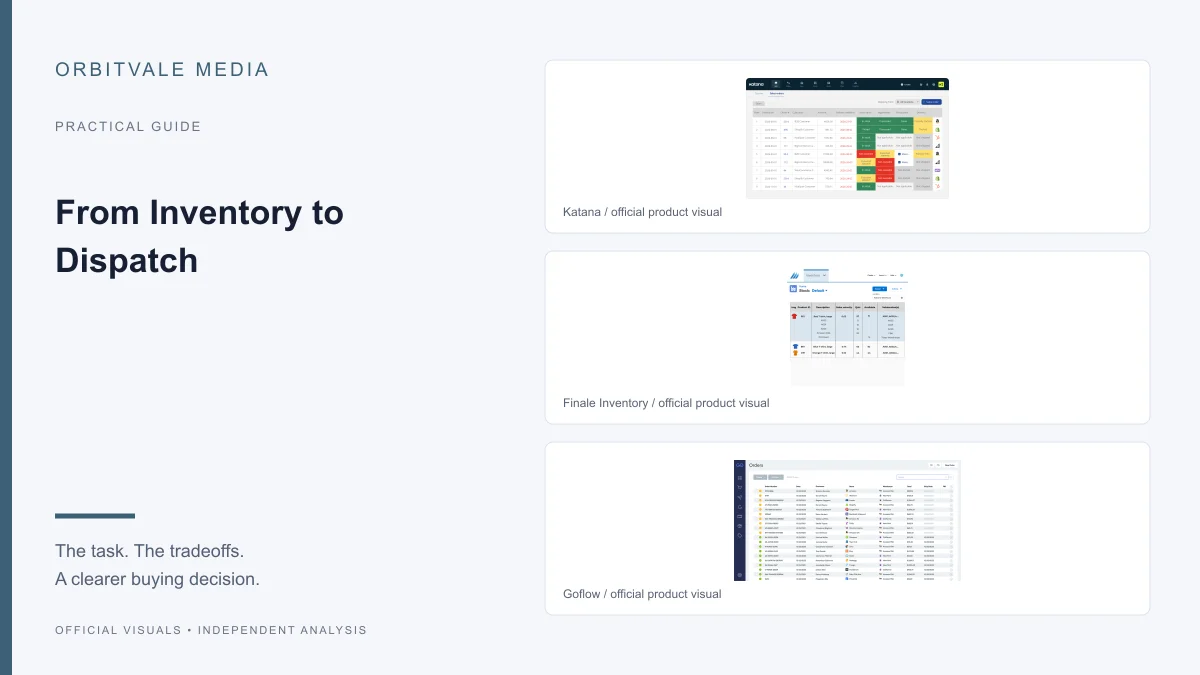
Katana is a relevant route when materials and production are the difficult part. Finale Inventory, Goflow and Unleashed deserve investigation around different stock and operations needs. Shippo and Sendcloud belong near the parcel and post-purchase layer. Their overlap does not make them universal substitutes.
Before adopting anything, ask the team to explain one problematic order using current records. The point where the explanation breaks is a useful starting requirement. Avoid importing the entire catalogue before agreeing on identifiers and opening balances.
Name the stock states
On hand, reserved, available, expected and quarantined describe different quantities. Decide which the storefront may promise. A returned item should not become available before inspection merely because a parcel arrived.
Keep locations meaningful to operators. A logical location that nobody uses physically makes reconciliation harder. Include transfers and temporary staging areas in the sample workflow.
Build an identifier dictionary
Connect supplier codes, internal SKUs, barcodes, marketplace identifiers and variants. One stable internal product identity reduces ambiguity when channel listings change. Bundles and multipacks require explicit component or unit rules.
Test a product with similar-looking variants. A quantity updating successfully is still wrong when it reaches the wrong size or pack. Keep the mapping owner and the date of the last change.
Reconcile the exception, not every screen
Compare the authoritative stock movements with receiving, fulfilment and channel records. Produce a small list of missing, duplicated or inconsistent identifiers that needs investigation.
Use adjustment reasons and appropriate authority. If staff routinely overwrite quantities to make an order work, the apparent accuracy can hide a process failure. Trace a sample variance back to a physical event.
Choose the right boundary for the system
A warehouse ledger, manufacturing planner and multichannel operations hub overlap but solve different primary jobs. Follow the movement that is hardest for the business to explain today.
Price the selected integrations and operating scope. Keep finance and operations involved where cost treatment matters. A shared definition of available stock is more valuable than another attractive dashboard.
Compare an equivalent parcel and service
Use packed weight, dimensions, origin and destination. Include the common parcel and a difficult case. A cheaper quote for a different service or ineligible route is not a like-for-like saving.
Separate software fees, postage, insurance and later adjustments. A label tool can expose choices, but the merchant still needs an accurate package profile and a reason for selecting the service.
Distinguish label, dispatch and delivery
A label being created does not prove carrier acceptance. A carrier scan does not prove the customer received an undamaged item. Keep these stages separate in the customer message and internal ledger.
Test what happens after an address correction, void or replacement label. The customer should not be left tracking an obsolete reference, and staff should know whether a postage refund is requested or completed.
Make the exception path visible
Define the response to a delayed parcel, failed delivery and missing tracking update. Give support the order, service and relevant event history without requiring several disconnected searches.
For returns, distinguish parcel receipt, item inspection, refund decision and restoration to sellable stock. An exchange can create a new shipment while the original order remains part of the case.
Reconcile the carrier bill
Use a sample period to compare purchased labels, voids, adjustments and carrier charges. Measurement errors often surface later than the original rate selection. Review the packed parcel process when adjustments recur.
The appropriate platform depends on supported origins, contracts, rules and post-purchase needs. A broad carrier list should lead to a route-specific trial, not an assumption that every service is available everywhere.
Separate material availability from finished availability
A finished product may be sellable now, in production or merely possible if materials arrive. Keep these states explicit. A shared component can constrain several products even when their individual demand looks manageable.
Use a real bill of materials with packaging and normal loss. Validate the quantities against actual production. If the source recipe is wrong, the planning system can calculate a precise answer to the wrong question.
Test partial work and substitution
Production rarely follows an ideal full-batch path every time. Include a partial completion, a damaged material and an approved substitute. Record who can authorize the change and how it affects stock and cost.
Avoid solving a physical discrepancy with an unexplained manual adjustment. The record should help the team learn whether the problem comes from consumption, receiving, measurement or the bill of materials.
Keep promised dates conditional on evidence
A material receipt date, production capacity and quality check can each change the earliest reliable dispatch. Make the source of the promise visible. A planned purchase is not the same as stock that passed receiving.
Use the pilot to identify which updates must happen promptly. If operators record completions only at the end of the week, the customer-facing availability cannot reasonably be treated as live.
Treat implementation as process work
Assign ownership for products, material recipes, locations and opening balances. A scoped contract should identify data cleanup, integrations, training and the support route after launch.
Start with a representative product family, reconcile physical quantities and expand when the team can explain every movement. The goal is dependable planning, not the fastest import of an entire catalogue.
Run one order through an exception
Use a partial receipt, an unavailable component, an address correction and a non-sellable return. Retain the identifiers linking each step. The test is complete when another operator can explain the physical movement and the customer-facing status without guessing.
Reconcile software and carrier charges after the sample period. A cleaner workflow may save handling time or prevent avoidable promises, but those benefits should be measured rather than assigned a speculative revenue value.
Sources, image credits and scope
OrbitVale’s analysis combines official product information with proposed operating exercises. We have not represented these exercises as hands-on tests, measured vendor results or customer case studies. Calculations use stated assumptions. Product and plan sources were reviewed on November 4, 2026.
Katana: Official overview · Current pricing.
Finale Inventory: Official overview · Current pricing.
Goflow: Official overview · Current pricing.
Shippo: Official overview · Current pricing.
Sendcloud: Official overview · Current pricing.
Official visuals are credited beside each figure; they are vendor-published material, not independent test screenshots. Interactive plan displays and account-specific terms can differ. Confirm checkout, region and required entitlements before purchasing. See our editorial method and commercial disclosure.