Research-based product review · 7 min read · Source check: November 4, 2026
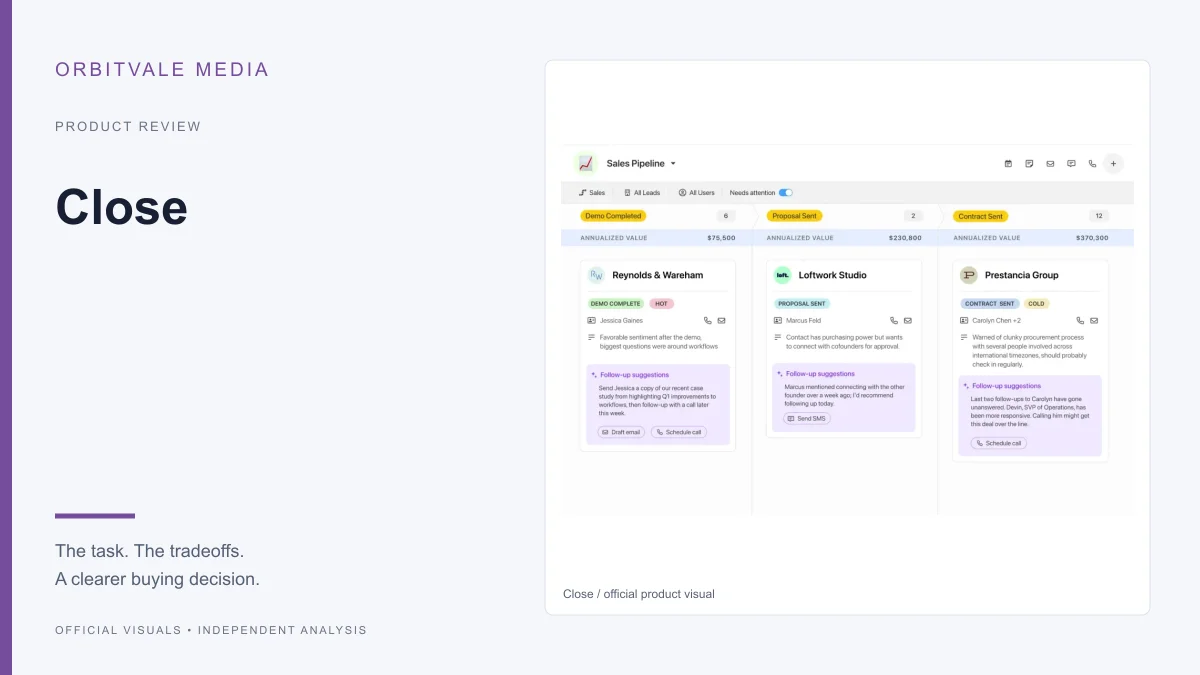
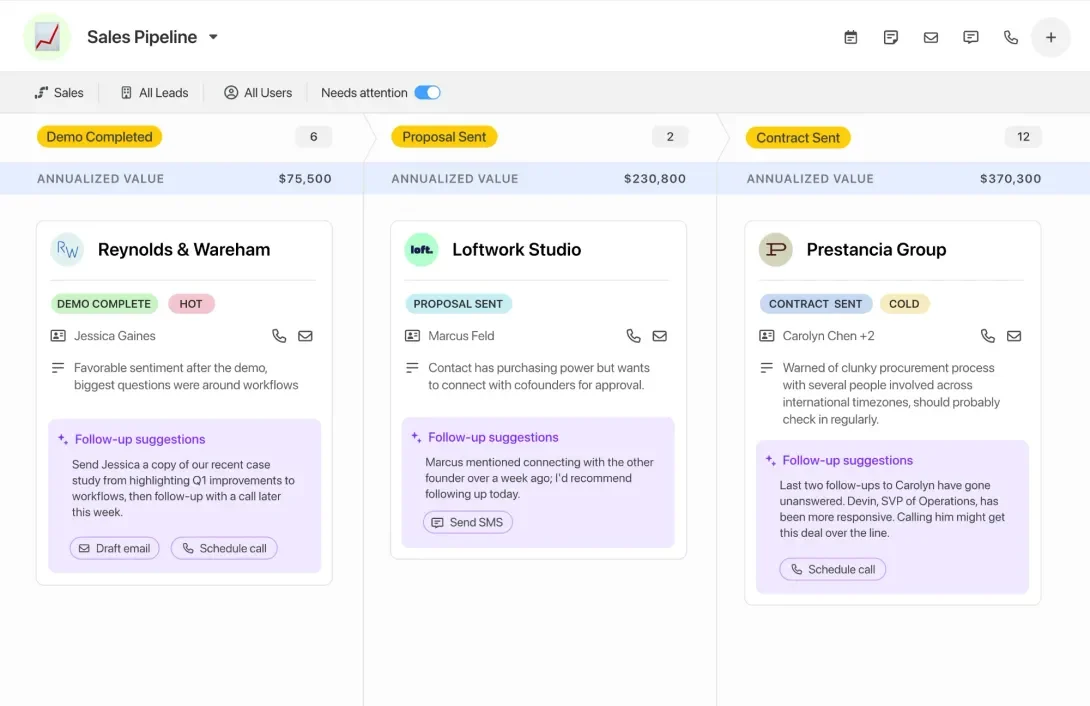
Close deserves consideration when representatives spend much of their day contacting prospects and updating the same opportunity context. Combining CRM and communication can reduce movement between applications. The important test is whether the next representative can understand what happened and make the right next move.
We would evaluate it with the team’s real call and email pattern. A communications-heavy sales process may value this focus; a business needing a different account model or specialist service workflow should test the fit. Current entry pricing does not establish that every automated workflow or calling requirement is included.
Table of Contents
The buying decision
| Put it on the shortlist when | Choose another route when |
|---|---|
| A sales team with frequent calls and emails that wants opportunity context close to daily communication. | A team choosing on a seat price without modelling communication usage, or one requiring a specialist non-sales case-management process. |
A realistic job for Close
A supplier follows up with trade buyers after a product event. The proposed pilot combines an email, a call outcome and a scheduled next action, then hands the account to another representative before the buyer replies.
What the capabilities mean in practice
CRM workflow
Close offers CRM tools focused on sales work. Official product overview.
Check lead, contact and opportunity organization against the team’s actual account relationships.
Communication
Calling and email are central to the product proposition. Official product overview.
Model the destination and use pattern. A software seat is only one part of the communication bill.
Automation
Current plans distinguish workflow capabilities. Official product overview.
The current pricing places automated workflows above Essentials. Verify the tier needed for the sequence rather than assuming entry-plan parity.
Reporting
The offering includes sales activity and performance views. Official product overview.
Use metrics that explain useful conversations and progress, not only attempts.
Current plan boundaries
Per-user tiers plus communication usage and AI credits. Solo is limited to one user and 10,000 leads. Essentials adds team collaboration; automated workflows and the power dialer start in Growth in the current table. Official plan source.
- Solo and Essentials do not include Workflows; a cheap entry seat is not a complete automated outbound stack.
- AI credit pools refresh monthly without rollover and vary by tier. Check calling, SMS and additional-credit charges for the target regions.
The snapshot above is tied to the review date. Promotions, billing interval, location and account migration can change the payable amount. The decision below uses the cost drivers rather than pretending a headline fee describes every configuration.
A practical evaluation sequence
Use the following as a proposed pilot. Keep source inputs and accepted outputs so another person can review the result. The sequence is designed around the task above; it is not a claim that OrbitVale ran an account test.
1. Map the sales day
List the calls, emails and CRM updates actually performed. Identify where the current handoff loses context.
2. Create representative accounts
Include several contacts at one company and a pre-existing customer relationship.
3. Run a complete follow-up
Record the communication and the customer’s stated next step. Use the tools the representative expects to operate daily.
4. Stop a sequence on reply
Test an interested reply, a wrong person and a request for no further contact.
5. Hand over the relationship
Ask another representative to find the promise made and the next action without an oral briefing.
6. Model the team bill
Use the required tier, seats and communication destinations, including the busy period.
The operating details that decide the fit
Make stages describe evidence
A useful stage explains what is known about a customer decision. “Sample requested” can be meaningful; “hot” is subjective unless the team agrees what it means. Define entry and exit conditions with a real example.
Keep a short pipeline initially. More stages can create administrative movement without improving the sales conversation. Add detail when it changes an action or forecast.
Give every active opportunity a next action
An owner, action and date are the minimum useful follow-up record. The action should describe a real next step, not simply “follow up” repeated forever. If the customer has no reason to continue, close or pause the opportunity honestly.
Review overdue work and missing owners. A CRM can make gaps visible, but a manager still needs to resolve capacity and priorities.
Preserve account context through handoff
Several people can belong to one buying organization. Keep their roles, messages and promises understandable. Deduplicate carefully so one account does not receive unrelated outreach from several representatives.
Test a colleague taking over without an oral briefing. They should find the customer’s actual request, the latest commitment and the next action.
Separate activity from commercial progress
Calls, emails and completed tasks describe effort. Qualification, accepted next steps and a decision describe customer progress. Use both kinds of measures without pretending they are interchangeable.
Price the actual seats, communication and automation requirements. A smaller maintained CRM can be more useful than a broad stack whose records nobody trusts.
Tradeoffs and reasons to reject the fit
Usage surprises
Calls, messages and related services may add variable costs. Use the actual destination mix.
Sequence overreach
Automation should stop when the customer changes the conversation.
Wrong account model
A fast daily interface is less useful if the business relationship cannot be represented clearly.
Pricing the complete job
Seats, workflows and communication
A three-person team should price the plan containing its actual automation, then add calling and messaging usage. If the integrated routine saves twelve minutes per representative each workday, the illustrative gross benefit is twelve hours in a 20-day month. Include the work needed to maintain clean account records.
| Cost line | Include in the estimate |
|---|---|
| Required subscription | Use the tier that contains the actual workflow and record currency, billing interval and team size. |
| Variable services | Count the real billing unit and separately priced carrier, payment, communication or model services. |
| Setup and change | Include source cleanup, integration, training and the first meaningful revision. |
| Review and exceptions | Budget the people who approve outputs, investigate discrepancies and complete customer follow-up. |
| What disappears | Only count a saving when the old subscription or manual task can actually be retired. |
Keep a normal-month estimate and a busy-month estimate. Use the same accepted outcome in both. If the tool produces an intermediate draft, alert, record or label, include the remaining work needed to complete the customer or publishing task. Replace the example assumptions with your own observed figures after the pilot.
Alternatives and the boundary between jobs
Pipedrive
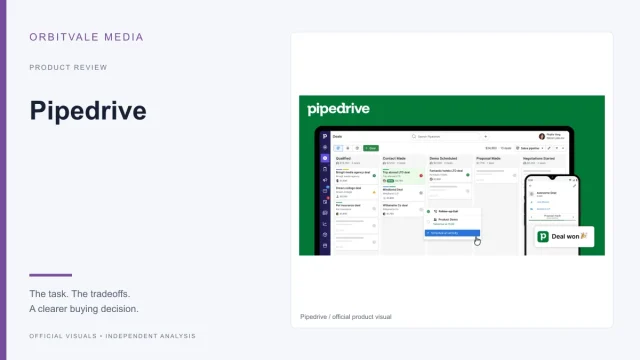
Read the Pipedrive review. A small sales team managing opportunities, activities and customer context with explicit ownership.
Pipedrive fits a business that knows it needs a reliable sales process but does not want opportunity follow-up scattered across inboxes and memory. A visual pipeline is useful when stages describe evidence about a deal and every active opportunity has an owner and next action. Moving cards is not progress unless the customer relationship changes.
Reply.io
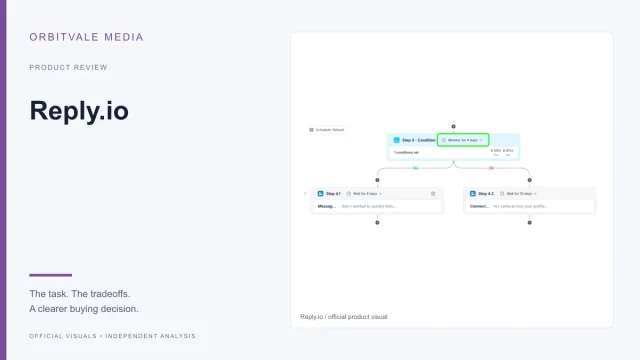
Read the Reply.io review. A B2B team managing structured follow-up with maintained prospect data and accountable reply handling.
Reply.io is relevant when a sales team wants to coordinate outreach and follow-up across the channels it actually uses. The potential benefit is a clearer sequence of work and response handling. The danger is an automated routine that continues after the prospect has already changed the conversation.
Aircall
Read the Aircall review. A sales or support team needing a more coordinated phone operation and connected customer context.
Aircall belongs on a shortlist when a business phone operation needs shared handling, routing and connections to sales or service records. The core buying problem is coordination: who answers, what context they see and who owns the next action when the first person cannot resolve the request. A phone integration should be evaluated through a complete customer conversation.
A decision record to keep
For Close, record the selected account and plan, the specific job, the accepted output and the unresolved limitation. The acceptance decision should explain whether “usage surprises” is manageable for this business. Name the owner of the next review and preserve the result of the changed-case exercise, not only the easiest first pass.
Our recommendation
Close is worth a deliberate trial when this describes your business: A sales team with frequent calls and emails that wants opportunity context close to daily communication. The case is weaker when this remains true: A team choosing on a seat price without modelling communication usage, or one requiring a specialist non-sales case-management process. Start with the bounded scenario, price the complete job and expand after the team can explain the exceptions. Open the official Close website.
Sources, image credits and scope
OrbitVale’s analysis combines official product information with proposed operating exercises. We have not represented these exercises as hands-on tests, measured vendor results or customer case studies. Calculations use stated assumptions. Product and plan sources were reviewed on November 4, 2026.
Close: Official overview · Current pricing.
Official visuals are credited beside each figure; they are vendor-published material, not independent test screenshots. Interactive plan displays and account-specific terms can differ. Confirm checkout, region and required entitlements before purchasing. See our editorial method and commercial disclosure.