Practical guide · Hypothetical procurement worksheet · November 4, 2026
Software comparisons become confusing when prices use different units and the team never defines an accepted result. A practical buying record connects the job, required plan, variable services and remaining human work. It should be short enough to update after a pilot.
This worksheet can be used for automation, marketing or creative software. It does not assume the most expensive tool is better or that the cheapest subscription creates the lowest total cost. The question is which configuration completes the task dependably at an acceptable operating burden.
Table of Contents
A completed example: trade inquiry routing
| Field | Example decision record |
|---|---|
| Job | Turn a valid trade inquiry into one assigned CRM follow-up |
| Source | Form submission with stable identifier and permission wording |
| Accepted output | Correct account, useful summary, owner and next-action date |
| Exception | Existing customer submits again while the destination is unavailable |
| Candidate routes | n8n and Make |
| Essential check | Replay without duplicating the opportunity |
| Cost denominator | Accepted inquiries after review, not raw executions |
| Change owner | Named operations maintainer and backup person |
Use a regular-year view
Separate introductory promotions from recurring prices. Annual billing can lower a displayed monthly equivalent while increasing commitment. Include the next audience or volume band if ordinary growth would reach it. A free allowance is useful only when the required feature and operating scope are included.
Record what the purchase actually retires. If the old spreadsheet and manual reconciliation remain essential, do not count their full cost as savings. A new tool may still improve accuracy, but that benefit should be described and evidenced separately.
Five cost lines
| Line | Question |
|---|---|
| Subscription | Which plan and how many users contain the required workflow? |
| Variable use | What real action, credit, contact, parcel or message is charged? |
| Setup | What source cleanup, integration and training are required? |
| Operation | Who reviews, corrects and completes the exceptions? |
| Exit | Which records and accepted outputs remain usable if the tool changes? |
Use an event ledger, not only a success counter
A useful automation ledger has an event ID, source, received time, workflow version, destination ID and final state. An operator should be able to distinguish waiting, rejected, partially completed and accepted work. A green execution can still be commercially incomplete when the destination record lacks its owner or a customer message was never approved.
For a store integration, use the order or submission identifier as part of the identity rule. If the same event arrives twice, the second delivery should be recognizable. Do not rely on a timestamp alone: two events can share a time, and the same event can be retried later. The ledger is also how the team explains why a correction ran without repeating a payment, email or task.
Put a contract around the AI step
Treat a model response as suggested data. Define required fields, allowed values and an explicit uncertainty outcome. For example, a request classifier can return product question, order question, trade inquiry or needs review. It should not invent an order identifier to satisfy a schema. Validate referenced products and amounts against their source system.
Keep the prompt and knowledge version with the result where practical. If a product description changes, the reviewer needs to know which version informed an earlier draft. Avoid logging unnecessary customer details simply because debugging is easier with a complete payload. The minimum useful record should explain the decision and support recovery.
Reconcile what the trigger did not reveal
Webhooks and polling are mechanisms for learning about change, not proof that every record arrived. A small scheduled reconciliation can compare source identifiers with accepted destination identifiers and produce an exception list. It should not blindly replay every source record into systems where side effects already occurred.
Assign one person to review failures and another documented route when they are unavailable. Set an operational expectation based on the business promise: an internal daily report can wait longer than an order-blocking exception. The appropriate alert is a useful record with the next action, not dozens of identical failure emails.
Know what self-hosting would transfer
Hosting control comes with patching, access, secrets, database protection and recovery. Before selecting a deployment route, ask who can restore the system and where the last accepted event is recorded. A backup that has never been restored is an incomplete recovery plan.
The commercial comparison should include engineering time and an interruption scenario. It may still favour a self-managed system when control and custom integration matter. It may favour managed hosting when the business has no infrastructure owner. Neither answer follows from the subscription line alone.
Make stages describe evidence
A useful stage explains what is known about a customer decision. “Sample requested” can be meaningful; “hot” is subjective unless the team agrees what it means. Define entry and exit conditions with a real example.
Keep a short pipeline initially. More stages can create administrative movement without improving the sales conversation. Add detail when it changes an action or forecast.
Give every active opportunity a next action
An owner, action and date are the minimum useful follow-up record. The action should describe a real next step, not simply “follow up” repeated forever. If the customer has no reason to continue, close or pause the opportunity honestly.
Review overdue work and missing owners. A CRM can make gaps visible, but a manager still needs to resolve capacity and priorities.
Preserve account context through handoff
Several people can belong to one buying organization. Keep their roles, messages and promises understandable. Deduplicate carefully so one account does not receive unrelated outreach from several representatives.
Test a colleague taking over without an oral briefing. They should find the customer’s actual request, the latest commitment and the next action.
Separate activity from commercial progress
Calls, emails and completed tasks describe effort. Qualification, accepted next steps and a decision describe customer progress. Use both kinds of measures without pretending they are interchangeable.
Price the actual seats, communication and automation requirements. A smaller maintained CRM can be more useful than a broad stack whose records nobody trusts.
A decision can be conditional
Write the assumption that would reverse the choice. A higher event volume, another editor, stricter export requirement or loss of the technical owner can change the preferred route. That is a useful buying conclusion, not a weakness in the comparison.
If the pilot exposes an unclear process, fix that before expanding software. The result may be a smaller scope or a delayed purchase. Keep the source inputs and changed-case evidence so the next review can begin from what was learned.
Sources, image credits and scope
OrbitVale’s analysis combines official product information with proposed operating exercises. We have not represented these exercises as hands-on tests, measured vendor results or customer case studies. Calculations use stated assumptions. Product and plan sources were reviewed on November 4, 2026.
n8n: Official overview · Current pricing · Supporting official source 1 · Supporting official source 2.
Make: Official overview · Current pricing.
Pipedrive: Official overview · Current pricing.
Close: Official overview · Current pricing.
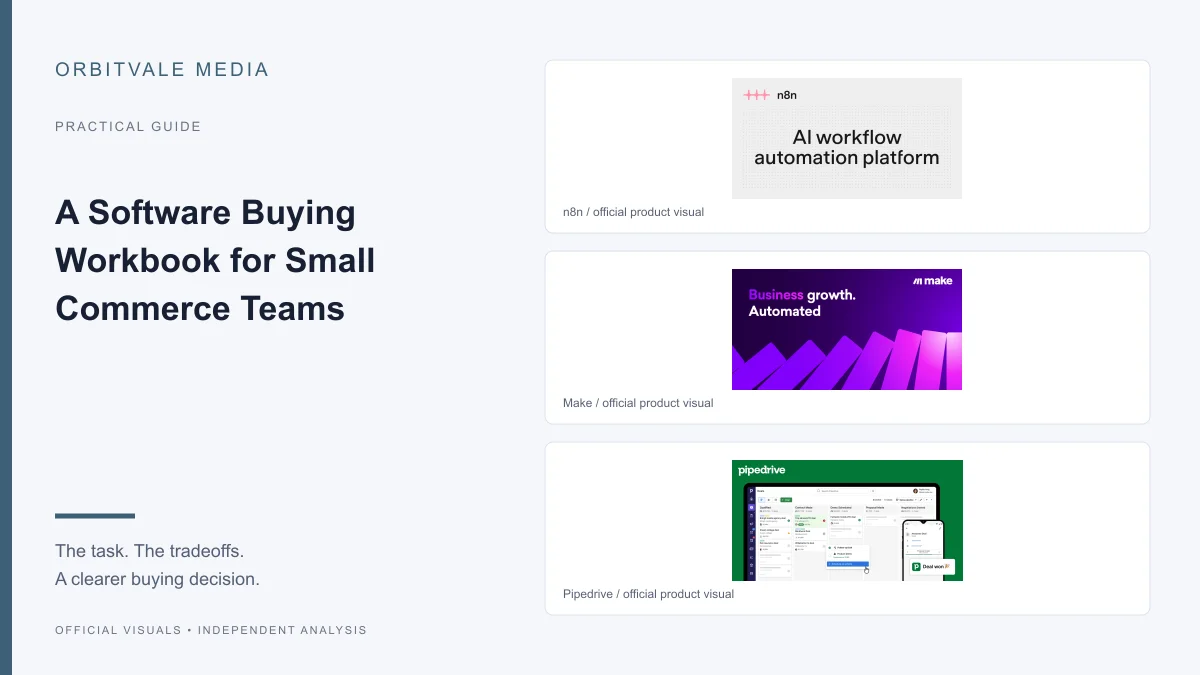
Official visuals are credited beside each figure; they are vendor-published material, not independent test screenshots. Interactive plan displays and account-specific terms can differ. Confirm checkout, region and required entitlements before purchasing. See our editorial method and commercial disclosure.