Research-based product review · 7 min read · Source check: November 4, 2026
Atria is relevant when an ecommerce team needs a more organized creative research and production process. A collection of ads becomes useful when the team can explain the customer problem, message and visual mechanism behind a reference. Copying a visible execution does not establish why it worked or whether it fits another product.
We would evaluate the path from saved inspiration to an original brief and measurable campaign variant. Keep observed competitor content separate from inferred performance. The current product also has AI and account-related plan limits, so compare the exact research and production workload rather than an old generic subscription quote.
Table of Contents
The buying decision
| Put it on the shortlist when | Choose another route when |
|---|---|
| A marketer or creative team producing recurring ad tests and willing to maintain a reasoned brief and learning record. | A plan to copy competitor assets, assume visible ads are profitable or generate factual product claims without review. |
A realistic job for Atria
A pet accessories brand studies how advertisers explain cleaning effort. The proposed workflow saves references, identifies the customer objection and produces an original demonstration using the brand’s real product. The hypothesis concerns clarity of the explanation, not an invented competitor return on ad spend.
What the capabilities mean in practice
Creative research
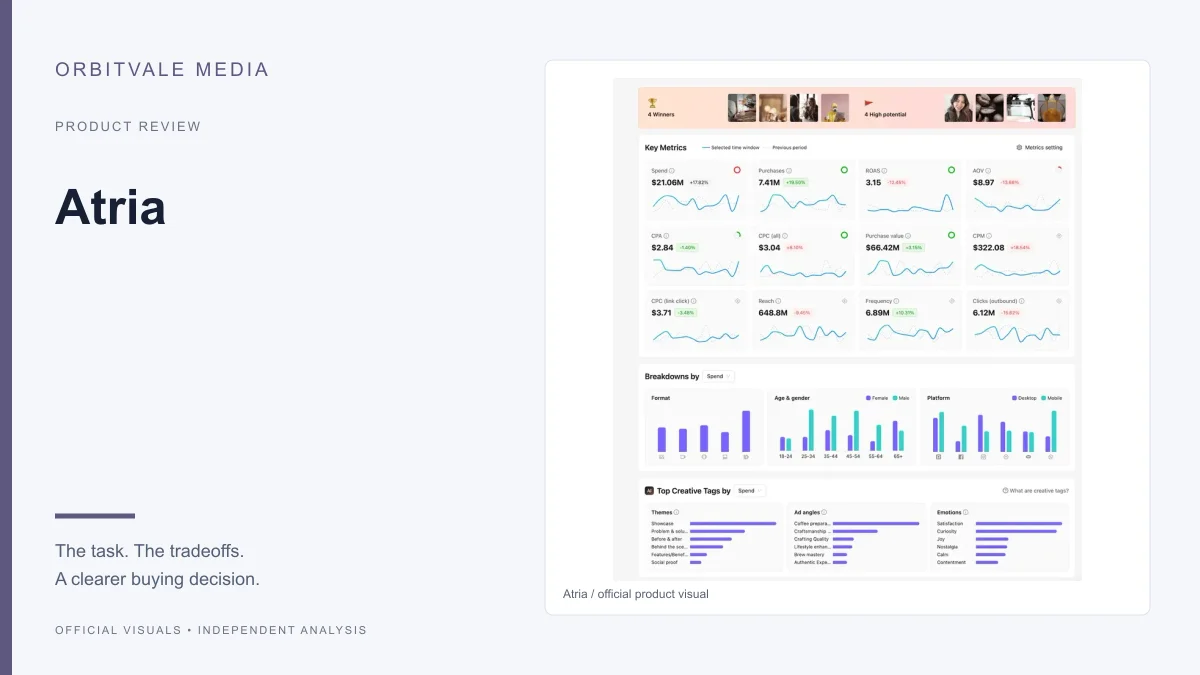
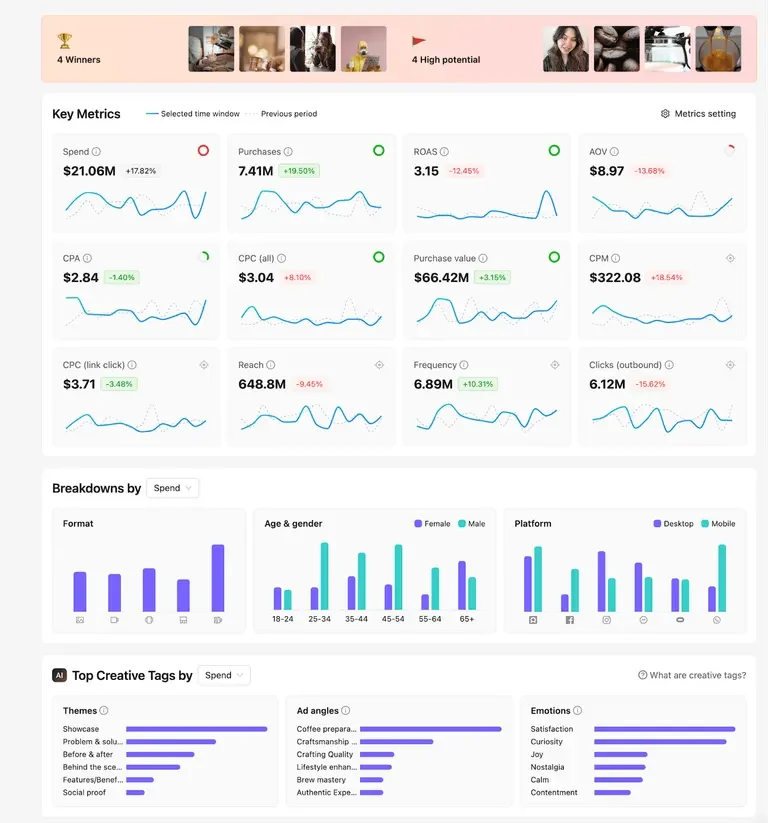
Atria offers ad research and creative workflow tools. Official product overview.
Save the reason a reference is relevant. A large inspiration library without a question becomes another backlog.
AI production
The current offering includes AI-assisted creative capabilities. Official product overview.
Keep product truth in an approved brief. Generated assets and copy need separate factual and rights review.
Connected advertising needs
Plans distinguish account and advertising-related usage. Official product overview.
Confirm the exact ad accounts, data scope and spending limits required for the team.
Creative organization
The product supports a more organized research-to-output process. Official product overview.
Keep the reference, original hypothesis, approved asset and observed test result connected.
Current plan boundaries
Core/Plus/Business/Enterprise plans vary in AI credits, connected accounts, analyzed ad spend, followed brands, storage, seats and API/MCP limits. At the shown annual setting Core is $129/month equivalent with 4,000 AI credits/month, five connected ad accounts and five seats. Monthly and renewal terms should be confirmed. Official plan source.
- Core's followed-brand feature does not include AI insights in the current table; API/MCP and storage allowances also vary.
- An observed competitor advertisement or AI-generated variant does not establish profitability, permission to reuse assets, or causation.
The snapshot above is tied to the review date. Promotions, billing interval, location and account migration can change the payable amount. The decision below uses the cost drivers rather than pretending a headline fee describes every configuration.
A practical evaluation sequence
Use the following as a proposed pilot. Keep source inputs and accepted outputs so another person can review the result. The sequence is designed around the task above; it is not a claim that OrbitVale ran an account test.
1. Choose a customer objection
Use a real question such as cleanup, installation or compatibility. Avoid starting with a fashionable visual effect.
2. Collect a small reference set
Record source, date and the mechanism being studied. Do not imply knowledge of undisclosed performance.
3. Write an original brief
Translate the mechanism into your product’s real demonstration and brand language.
4. Review generated material
Check product appearance, wording and permissions. Replace invented evidence with actual footage or photography.
5. Create a controlled variant
Change one meaningful element while keeping the offer and audience assumptions reviewable.
6. Record the learning
Use the actual campaign result and its limits. Save what the team would change next, not just the final asset.
The operating details that decide the fit
Save the mechanism, not only the ad
For each reference, write the customer objection, message structure and visual action being studied. Keep the source and observation date. A large saved library becomes useful when it answers a question.
Do not infer undisclosed spend, profitability or incrementality from an ad being visible. Treat performance explanations as hypotheses unless evidence supports them.
Translate inspiration into an original brief
Use your own product truth, source footage and brand language. The useful lesson may be how a demonstration clarifies installation, not another advertiser’s exact wording or visual asset.
Write the hypothesis so the team can evaluate it later. “Show the cleaning action before the offer” is testable; “make it look viral” is not a clear production instruction.
Keep generation behind factual review
An AI draft can introduce a claim, endorsement or product feature the source material never supported. Review copy and visuals separately against the approved brief.
Use real demonstration footage where physical accuracy matters. A generated context scene can be useful when it does not imply documentary proof.
Record what the test taught
Keep the approved asset, audience assumptions, spend period and observed result together. State the limits of a small or uncontrolled comparison.
Measure useful accepted tests and the time needed to prepare them. A larger folder of drafts is not necessarily a faster learning cycle, and a rejected idea can still improve the next brief if its reason is retained.
Tradeoffs and reasons to reject the fit
Visibility mistaken for success
An active ad is not proof of profitability or incrementality.
Imitation without fit
A borrowed execution may solve another audience’s objection and create an unoriginal brand.
Unreviewed claims
Generated creative can imply benefits or endorsements absent from the source material.
Pricing the complete job
Research, AI credits and useful tests
If a team produces twelve variants but only four reach an approved campaign, divide research, generation and review cost by four accepted tests. Include selected ad accounts and current AI limits. The aim is a faster learning cycle, not a larger folder of unused drafts.
| Cost line | Include in the estimate |
|---|---|
| Required subscription | Use the tier that contains the actual workflow and record currency, billing interval and team size. |
| Variable services | Count the real billing unit and separately priced carrier, payment, communication or model services. |
| Setup and change | Include source cleanup, integration, training and the first meaningful revision. |
| Review and exceptions | Budget the people who approve outputs, investigate discrepancies and complete customer follow-up. |
| What disappears | Only count a saving when the old subscription or manual task can actually be retired. |
Keep a normal-month estimate and a busy-month estimate. Use the same accepted outcome in both. If the tool produces an intermediate draft, alert, record or label, include the remaining work needed to complete the customer or publishing task. Replace the example assumptions with your own observed figures after the pilot.
Alternatives and the boundary between jobs
Jasper
Read the Jasper review. A marketing team with recurring campaigns, maintained source material and an editor accountable for the final claims.
Jasper is relevant when marketing production is a repeatable team process rather than an occasional request for text. Brand context and coordinated drafting can help a team keep several assets aligned. The buying question is whether that environment reduces factual corrections and editorial rework enough to justify a dedicated platform.
Canva AI
Read the Canva AI review. A small marketing team creating recurring social, email, presentation and print assets with shared brand rules.
Canva AI is most interesting as part of a broad design workflow: marketing teams can move between generated ideas, templates and familiar publishing formats in one environment. That can reduce handoffs for recurring campaign assets. Its breadth also requires restraint, because every generated variation can become another inconsistent brand file if the team has no approved template.
DataHawk
Read the DataHawk review. An Amazon or Walmart-oriented team needing maintained marketplace analysis with defined metrics and source ownership.
DataHawk is relevant when marketplace operators need a more deliberate view of performance data across products, advertising and commerce operations. Its value is the ability to ask consistent business questions from an understood data model. A dashboard cannot settle whether two reports use the same attribution window, fee treatment or product identity.
A decision record to keep
For Atria, record the selected account and plan, the specific job, the accepted output and the unresolved limitation. The acceptance decision should explain whether “visibility mistaken for success” is manageable for this business. Name the owner of the next review and preserve the result of the changed-case exercise, not only the easiest first pass.
Our recommendation
Atria is worth a deliberate trial when this describes your business: A marketer or creative team producing recurring ad tests and willing to maintain a reasoned brief and learning record. The case is weaker when this remains true: A plan to copy competitor assets, assume visible ads are profitable or generate factual product claims without review. Start with the bounded scenario, price the complete job and expand after the team can explain the exceptions. Open the official Atria website.
Sources, image credits and scope
OrbitVale’s analysis combines official product information with proposed operating exercises. We have not represented these exercises as hands-on tests, measured vendor results or customer case studies. Calculations use stated assumptions. Product and plan sources were reviewed on November 4, 2026.
Atria: Official overview · Current pricing.
Official visuals are credited beside each figure; they are vendor-published material, not independent test screenshots. Interactive plan displays and account-specific terms can differ. Confirm checkout, region and required entitlements before purchasing. See our editorial method and commercial disclosure.