Research-based product review · 15 min read · Source check: November 4, 2026
Unbounce is worth considering when a marketer needs to build and improve dedicated landing pages without routing every campaign edit through a full website release. Faster page production can help a team test a clear offer and audience. The meaningful result is the quality of the downstream action, not simply a higher count of form submissions.
We would begin with one real campaign, an agreed conversion definition and the actual receiving CRM or store. Test the mobile page, attribution and duplicate handling before splitting traffic. A testing feature does not create valid evidence when the offer, audience and measurement change at the same time.
Table of Contents
The buying decision
| Put it on the shortlist when | Choose another route when |
|---|---|
| A marketing team running focused acquisition campaigns with a clear offer and a maintained downstream lead or purchase process. | A business with no useful conversion definition, insufficient representative traffic or an expectation that a page builder will fix an unclear offer. |
A realistic job for Unbounce
A wholesale food brand offers a sample consultation to qualified retailers. The proposed evaluation connects the form to a CRM, excludes existing customers from duplicate opportunities and distinguishes submitted forms from accepted trade leads.
What the capabilities mean in practice
Page building
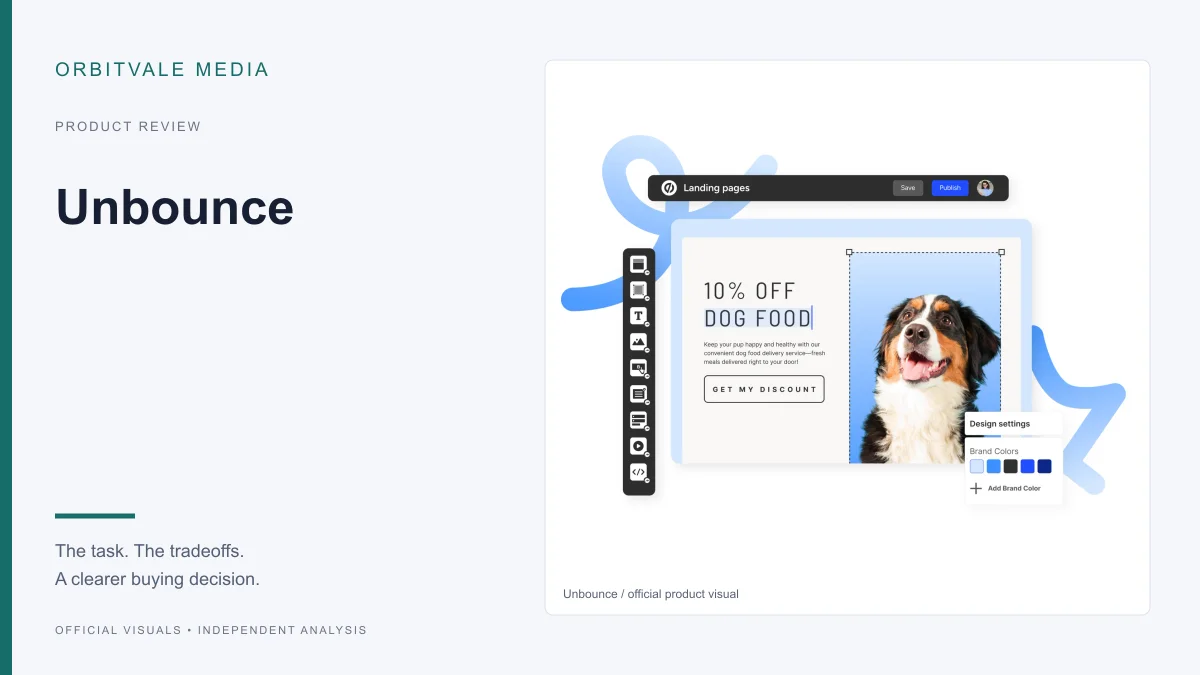
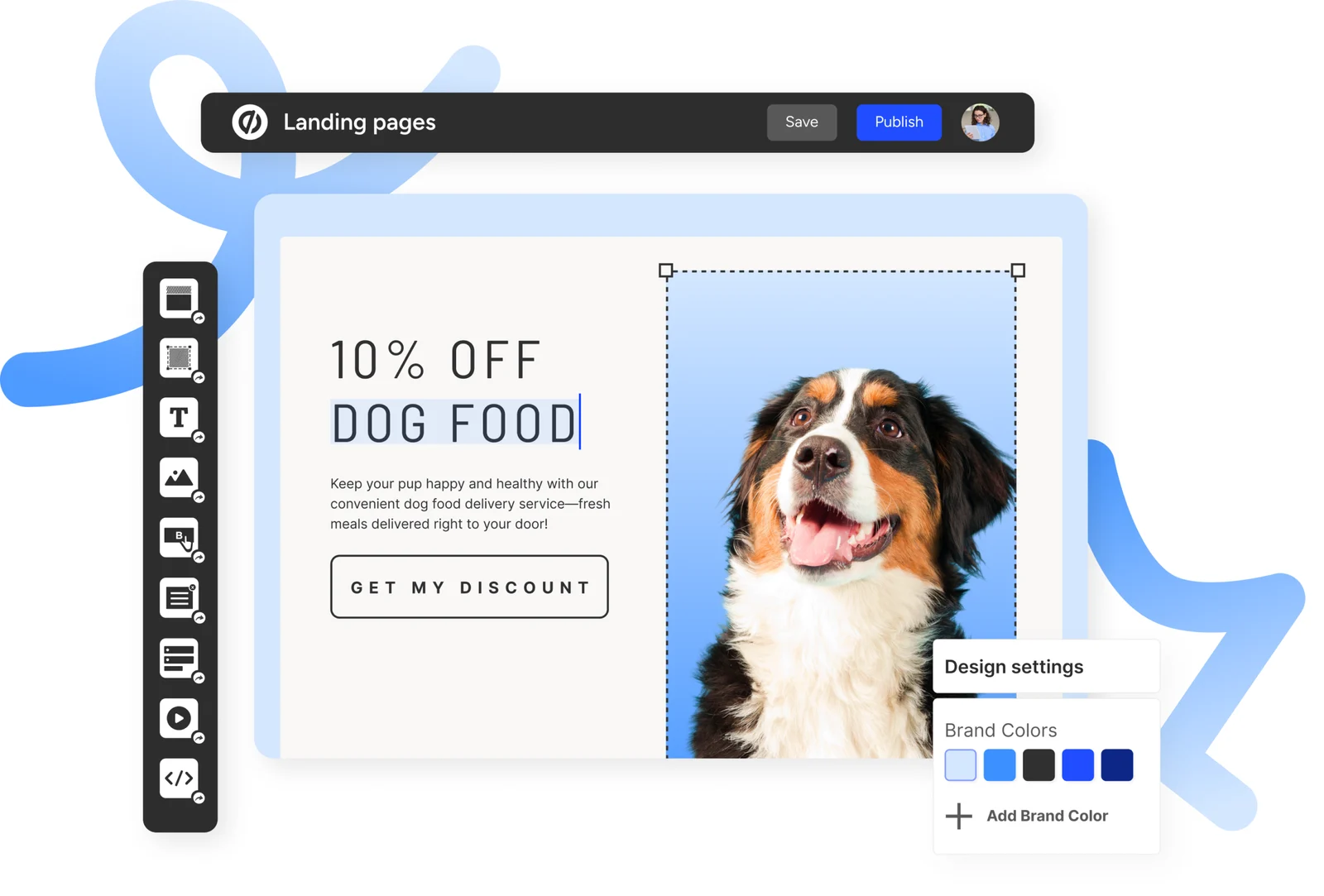
Unbounce provides landing-page creation tools. Official product overview.
Build the actual mobile offer, including long labels, errors and a useful confirmation state.
Testing
The platform offers page optimization and testing capabilities. Official product overview.
Agree the hypothesis and conversion event before launch. Avoid changing several commercial assumptions in a supposedly controlled comparison.
Conversion routes
Pages can connect to wider marketing workflows. Official product overview.
Inspect the destination record and assignment. A thank-you page is not proof that a lead reached a salesperson.
Plan limits
Pricing distinguishes traffic and feature requirements. Official product overview.
Model visitors, pages, domains and required optimization tools using the current plan.
Current plan boundaries
The current public lineup is Starter, Build, Experiment, Optimize, Concierge and Agency. Traffic allowance, root domains, users, AI credits and feature entitlement determine capacity; unlimited conversions does not mean unlimited traffic. Official plan source.
- Starter currently lists five pages, traffic volume up to 500, one user/domain and 4,000 AI credits. Build adds unlimited pages and custom code with higher traffic capacity.
- Unlimited A/B testing begins in Experiment, while AI traffic routing is listed in Optimize. Do not imply these are entry-plan functions.
- All plans list unlimited subdomains, but root-domain limits still apply. Ads, CRM/email software and the offer itself remain separate from landing-page hosting.
The snapshot above is tied to the review date. Promotions, billing interval, location and account migration can change the payable amount. The decision below uses the cost drivers rather than pretending a headline fee describes every configuration.
A practical evaluation sequence
Use the following as a proposed pilot. Keep source inputs and accepted outputs so another person can review the result. The sequence is designed around the task above; it is not a claim that OrbitVale ran an account test.
1. Write one hypothesis
State the customer objection and the change expected to address it. Keep the offer and audience reviewable.
2. Define accepted conversion
For a trade offer, distinguish a form submission from an eligible qualified lead.
3. Build the full mobile path
Include validation, missing fields, confirmation and the return route to relevant information.
4. Inspect downstream records
Check identity, source, consent and assigned next action in the receiving system.
5. Run a stable comparison
Use agreed traffic and measurement, record changes and avoid premature conclusions from a few events.
6. Review quality and economics
Compare qualified outcomes, staff response capacity and contribution rather than raw submission count.
The operating details that decide the fit
Define the accepted conversion
A form submission, verified lead and customer are different events. Decide which result the page is meant to create and how the receiving team confirms it. Use the same definition across variants.
The confirmation state should explain what happens next. A prospect waiting for a call needs an honest expectation, while a resource request needs working access to the promised material.
Test the whole mobile journey
Use long names, missing fields, validation errors and a slow connection. Check that the page remains readable and the action is understandable before optimizing decorative details.
Follow the data into the receiving system. Source, consent, identity and owner matter more than an attractive thank-you page. Duplicate submissions should not create repeated opportunities without a rule.
Keep an experiment interpretable
Write one hypothesis and identify the meaningful change. Record audience, traffic source, conversion event and timing. If the offer or tracking changes, preserve that fact in the analysis.
Avoid a confident winner from a few events. Use the traffic and business context to decide what the comparison can reasonably establish. Sometimes the useful finding is a data or lead-quality issue rather than a design preference.
Connect acquisition to response capacity
A page can generate more inquiries than the team can handle. Assign the next action and monitor the time to a useful response. A lead that expires in a queue has not completed the acquisition job.
Price advertising, page software, integrations and human qualification together. A higher raw conversion rate can be poor value when accepted lead quality falls.
Tradeoffs and reasons to reject the fit
Proxy conversions
A form count can rise while qualified leads fall. Measure the actual business outcome.
Measurement drift
Changing tracking or the offer during a comparison weakens interpretation.
Traffic assumptions
Plan capacity and meaningful experiment evidence depend on real visitor volume and quality.
Pricing the complete job
Visitors, qualified outcomes and response capacity
If 2,000 visitors produce 100 submissions but only 30 accepted leads, the useful denominator is 30 for a lead-quality cost estimate. Add advertising, page subscription and response time. A variant with 120 submissions and 20 accepted leads is not automatically the better page.
| Cost line | Include in the estimate |
|---|---|
| Required subscription | Use the tier that contains the actual workflow and record currency, billing interval and team size. |
| Variable services | Count the real billing unit and separately priced carrier, payment, communication or model services. |
| Setup and change | Include source cleanup, integration, training and the first meaningful revision. |
| Review and exceptions | Budget the people who approve outputs, investigate discrepancies and complete customer follow-up. |
| What disappears | Only count a saving when the old subscription or manual task can actually be retired. |
Keep a normal-month estimate and a busy-month estimate. Use the same accepted outcome in both. If the tool produces an intermediate draft, alert, record or label, include the remaining work needed to complete the customer or publishing task. Replace the example assumptions with your own observed figures after the pilot.
Alternatives and the boundary between jobs
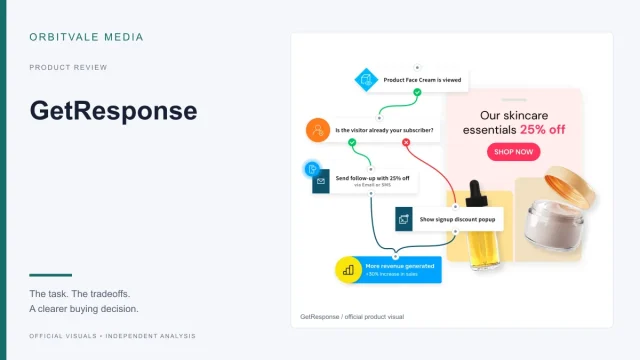
GetResponse
Read the GetResponse review. A small ecommerce or knowledge business combining acquisition pages with permission-based email and a manageable automation programme.
GetResponse is a sensible shortlist when email marketing and lead capture currently live in disconnected tools. Forms, landing pages and automations can support one customer journey from initial interest to a useful follow-up. The important question is whether the chosen plan covers the actual journey, including ecommerce events and the maintenance of customer permission.
Moosend
Read the Moosend review. A small marketing team needing recurring email and selected automations without unnecessary operational complexity.
Moosend is relevant to a small business that wants a manageable email campaign and automation workflow. Its value should be judged through the recurring newsletter, segmentation and follow-up the team actually needs. A focused programme can be easier to maintain than an ambitious platform rollout when there is only one person responsible for marketing.
Pipedrive
Read the Pipedrive review. A small sales team managing opportunities, activities and customer context with explicit ownership.
Pipedrive fits a business that knows it needs a reliable sales process but does not want opportunity follow-up scattered across inboxes and memory. A visual pipeline is useful when stages describe evidence about a deal and every active opportunity has an owner and next action. Moving cards is not progress unless the customer relationship changes.
A decision record to keep
For Unbounce, record the selected account and plan, the specific job, the accepted output and the unresolved limitation. The acceptance decision should explain whether “proxy conversions” is manageable for this business. Name the owner of the next review and preserve the result of the changed-case exercise, not only the easiest first pass.
Our recommendation
Unbounce is worth a deliberate trial when this describes your business: A marketing team running focused acquisition campaigns with a clear offer and a maintained downstream lead or purchase process. The case is weaker when this remains true: A business with no useful conversion definition, insufficient representative traffic or an expectation that a page builder will fix an unclear offer. Start with the bounded scenario, price the complete job and expand after the team can explain the exceptions. Open the official Unbounce website.
A worked lead-quality example
Consider two hypothetical versions of a wholesale sample page. Version A receives 1,000 comparable visitors and produces 50 submissions, of which the sales team accepts 20 as suitable trade leads. Version B receives another 1,000 comparable visitors and produces 65 submissions, but only 13 are accepted. The raw form rate rises from 5% to 6.5%; the accepted-lead rate falls from 2% to 1.3%. The apparent winner depends on the event being measured.
If advertising cost is an assumed $800 per version, the media-only cost per accepted lead is $40 for A and approximately $61.54 for B. Add page software, qualification time and any sample cost before estimating the full economics. These numbers illustrate a decision method, not an Unbounce experiment or a suggested universal target.
The quality decline might come from unclear eligibility, an overly broad promise or a different traffic mix. Do not diagnose the cause from the totals alone. Inspect the submitted information and compare the source assumptions. If the audiences were materially different, describe the observation without presenting it as a controlled page effect.
Write a hypothesis that a page can actually test
A useful hypothesis names a customer objection and the change expected to address it. For example: retailers are unsure whether a consultation is intended for their order size, so clearly stating the minimum commercial fit may improve the share of accepted inquiries. This is more useful than “make the page convert better” because it explains why a change belongs on the page.
Choose the evidence needed to interpret the result. Keep the qualification definition stable and have the receiving team apply it consistently. If the sales manager changes what counts as an accepted lead halfway through the period, preserve that change in the record. A page test cannot remain interpretable when its outcome definition shifts silently.
Avoid combining a new headline, another offer, a different audience and a revised qualification form into one supposedly isolated layout test. Such a campaign can still produce useful business evidence, but the result concerns the combined change. Write that scope honestly rather than assigning the improvement to the page builder.
Design the form around the receiving decision
Ask for information that changes what the business will do next. A trade application may need company identity, market and a practical order requirement. Asking for many fields without a clear purpose adds friction and creates data the team must maintain. Asking too little can push the burden into a long qualification call.
Use clear labels, appropriate input types and helpful errors. A visitor should understand why a required field is missing and how to fix it. Test a long company name, an international phone format and a legitimate answer that does not fit a short dropdown. The form should represent real customers rather than the internal database’s easiest examples.
Review the mobile keyboard and the error position. A message appearing far above the field can be easy to miss. Preserve already entered information after validation where the implementation allows it. The full path should include an honest confirmation: who will respond, through which route and what the visitor can do while waiting.
Inspect the destination before counting a success
Use a stable submission identifier and inspect the record created in the receiving system. Check source, campaign, permission wording, company identity and assigned owner. A successful redirect proves only that the browser reached another page; it does not prove a salesperson received a usable inquiry.
Submit twice with the same test identity. Decide whether the second event updates an existing request or creates a new one. Include an existing customer whose inquiry belongs to account management rather than acquisition. Avoid a duplicate opportunity simply because a customer needed the form twice.
Make the receiving integration temporarily unavailable in a safe test environment. Determine where the submission waits, who is alerted and how it is recovered. Recovery should preserve the original event and avoid sending several confirmations. The practical value of the landing page depends partly on this handoff, even when another product implements it.
Use an experiment log that survives a busy week
Record the hypothesis, dates, audience source, page version, conversion definition and any material changes. Keep the person responsible for interpreting the result visible. A compact shared record is usually more useful than an elaborate document nobody updates.
Distinguish technical checks from experiment evidence. A form working on a phone establishes basic readiness. It does not establish that the message will attract the right visitor or improve qualified outcomes. Likewise, a strong early result from a small number of events is a reason to investigate, not automatically a dependable forecast.
Agree how the team will handle sparse traffic before opening the results. A small business may learn more from customer interviews, usability observation or a longer stable campaign than from frequent variant changes. A testing capability is valuable when the team can use it to answer a sensible question.
Budget the response queue alongside acquisition
Suppose a campaign is expected to produce 40 accepted leads a week, each needing twelve minutes for a useful initial response. That is eight hours of weekly work before longer sales conversations. If one person has only three hours available, a higher form rate can worsen the customer experience by lengthening the queue.
Use the lead-quality model to decide which inquiries need immediate personal attention, which need missing information and which should receive a polite alternative. Keep the source promise consistent with that capacity. Do not advertise a same-day consultation if the operating team cannot reasonably provide it.
For the software estimate, include current visitor allowances, relevant domains, pages, required optimization features and receiving integrations. Separate temporary discounts from regular pricing. The meaningful comparison is the complete acquisition process at the intended volume, not the entry fee of a page editor.
A practical acceptance record for the pilot
A completed record might read: the mobile page communicates the trade offer, the form accepts representative customer data, the receiving CRM contains one correctly assigned opportunity and an existing customer is routed to the right owner. The duplicate and unavailable-destination cases have been demonstrated. Remaining uncertainty concerns audience demand, which requires campaign evidence rather than another technical check.
Keep screenshots or retained versions of the actual page and the destination record with appropriate test data. Record the account plan used, because a feature demonstrated in a trial may not belong to the tier intended for ongoing use. Ask a second marketer to change the offer date and verify the full path again.
This acceptance record makes a buying discussion concrete. If the workflow passes but the programme lacks traffic or a useful offer, postpone broader optimization claims. If the handoff fails, repair it before spending more on acquisition. The page tool should support the business experiment rather than become a substitute for defining it.
Separate usability evidence from commercial evidence
A usability session can reveal that a visitor cannot understand eligibility, find an error or identify the next step. It does not estimate the conversion rate of the full audience. A campaign result can show a pattern in accepted leads, but it may not explain why an individual visitor hesitated. Use each method for the question it can answer.
For the hypothetical trade page, ask an unfamiliar person to explain who the consultation is for and what happens after submission. Do not lead them toward the intended interpretation. If they think the offer is a free product sample when it is a qualification discussion, the page needs clearer language before a larger traffic test.
Retain the observation and change the relevant wording. Then check the full path again, including the receiving team’s response. Improving comprehension is useful even before enough traffic exists for a dependable commercial comparison. Describe that improvement as observed understanding in the limited exercise, not a guaranteed revenue result.
Use a launch checklist tied to the customer promise
Before launch, confirm the domain, working links, readable mobile layout, form validation, confirmation, receiving record and assigned owner. Check the current offer date and any qualification that affects eligibility. Use representative test data and remove it from operational reporting when the exercise ends.
Record which checks passed and which remain unresolved. A team should know whether an open issue affects basic operation, lead quality or interpretation of a test. A small visual imperfection and a lost CRM submission deserve different priorities.
After launch, inspect the first appropriate submissions and the response queue. The page may be technically correct while an audience misunderstands the offer. Keep a change log so corrections do not silently alter the experiment. Unbounce is most useful when the team treats page production, measurement and lead handling as one maintained workflow.
A stable result can still be useful
A comparison may show no clear improvement within the available evidence. That does not mean the work failed. The team may have learned that both versions communicate the offer adequately, that the audience is too small for a strong rate conclusion or that lead qualification creates more variation than the page change.
Write what the evidence supports and what it does not. Keep a stable version when the alternative adds complexity without a demonstrated benefit. The next useful question may concern the offer or traffic source rather than another visual variant.
Use qualitative observations to guide that next question, while keeping them separate from a numerical performance claim. A visitor misunderstanding eligibility is a concrete problem to fix even if the overall submission count appears unchanged. The page programme becomes more valuable when its learning record prevents repeated guesses and unnecessary redesigns.
Sources, image credits and scope
OrbitVale’s analysis combines official product information with proposed operating exercises. We have not represented these exercises as hands-on tests, measured vendor results or customer case studies. Calculations use stated assumptions. Product and plan sources were reviewed on November 4, 2026.
Unbounce: Official overview · Current pricing.
Official visuals are credited beside each figure; they are vendor-published material, not independent test screenshots. Interactive plan displays and account-specific terms can differ. Confirm checkout, region and required entitlements before purchasing. See our editorial method and commercial disclosure.