Research-based product review · 7 min read · Source check: November 4, 2026
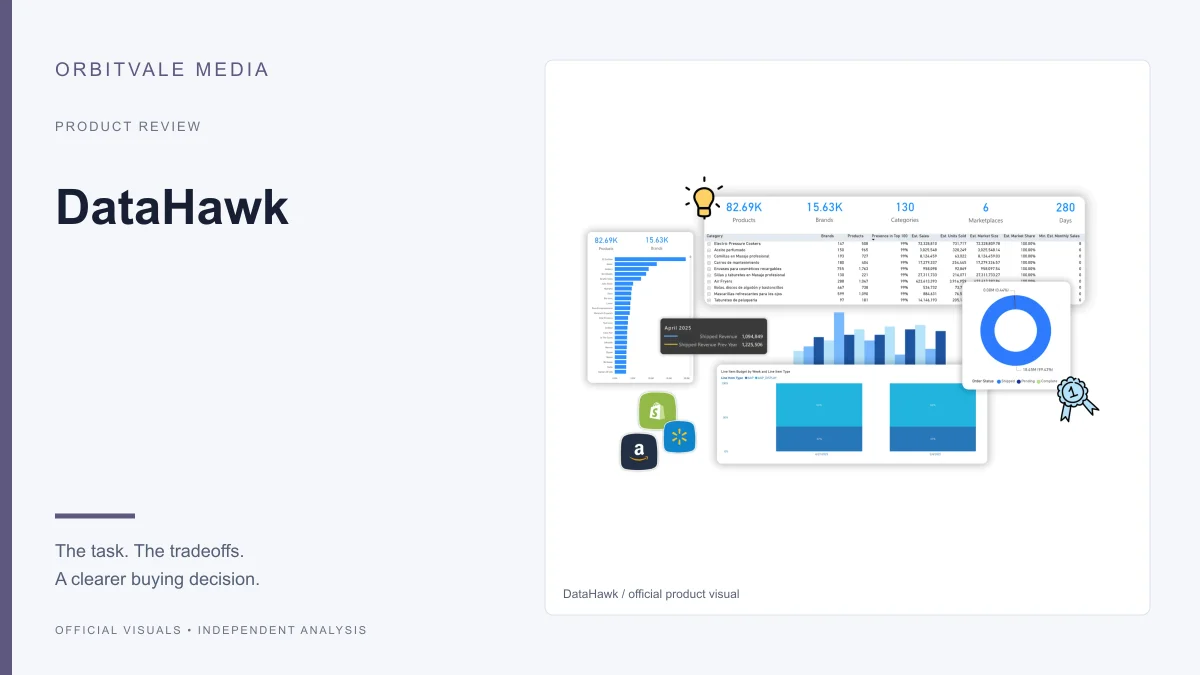
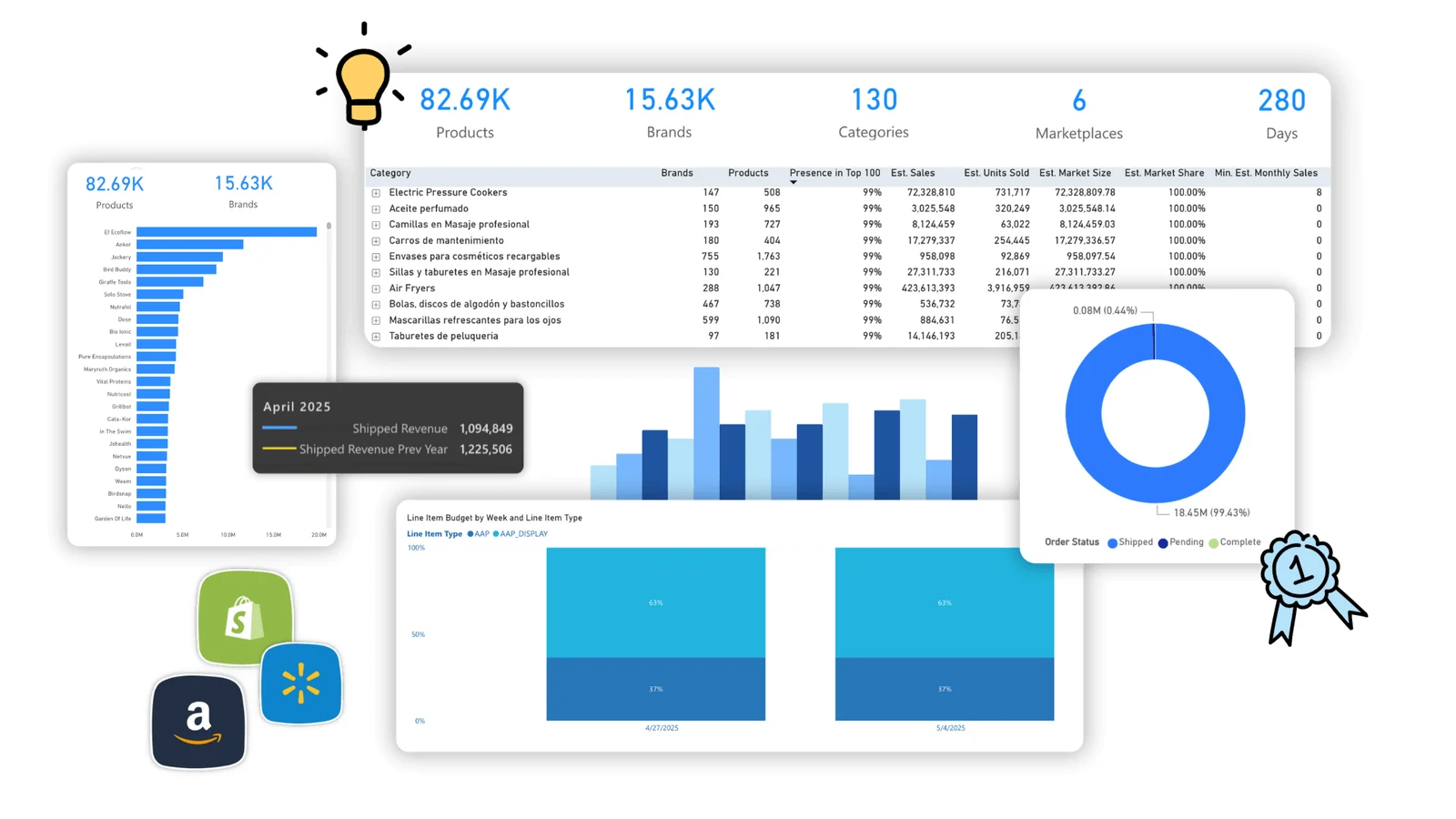
DataHawk is relevant when marketplace operators need a more deliberate view of performance data across products, advertising and commerce operations. Its value is the ability to ask consistent business questions from an understood data model. A dashboard cannot settle whether two reports use the same attribution window, fee treatment or product identity.
We would start with one management decision: which product deserves attention and why? Reconcile a small set of figures with the underlying marketplace reports before building an executive view. The best reporting system reduces unexplained differences rather than simply adding more charts.
Table of Contents
The buying decision
| Put it on the shortlist when | Choose another route when |
|---|---|
| An Amazon or Walmart-oriented team needing maintained marketplace analysis with defined metrics and source ownership. | A merchant expecting a dashboard to repair missing costs or make causal advertising claims from attributed revenue alone. |
A realistic job for DataHawk
A home electronics seller compares two marketplace products. One has higher sales but more returns and ad spend. The proposed trial reconciles revenue, fees and advertising periods before deciding which product’s apparent performance is actually useful.
What the capabilities mean in practice
Marketplace analysis
DataHawk offers ecommerce and marketplace data capabilities. Official product overview.
Confirm supported accounts, markets and data sources for the real operation.
Performance reporting
The platform presents dashboards and analytical workflows. Official product overview.
Define revenue, profit and return measures explicitly. Similar chart labels can hide different accounting treatments.
Advertising context
Official positioning includes advertising-related analysis. Official product overview.
Keep attributed sales separate from total sales and causal lift. Match time windows before comparing ratios.
Data delivery
The offering includes connected data and reporting needs. Official product overview.
Validate refresh timing, exports and ownership of the metric dictionary before relying on a recurring report.
Current plan boundaries
Custom annual plans tailored to marketplace data requirements. The affiliate page notes that clients commonly sign at least one-year contracts. Get the number of accounts, marketplaces, SKUs, metrics, history and data access scoped in a quote. Official plan source.
- The current pricing page does not publish a universal monthly starting price.
- Do not claim that combined metrics automatically establish net profit or causal advertising lift; source definitions, fees, returns and reporting latency still matter.
The snapshot above is tied to the review date. Promotions, billing interval, location and account migration can change the payable amount. The decision below uses the cost drivers rather than pretending a headline fee describes every configuration.
A practical evaluation sequence
Use the following as a proposed pilot. Keep source inputs and accepted outputs so another person can review the result. The sequence is designed around the task above; it is not a claim that OrbitVale ran an account test.
1. Choose one decision
For example, identify products with rising sales but weakening contribution. Avoid building every possible dashboard first.
2. Define the metrics
Write treatment of refunds, fees, taxes, currencies and ad attribution windows.
3. Reconcile a sample
Compare a small period and SKU set with original marketplace exports. Explain differences before scaling.
4. Test identity mapping
Follow a parent and variant relationship across reports. Confirm merged or changed listings remain understandable.
5. Review freshness
Record when data becomes complete enough for the decision. A partially updated morning should not be mistaken for a final day.
6. Assign an action owner
A report should lead to investigation or a decision, with a way to record what changed.
The operating details that decide the fit
Publish a metric dictionary internally
Define revenue, fees, refunds, product cost and advertising attribution before creating a management view. Record currency and time zone. Two reports with the same title can legitimately use different periods or accounting treatments.
Assign an owner to every important metric. When a number changes, the team should be able to explain whether the business changed or the definition did.
Reconcile a small source sample
Choose a short period and a few products, then compare the report with original marketplace exports. Explain differences before adding more accounts. A beautiful dashboard should not hide a missing source.
Keep parent, variant and changed-listing identities clear. A merged product can make a trend look like growth when the underlying reporting scope changed.
Distinguish attribution from cause
Attributed advertising revenue reflects the platform’s rules. It is not automatically incremental revenue. Keep attribution windows and total sales visible when comparing ratios.
For profit analysis, include relevant product, marketplace, fulfilment and return costs. Revenue minus ad spend is a partial measure, not necessarily full contribution.
Connect a report to an action
A useful weekly view identifies which products need investigation, who will investigate and what decision follows. Record the action and later observation so the reporting process learns.
Set expectations for data freshness. An incomplete recent day should not trigger a confident conclusion. Include reconciliation and metric maintenance in the platform’s operating cost.
Tradeoffs and reasons to reject the fit
Metric mismatch
Two valid systems can disagree because definitions differ. Make the difference explicit.
Incomplete margin
Revenue minus advertising is not full profit when product costs, fees and returns are missing.
Attribution certainty
Attributed revenue is not proof of incrementality. Keep causal claims proportionate to evidence.
Pricing the complete job
Coverage, reporting and decision value
If a weekly report currently takes four hours and a maintained data route reduces it to one, the illustrative gross saving is 12 hours over four weeks. Deduct reconciliation and metric maintenance. Obtain the quote for actual accounts and data needs, and avoid assigning speculative revenue gains to a dashboard.
| Cost line | Include in the estimate |
|---|---|
| Required subscription | Use the tier that contains the actual workflow and record currency, billing interval and team size. |
| Variable services | Count the real billing unit and separately priced carrier, payment, communication or model services. |
| Setup and change | Include source cleanup, integration, training and the first meaningful revision. |
| Review and exceptions | Budget the people who approve outputs, investigate discrepancies and complete customer follow-up. |
| What disappears | Only count a saving when the old subscription or manual task can actually be retired. |
Keep a normal-month estimate and a busy-month estimate. Use the same accepted outcome in both. If the tool produces an intermediate draft, alert, record or label, include the remaining work needed to complete the customer or publishing task. Replace the example assumptions with your own observed figures after the pilot.
Alternatives and the boundary between jobs
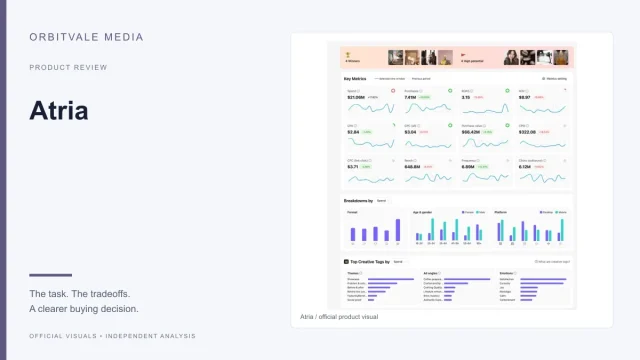
Atria
Read the Atria review. A marketer or creative team producing recurring ad tests and willing to maintain a reasoned brief and learning record.
Atria is relevant when an ecommerce team needs a more organized creative research and production process. A collection of ads becomes useful when the team can explain the customer problem, message and visual mechanism behind a reference. Copying a visible execution does not establish why it worked or whether it fits another product.
Goflow
Read the Goflow review. A multichannel merchant coordinating marketplace orders, stock and shipping across several operating steps.
Goflow is relevant when a business’s operational problem crosses marketplaces, inventory and fulfilment. Bringing order activity into a coherent workflow can reduce repeated data entry and unclear handoffs. The harder issue is deciding which system owns stock and how the team recovers when a marketplace or carrier update arrives late.
Unleashed
Read the Unleashed review. A growing wholesale or product business needing stronger inventory, purchasing and connected commercial controls.
Unleashed is worth investigating when purchasing, stock and commercial reporting need a more structured relationship. A wholesale or product business may need to understand not just how many units exist, but where they are, what they cost and whether committed orders can be fulfilled. The correct shortlist depends on the operational scope and the accounting connection required.
A decision record to keep
For DataHawk, record the selected account and plan, the specific job, the accepted output and the unresolved limitation. The acceptance decision should explain whether “metric mismatch” is manageable for this business. Name the owner of the next review and preserve the result of the changed-case exercise, not only the easiest first pass.
Our recommendation
DataHawk is worth a deliberate trial when this describes your business: An Amazon or Walmart-oriented team needing maintained marketplace analysis with defined metrics and source ownership. The case is weaker when this remains true: A merchant expecting a dashboard to repair missing costs or make causal advertising claims from attributed revenue alone. Start with the bounded scenario, price the complete job and expand after the team can explain the exceptions. Open the official DataHawk website.
Sources, image credits and scope
OrbitVale’s analysis combines official product information with proposed operating exercises. We have not represented these exercises as hands-on tests, measured vendor results or customer case studies. Calculations use stated assumptions. Product and plan sources were reviewed on November 4, 2026.
DataHawk: Official overview · Current pricing.
Official visuals are credited beside each figure; they are vendor-published material, not independent test screenshots. Interactive plan displays and account-specific terms can differ. Confirm checkout, region and required entitlements before purchasing. See our editorial method and commercial disclosure.