Research-based product review · 7 min read · Source check: November 4, 2026
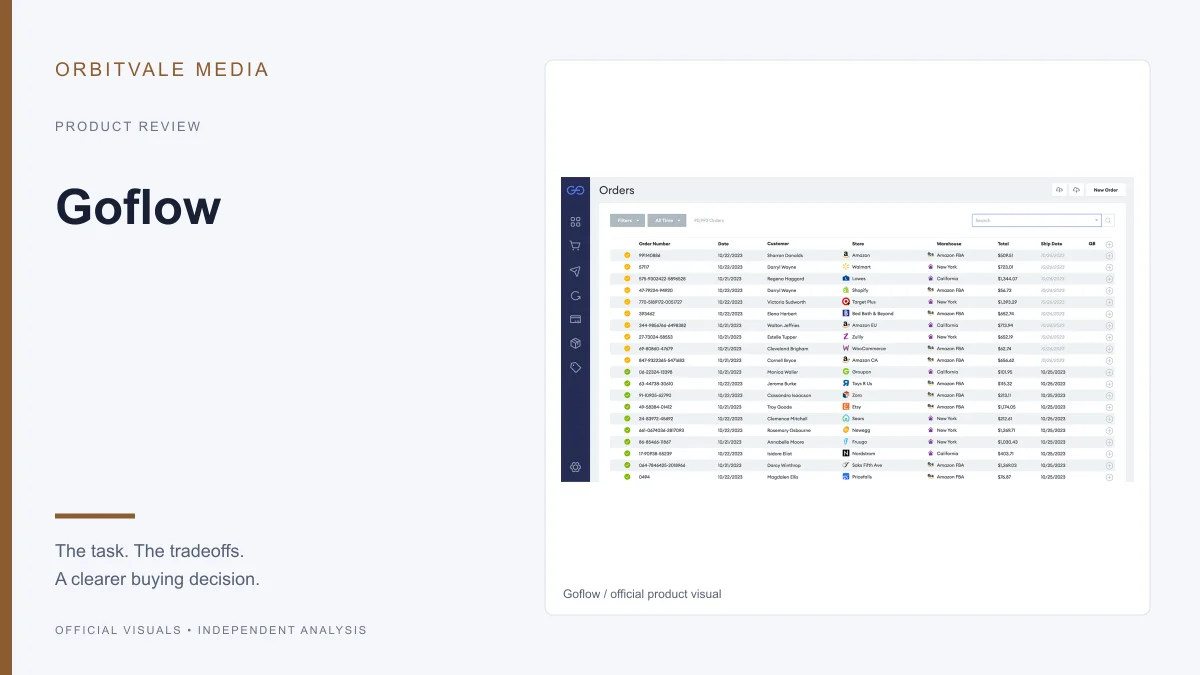
Goflow is relevant when a business’s operational problem crosses marketplaces, inventory and fulfilment. Bringing order activity into a coherent workflow can reduce repeated data entry and unclear handoffs. The harder issue is deciding which system owns stock and how the team recovers when a marketplace or carrier update arrives late.
We would shortlist it for a seller with meaningful channel complexity and an operations owner. Test the same SKU across two channels, a partial shipment and a cancelled line. A broad integration list is useful only after the actual connector behaviour and exception process are understood.
Table of Contents
The buying decision
| Put it on the shortlist when | Choose another route when |
|---|---|
| A multichannel merchant coordinating marketplace orders, stock and shipping across several operating steps. | A simple single-channel store with no meaningful coordination problem, or a team expecting every connector to behave identically. |
A realistic job for Goflow
A household goods seller receives orders from a store and two marketplaces. The proposed pilot includes simultaneous purchases of the last item, an address correction and a split shipment. The operator should know which system can change each piece of information.
What the capabilities mean in practice
Order coordination
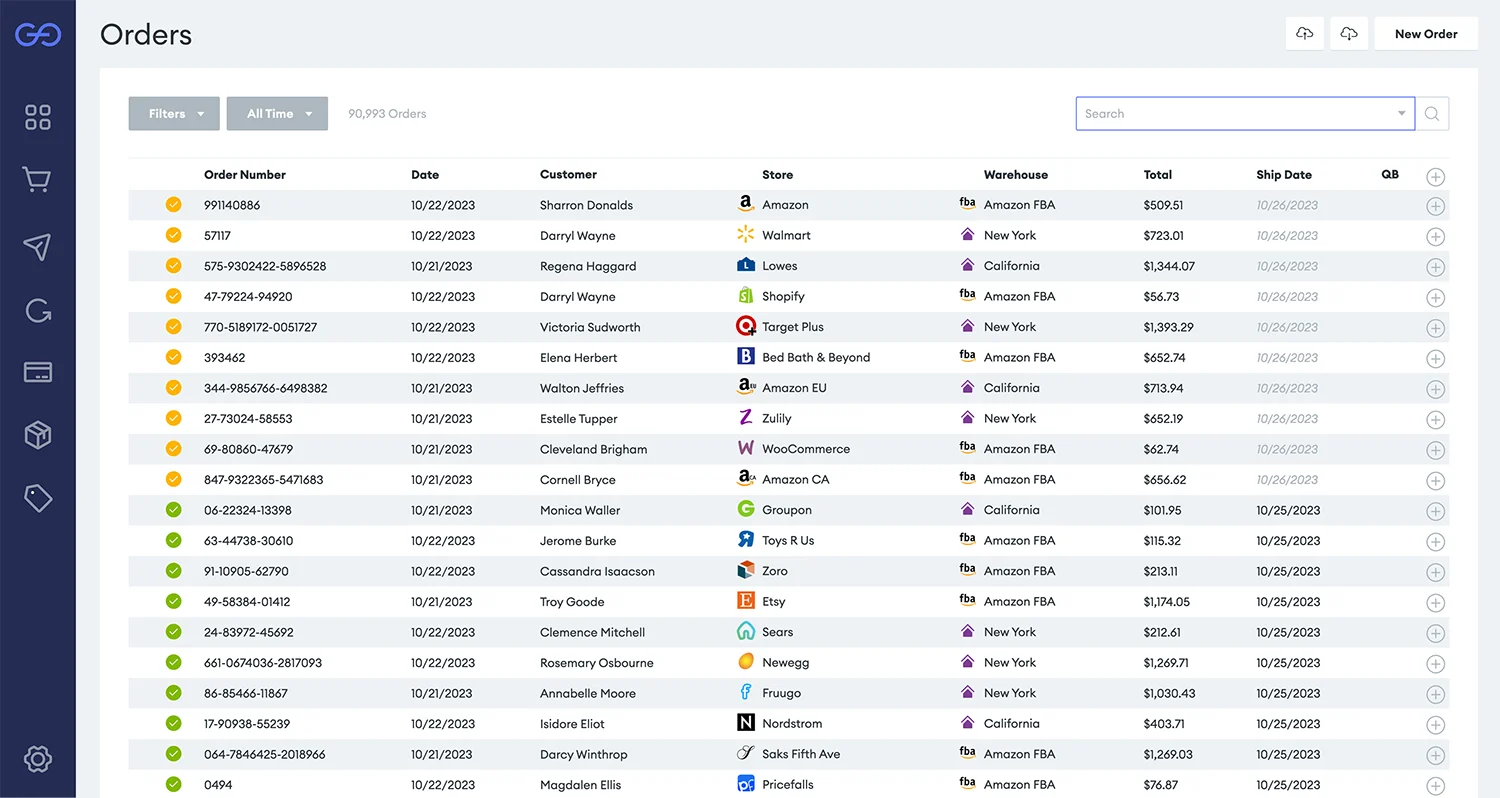
Goflow presents multichannel ecommerce operations tools. Official product overview.
Follow an order from import through fulfilment and cancellation. A consolidated list is only the start of the job.
Inventory connections
The platform includes inventory-related channel workflows. Official product overview.
Choose a source of truth and test latency. Do not allow several systems to overwrite each other’s quantity without a rule.
Shipping operations
The offering connects shipping and operational steps. Official product overview.
Validate the relevant carriers, service mapping and tracking return path in the account.
Channel scope
The official product describes multiple integrations. Official product overview.
Check the exact marketplace region, account type, fields and current connector limits.
Current plan boundaries
Every paid subscription includes the full platform with unlimited users, stores and listings. Pricing is based on order volumes and fulfilment type, with overages. Channel-fulfilled orders such as FBA/WFS/FBT count as half a regular retail order; integrated wholesale orders are counted separately. Official plan source.
- Manually entered/imported wholesale orders count as regular retail orders rather than the separate integrated-wholesale category.
- Shipping charges, implementation, external integration requirements and seasonal overages still need a real operating-cost model.
The snapshot above is tied to the review date. Promotions, billing interval, location and account migration can change the payable amount. The decision below uses the cost drivers rather than pretending a headline fee describes every configuration.
A practical evaluation sequence
Use the following as a proposed pilot. Keep source inputs and accepted outputs so another person can review the result. The sequence is designed around the task above; it is not a claim that OrbitVale ran an account test.
1. Map system ownership
Assign order identity, stock quantity, customer address and tracking to their authoritative systems.
2. Use a shared SKU
Sell the same variant through two connected channels and inspect the resulting reservation and quantity updates.
3. Introduce an import delay
Determine what staff can safely fulfil while one channel is late. Reconciliation should identify missing orders.
4. Split one order
Ship available items first and check line-level status and customer tracking.
5. Cancel after import
Confirm the stock and fulfilment consequences without assuming the channel change is instantaneous.
6. Reconcile by exception
Compare source orders with accepted destination records. Create a small list requiring human action instead of inspecting every order manually.
The operating details that decide the fit
Name the stock states
On hand, reserved, available, expected and quarantined describe different quantities. Decide which the storefront may promise. A returned item should not become available before inspection merely because a parcel arrived.
Keep locations meaningful to operators. A logical location that nobody uses physically makes reconciliation harder. Include transfers and temporary staging areas in the sample workflow.
Build an identifier dictionary
Connect supplier codes, internal SKUs, barcodes, marketplace identifiers and variants. One stable internal product identity reduces ambiguity when channel listings change. Bundles and multipacks require explicit component or unit rules.
Test a product with similar-looking variants. A quantity updating successfully is still wrong when it reaches the wrong size or pack. Keep the mapping owner and the date of the last change.
Reconcile the exception, not every screen
Compare the authoritative stock movements with receiving, fulfilment and channel records. Produce a small list of missing, duplicated or inconsistent identifiers that needs investigation.
Use adjustment reasons and appropriate authority. If staff routinely overwrite quantities to make an order work, the apparent accuracy can hide a process failure. Trace a sample variance back to a physical event.
Choose the right boundary for the system
A warehouse ledger, manufacturing planner and multichannel operations hub overlap but solve different primary jobs. Follow the movement that is hardest for the business to explain today.
Price the selected integrations and operating scope. Keep finance and operations involved where cost treatment matters. A shared definition of available stock is more valuable than another attractive dashboard.
Tradeoffs and reasons to reject the fit
Competing stock writers
Several systems updating the same field can create oscillating quantities.
Connector variation
A supported marketplace name does not establish all regional or order-type capabilities.
Partial completion
An order can be accepted in one system and incomplete in another. Recovery needs a durable order key.
Pricing the complete job
Channels, order load and recovery
Model normal and peak order volumes with required connections and support. If a pilot removes four minutes of repeated work from 300 orders, the illustrative saving is 20 hours. Deduct reconciliation and exception time before calling it a net benefit; a central system also requires an accountable operator.
| Cost line | Include in the estimate |
|---|---|
| Required subscription | Use the tier that contains the actual workflow and record currency, billing interval and team size. |
| Variable services | Count the real billing unit and separately priced carrier, payment, communication or model services. |
| Setup and change | Include source cleanup, integration, training and the first meaningful revision. |
| Review and exceptions | Budget the people who approve outputs, investigate discrepancies and complete customer follow-up. |
| What disappears | Only count a saving when the old subscription or manual task can actually be retired. |
Keep a normal-month estimate and a busy-month estimate. Use the same accepted outcome in both. If the tool produces an intermediate draft, alert, record or label, include the remaining work needed to complete the customer or publishing task. Replace the example assumptions with your own observed figures after the pilot.
Alternatives and the boundary between jobs
Finale Inventory
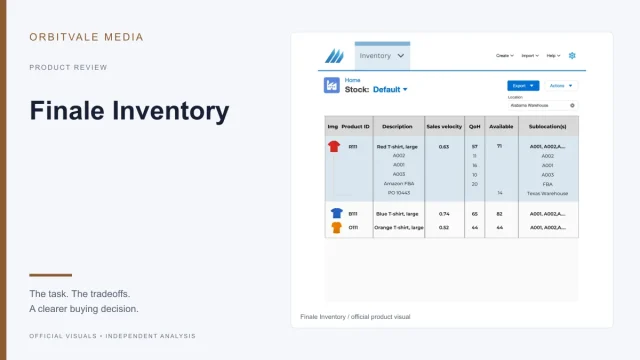
Read the Finale Inventory review. A multichannel seller needing a maintained stock ledger and clearer warehouse or order-related operations.
Finale Inventory is worth investigating when a merchant’s stock movements have outgrown a spreadsheet or disconnected channel counts. Multi-location inventory and operational workflows matter most when receiving, picking and adjustments need to agree on the same physical reality. The purchase should begin with a stock accuracy problem, not a desire for another dashboard.
Shippo
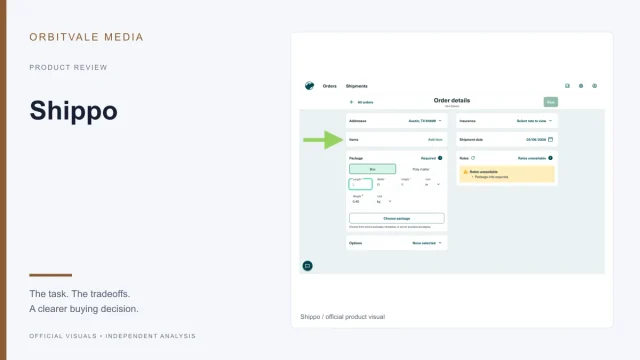
Read the Shippo review. A merchant needing a more coherent rate-and-label workflow with supported carriers and package types.
Shippo fits the practical shipping layer between an order and a parcel. Rate access, carrier connections and label workflows can simplify fulfilment for merchants that otherwise move between carrier sites. The complete decision includes address quality, package measurement, voids and customer exceptions after a label has been created.
Katana
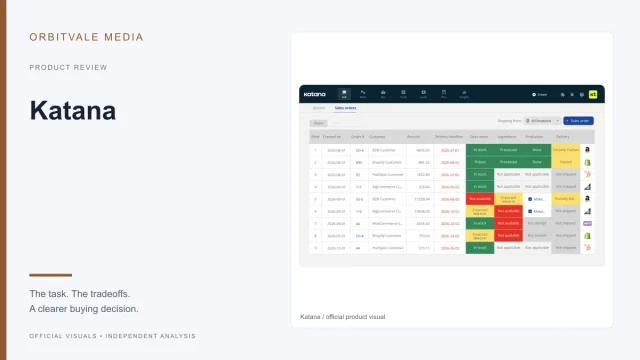
Read the Katana review. A growing brand needing material availability, production and sales orders to inform one operating plan.
Katana is relevant when the business makes, assembles or transforms what it sells. A finished-goods count alone cannot explain whether the next batch can be produced: materials, work in progress and purchasing need to be connected. That makes Katana a different buying decision from a lightweight stock counter.
A decision record to keep
For Goflow, record the selected account and plan, the specific job, the accepted output and the unresolved limitation. The acceptance decision should explain whether “competing stock writers” is manageable for this business. Name the owner of the next review and preserve the result of the changed-case exercise, not only the easiest first pass.
Our recommendation
Goflow is worth a deliberate trial when this describes your business: A multichannel merchant coordinating marketplace orders, stock and shipping across several operating steps. The case is weaker when this remains true: A simple single-channel store with no meaningful coordination problem, or a team expecting every connector to behave identically. Start with the bounded scenario, price the complete job and expand after the team can explain the exceptions. Open the official Goflow website.
Sources, image credits and scope
OrbitVale’s analysis combines official product information with proposed operating exercises. We have not represented these exercises as hands-on tests, measured vendor results or customer case studies. Calculations use stated assumptions. Product and plan sources were reviewed on November 4, 2026.
Goflow: Official overview · Current pricing.
Official visuals are credited beside each figure; they are vendor-published material, not independent test screenshots. Interactive plan displays and account-specific terms can differ. Confirm checkout, region and required entitlements before purchasing. See our editorial method and commercial disclosure.