Research-based product review · 7 min read · Source check: November 4, 2026
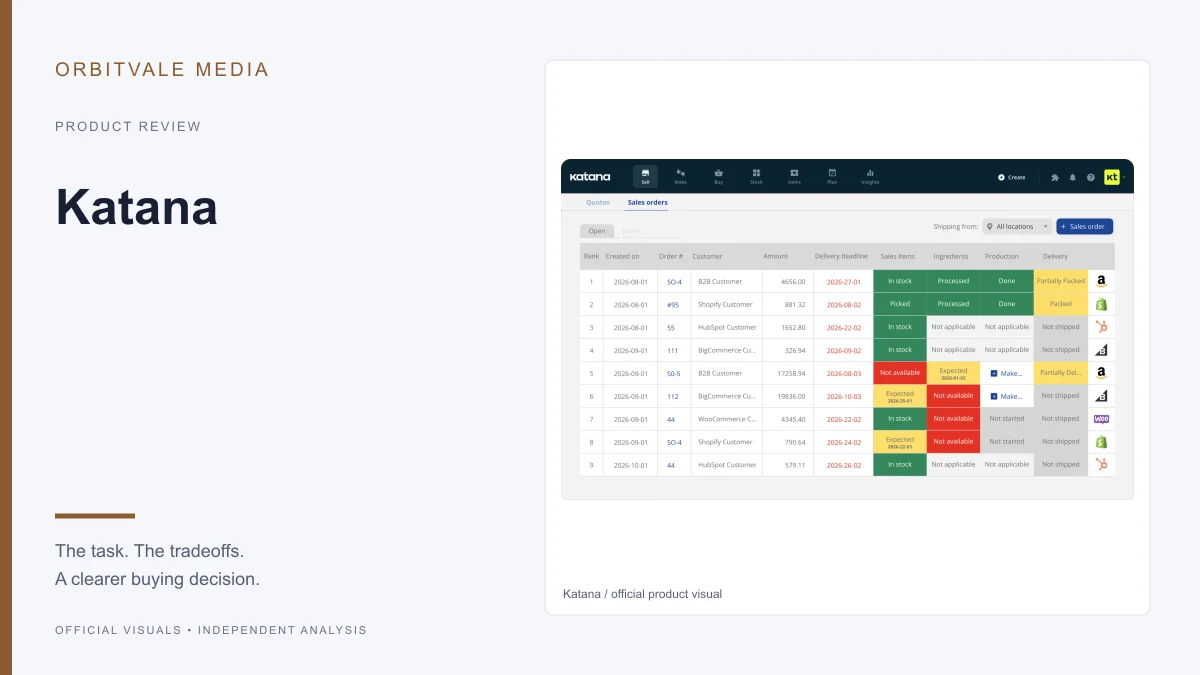
Katana is relevant when the business makes, assembles or transforms what it sells. A finished-goods count alone cannot explain whether the next batch can be produced: materials, work in progress and purchasing need to be connected. That makes Katana a different buying decision from a lightweight stock counter.
We would shortlist it after confirming that manufacturing complexity is the real problem. If the warehouse only receives and resells finished items, another inventory route may be simpler. Current Free and Advantage packaging also changes the cost discussion: evaluate the agreed scope and implementation rather than importing an old fixed-tier price table.
Table of Contents
The buying decision
| Put it on the shortlist when | Choose another route when |
|---|---|
| A growing brand needing material availability, production and sales orders to inform one operating plan. | A simple resale catalogue that does not need manufacturing logic, or a team expecting software to repair inaccurate material records automatically. |
A realistic job for Katana
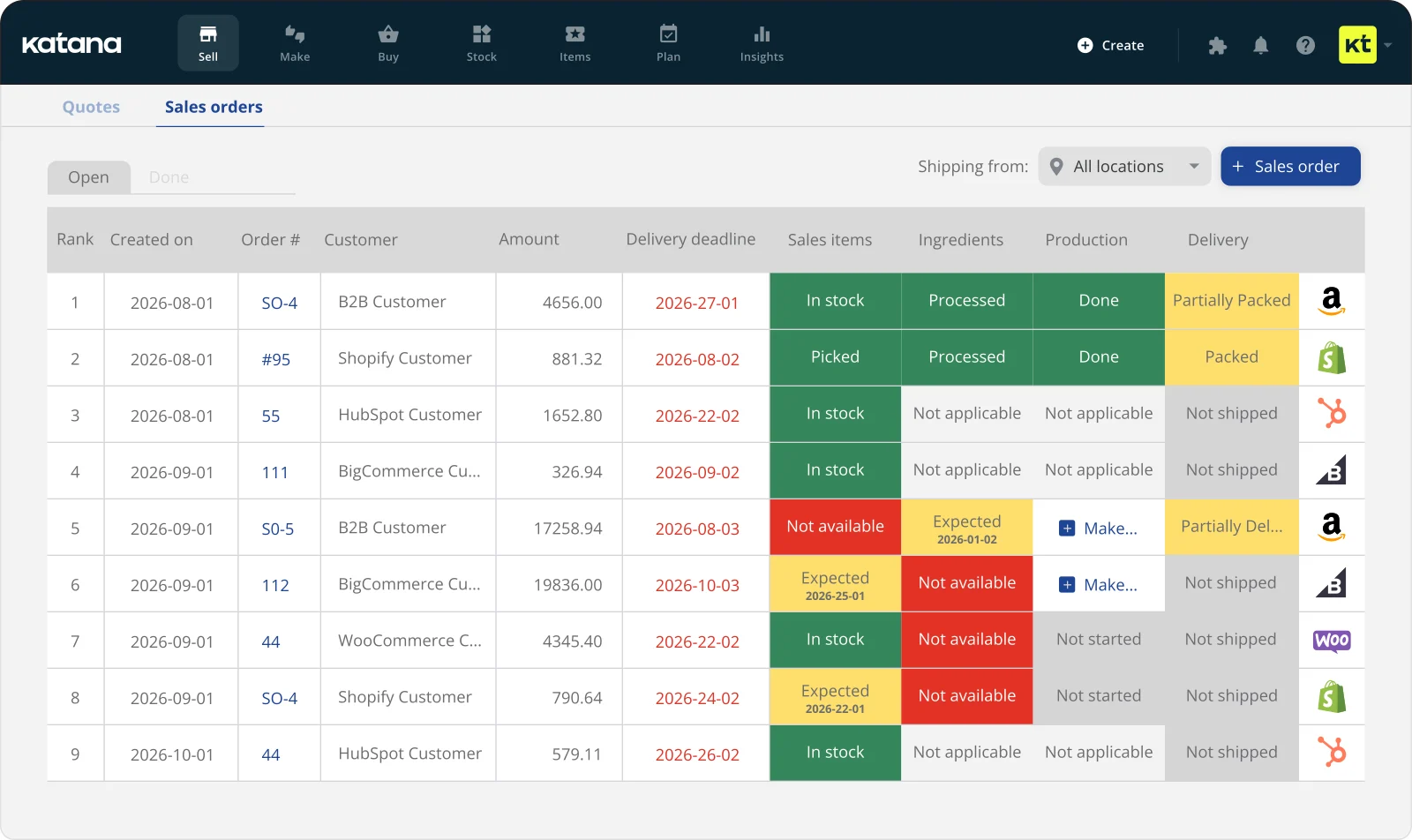
A candle maker sells individual jars and gift sets. One delayed fragrance delivery affects several products. The proposed pilot maps the material shortage to production and customer orders, then introduces a partial batch completion and a changed gift-set requirement.
What the capabilities mean in practice
Production and materials
Katana offers inventory and manufacturing workflows. Official product overview.
Model a real bill of materials, not just a finished SKU. Include yield, packaging and the component that actually constrains production.
Purchasing and sales
The product connects purchasing, inventory and order information. Official product overview.
Check whether the operator can see the consequence of a late receipt before promising a delivery date.
Traceability and warehouse needs
Official features cover operational stock workflows. Official product overview.
Use the identifiers and locations needed by the business. A clean dashboard is less useful if staff cannot reconcile the physical batch.
Current commercial model
The pricing page offers Free and scoped Advantage options. Official product overview.
Free has a 30-SKU limit after evaluation and a narrower integration scope. Advantage requires a written understanding of implementation, support and included workflows.
Current plan boundaries
The current pricing page offers Free and Advantage. Free is limited to 30 SKUs after an initial 15-day unlimited-SKU evaluation; Advantage is a scoped custom annual contract including implementation and ongoing support. It is not currently sold publicly through the older Standard/Professional price table. Official plan source.
- Free's ecommerce connection is currently Shopify only, despite general unlimited-integration language.
- Advantage's agreed scope matters for custom integrations, reports and automations; obtain a written scope and total contract price.
The snapshot above is tied to the review date. Promotions, billing interval, location and account migration can change the payable amount. The decision below uses the cost drivers rather than pretending a headline fee describes every configuration.
A practical evaluation sequence
Use the following as a proposed pilot. Keep source inputs and accepted outputs so another person can review the result. The sequence is designed around the task above; it is not a claim that OrbitVale ran an account test.
1. Choose one representative product
Include a component shared with another SKU, packaging and a meaningful production lead time.
2. Validate the material map
Compare the bill of materials with what the team actually consumes. Record substitutions and normal loss.
3. Create a shortage
Delay a key component and inspect the resulting production and sales priorities. A date should change for an explainable reason.
4. Receive a partial quantity
Test what remains outstanding and whether the planner can distinguish available from expected stock.
5. Complete part of a batch
Check material consumption and finished availability before the entire job is complete.
6. Reconcile physically
Count the selected materials and finished items. Investigate differences before trusting the system for wider promises.
The operating details that decide the fit
Separate material availability from finished availability
A finished product may be sellable now, in production or merely possible if materials arrive. Keep these states explicit. A shared component can constrain several products even when their individual demand looks manageable.
Use a real bill of materials with packaging and normal loss. Validate the quantities against actual production. If the source recipe is wrong, the planning system can calculate a precise answer to the wrong question.
Test partial work and substitution
Production rarely follows an ideal full-batch path every time. Include a partial completion, a damaged material and an approved substitute. Record who can authorize the change and how it affects stock and cost.
Avoid solving a physical discrepancy with an unexplained manual adjustment. The record should help the team learn whether the problem comes from consumption, receiving, measurement or the bill of materials.
Keep promised dates conditional on evidence
A material receipt date, production capacity and quality check can each change the earliest reliable dispatch. Make the source of the promise visible. A planned purchase is not the same as stock that passed receiving.
Use the pilot to identify which updates must happen promptly. If operators record completions only at the end of the week, the customer-facing availability cannot reasonably be treated as live.
Treat implementation as process work
Assign ownership for products, material recipes, locations and opening balances. A scoped contract should identify data cleanup, integrations, training and the support route after launch.
Start with a representative product family, reconcile physical quantities and expand when the team can explain every movement. The goal is dependable planning, not the fastest import of an entire catalogue.
Tradeoffs and reasons to reject the fit
Incorrect bills of materials
Small consumption errors accumulate across production. Assign ownership for changes and verify actual usage.
Implementation scope
A custom annual offer needs written deliverables and responsibilities. Clarify integrations and ongoing support.
False precision
A production date is only as reliable as material receipts, capacity assumptions and operator updates.
Pricing the complete job
Contract, implementation and inventory accuracy
Suppose ten staff each spend 15 minutes daily resolving stock questions. That is 37.5 hours over 15 working days, an illustrative baseline to validate. A manufacturing system is valuable only to the extent that it removes that work and improves reliable planning. Add onboarding, material cleanup, integrations and the agreed annual scope rather than comparing subscription fees alone.
| Cost line | Include in the estimate |
|---|---|
| Required subscription | Use the tier that contains the actual workflow and record currency, billing interval and team size. |
| Variable services | Count the real billing unit and separately priced carrier, payment, communication or model services. |
| Setup and change | Include source cleanup, integration, training and the first meaningful revision. |
| Review and exceptions | Budget the people who approve outputs, investigate discrepancies and complete customer follow-up. |
| What disappears | Only count a saving when the old subscription or manual task can actually be retired. |
Keep a normal-month estimate and a busy-month estimate. Use the same accepted outcome in both. If the tool produces an intermediate draft, alert, record or label, include the remaining work needed to complete the customer or publishing task. Replace the example assumptions with your own observed figures after the pilot.
Alternatives and the boundary between jobs
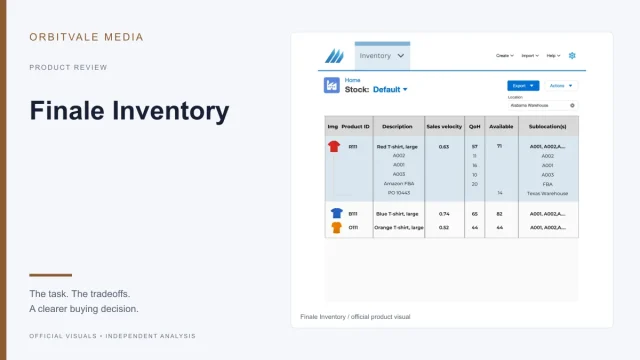
Finale Inventory
Read the Finale Inventory review. A multichannel seller needing a maintained stock ledger and clearer warehouse or order-related operations.
Finale Inventory is worth investigating when a merchant’s stock movements have outgrown a spreadsheet or disconnected channel counts. Multi-location inventory and operational workflows matter most when receiving, picking and adjustments need to agree on the same physical reality. The purchase should begin with a stock accuracy problem, not a desire for another dashboard.
Unleashed
Read the Unleashed review. A growing wholesale or product business needing stronger inventory, purchasing and connected commercial controls.
Unleashed is worth investigating when purchasing, stock and commercial reporting need a more structured relationship. A wholesale or product business may need to understand not just how many units exist, but where they are, what they cost and whether committed orders can be fulfilled. The correct shortlist depends on the operational scope and the accounting connection required.
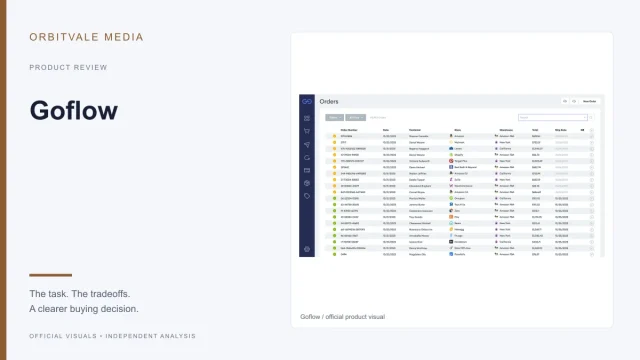
Goflow
Read the Goflow review. A multichannel merchant coordinating marketplace orders, stock and shipping across several operating steps.
Goflow is relevant when a business’s operational problem crosses marketplaces, inventory and fulfilment. Bringing order activity into a coherent workflow can reduce repeated data entry and unclear handoffs. The harder issue is deciding which system owns stock and how the team recovers when a marketplace or carrier update arrives late.
A decision record to keep
For Katana, record the selected account and plan, the specific job, the accepted output and the unresolved limitation. The acceptance decision should explain whether “incorrect bills of materials” is manageable for this business. Name the owner of the next review and preserve the result of the changed-case exercise, not only the easiest first pass.
Our recommendation
Katana is worth a deliberate trial when this describes your business: A growing brand needing material availability, production and sales orders to inform one operating plan. The case is weaker when this remains true: A simple resale catalogue that does not need manufacturing logic, or a team expecting software to repair inaccurate material records automatically. Start with the bounded scenario, price the complete job and expand after the team can explain the exceptions. Open the official Katana website.
Sources, image credits and scope
OrbitVale’s analysis combines official product information with proposed operating exercises. We have not represented these exercises as hands-on tests, measured vendor results or customer case studies. Calculations use stated assumptions. Product and plan sources were reviewed on November 4, 2026.
Katana: Official overview · Current pricing.
Official visuals are credited beside each figure; they are vendor-published material, not independent test screenshots. Interactive plan displays and account-specific terms can differ. Confirm checkout, region and required entitlements before purchasing. See our editorial method and commercial disclosure.