Research-based comparison · 8 min read · Source check: November 4, 2026
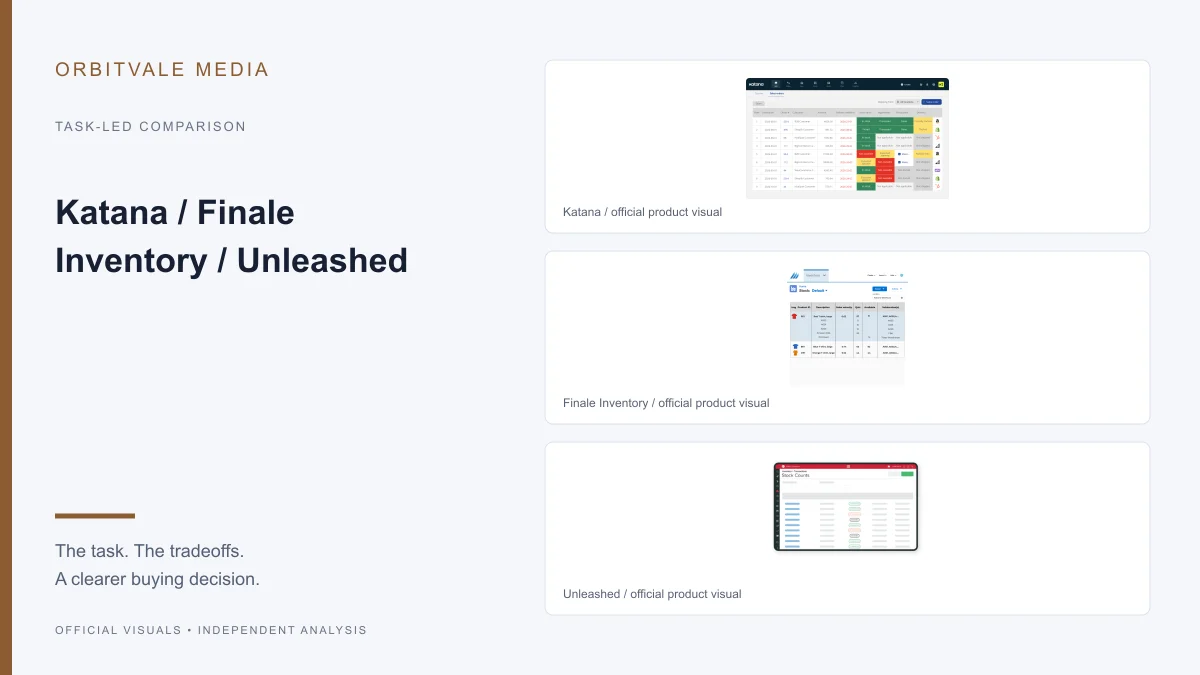
These systems overlap around inventory but should be shortlisted by the hardest operational movement. Katana is especially relevant when materials and production constrain finished goods. Finale Inventory is worth investigating for stock and warehouse control. Unleashed is relevant to product businesses needing purchasing, inventory and connected commercial discipline.
Table of Contents
The common task
Receive a partial delivery, move stock, reserve an order and process a non-sellable return. Add a manufacturing component case for businesses that actually make products; do not make that complexity mandatory for a reseller.
This is a proposed comparison, not a report of controlled product tests. Use the same source material, required outcome and review standard for every candidate. When products solve different stages, compare the complete architecture instead of forcing an artificial winner.
The decision in one view
| Dimension | What to compare |
|---|---|
| Primary job | Distinguish production planning, warehouse accuracy and connected product-business control. |
| Identity | Test units, variants, supplier codes and internal SKUs. |
| Availability | Separate on-hand, reserved, expected and quarantined quantities. |
| Implementation | Include opening reconciliation, training and integrations. |
| Cost | Compare the scoped regular contract and operating work rather than an obsolete fixed price. |
Where each candidate earns a place
Katana
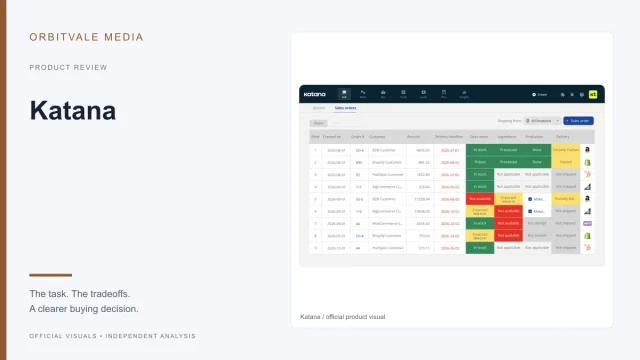
Katana is relevant when the business makes, assembles or transforms what it sells. A finished-goods count alone cannot explain whether the next batch can be produced: materials, work in progress and purchasing need to be connected. That makes Katana a different buying decision from a lightweight stock counter.
Strong-fit brief: A growing brand needing material availability, production and sales orders to inform one operating plan.
Weak-fit brief: A simple resale catalogue that does not need manufacturing logic, or a team expecting software to repair inaccurate material records automatically.
Full Katana analysis · Official website.
Finale Inventory
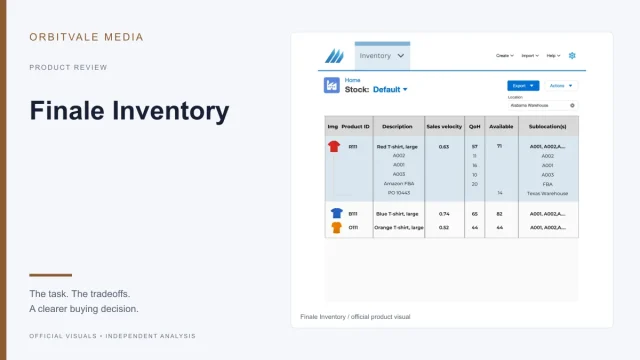
Finale Inventory is worth investigating when a merchant’s stock movements have outgrown a spreadsheet or disconnected channel counts. Multi-location inventory and operational workflows matter most when receiving, picking and adjustments need to agree on the same physical reality. The purchase should begin with a stock accuracy problem, not a desire for another dashboard.
Strong-fit brief: A multichannel seller needing a maintained stock ledger and clearer warehouse or order-related operations.
Weak-fit brief: A manufacturer whose main requirement is material planning without verifying production scope, or a team unwilling to reconcile the opening stock.
Full Finale Inventory analysis · Official website.
Unleashed
Unleashed is worth investigating when purchasing, stock and commercial reporting need a more structured relationship. A wholesale or product business may need to understand not just how many units exist, but where they are, what they cost and whether committed orders can be fulfilled. The correct shortlist depends on the operational scope and the accounting connection required.
Strong-fit brief: A growing wholesale or product business needing stronger inventory, purchasing and connected commercial controls.
Weak-fit brief: A basic catalogue with little operational complexity, or a team unwilling to assign ownership for stock and cost data.
Full Unleashed analysis · Official website.
Run the evaluation through six checkpoints
1. Define the source and ownership
| Candidate | Product-specific task |
|---|---|
| Katana | Choose one representative product: Include a component shared with another SKU, packaging and a meaningful production lead time. |
| Finale Inventory | Reconcile opening quantities: Count a representative set and explain the difference from the old system before importing balances. |
| Unleashed | Define units and identities: Document purchase, stock and sales units. Use a representative conversion case. |
2. Prepare the representative case
| Candidate | Product-specific task |
|---|---|
| Katana | Validate the material map: Compare the bill of materials with what the team actually consumes. Record substitutions and normal loss. |
| Finale Inventory | Map identifiers: Connect supplier codes, internal SKUs, barcodes and channel variants. Preserve one stable internal identity. |
| Unleashed | Clean the opening records: Count selected stock and validate product costs before import. |
3. Inspect the first accepted result
| Candidate | Product-specific task |
|---|---|
| Katana | Create a shortage: Delay a key component and inspect the resulting production and sales priorities. A date should change for an explainable reason. |
| Finale Inventory | Receive a discrepancy: Use a partial delivery and one damaged unit. Staff should record expected, received and sellable quantities separately. |
| Unleashed | Receive in two parts: Record what arrived, what remains expected and when each quantity becomes sellable. |
4. Introduce an ordinary exception
| Candidate | Product-specific task |
|---|---|
| Katana | Receive a partial quantity: Test what remains outstanding and whether the planner can distinguish available from expected stock. |
| Finale Inventory | Transfer and reserve: Move stock between locations while an order is waiting. Check whether available quantity remains accurate. |
| Unleashed | Add a cost change: Explain treatment of freight and other landed costs using the business’s accounting policy. |
5. Ask another operator
| Candidate | Product-specific task |
|---|---|
| Katana | Complete part of a batch: Check material consumption and finished availability before the entire job is complete. |
| Finale Inventory | Process a non-sellable return: Inspect the item before restoring availability. An automatic increment can create a false promise. |
| Unleashed | Fulfil a mixed order: Include a partial quantity and a reserved item. Check the downstream accounting and customer status. |
6. Price and document the result
| Candidate | Product-specific task |
|---|---|
| Katana | Reconcile physically: Count the selected materials and finished items. Investigate differences before trusting the system for wider promises. |
| Finale Inventory | Trace an adjustment: Ask another operator to explain a variance using the system history and the physical record. |
| Unleashed | Reconcile and hand over: Have the operations and finance owners agree the sample ledger and document unresolved differences. |
Operating questions behind the comparison
Name the stock states
On hand, reserved, available, expected and quarantined describe different quantities. Decide which the storefront may promise. A returned item should not become available before inspection merely because a parcel arrived.
Keep locations meaningful to operators. A logical location that nobody uses physically makes reconciliation harder. Include transfers and temporary staging areas in the sample workflow.
Build an identifier dictionary
Connect supplier codes, internal SKUs, barcodes, marketplace identifiers and variants. One stable internal product identity reduces ambiguity when channel listings change. Bundles and multipacks require explicit component or unit rules.
Test a product with similar-looking variants. A quantity updating successfully is still wrong when it reaches the wrong size or pack. Keep the mapping owner and the date of the last change.
Reconcile the exception, not every screen
Compare the authoritative stock movements with receiving, fulfilment and channel records. Produce a small list of missing, duplicated or inconsistent identifiers that needs investigation.
Use adjustment reasons and appropriate authority. If staff routinely overwrite quantities to make an order work, the apparent accuracy can hide a process failure. Trace a sample variance back to a physical event.
Choose the right boundary for the system
A warehouse ledger, manufacturing planner and multichannel operations hub overlap but solve different primary jobs. Follow the movement that is hardest for the business to explain today.
Price the selected integrations and operating scope. Keep finance and operations involved where cost treatment matters. A shared definition of available stock is more valuable than another attractive dashboard.
Compare the same complete cost
Katana cost drivers
Suppose ten staff each spend 15 minutes daily resolving stock questions. That is 37.5 hours over 15 working days, an illustrative baseline to validate. A manufacturing system is valuable only to the extent that it removes that work and improves reliable planning. Add onboarding, material cleanup, integrations and the agreed annual scope rather than comparing subscription fees alone.
Finale Inventory cost drivers
If six operators each lose ten minutes a day checking uncertain quantities, a 20-day month contains 20 hours of such work. Measure how much a pilot actually removes and include stock-count, training and integration costs. Reduced overselling is valuable, but do not assign a revenue benefit without evidence.
Check current Finale Inventory pricing.
Unleashed cost drivers
Estimate the selected regular plan, implementation, integration and stock-cleanup effort. If the business spends an illustrative 25 hours monthly reconciling purchasing and availability, measure the portion the pilot actually removes. Keep accuracy improvements separate from unproven revenue benefits.
Check current Unleashed pricing.
| Shared cost line | Comparable assumption |
|---|---|
| Required subscription | Use the tier that contains the actual workflow and record currency, billing interval and team size. |
| Variable services | Count the real billing unit and separately priced carrier, payment, communication or model services. |
| Setup and change | Include source cleanup, integration, training and the first meaningful revision. |
| Review and exceptions | Budget the people who approve outputs, investigate discrepancies and complete customer follow-up. |
| What disappears | Only count a saving when the old subscription or manual task can actually be retired. |
Reasons to reject a candidate
Katana limits for this task
- Incorrect bills of materials: Small consumption errors accumulate across production. Assign ownership for changes and verify actual usage.
- Implementation scope: A custom annual offer needs written deliverables and responsibilities. Clarify integrations and ongoing support.
- False precision: A production date is only as reliable as material receipts, capacity assumptions and operator updates.
Finale Inventory limits for this task
- Dirty opening balance: A new system faithfully carries old errors if the initial count is wrong.
- Identifier mismatch: Duplicate or ambiguous SKUs can send stock updates to the wrong listing.
- Unowned adjustments: Unexplained manual changes undermine trust. Assign authority and a reason code.
Unleashed limits for this task
- Unit errors: An incorrect conversion can distort stock and margin at once.
- Cost assumptions: Operational and accounting definitions must agree. A dashboard cannot choose the policy for the business.
- Migration burden: Cleanup, training and integrations are part of the purchase, not an optional afterthought.
These are evaluation questions, not assertions that a product always fails. When a limitation creates another handoff, assign an owner and price that work. If neither candidate meets the essential requirement, revise the shortlist rather than quietly weakening the requirement after seeing a polished demo.
The comparison mistake to avoid
A successful import is not evidence of stock accuracy. Reconcile a physical sample and follow the difficult movements before trusting customer-facing availability.
Our conditional recommendation
Choose the smallest scope that explains the real movements reliably. A manufacturer should test material shortages and partial production; a reseller should prioritize receiving and channel accuracy. Have operations and finance agree the definitions before a broad migration.
What to retain after deciding
Keep the original brief, selected account configuration, accepted output and changed-case result. Record which assumption would reverse the recommendation: volume, team ownership, output format or the cost of an exception. This makes the comparison useful again when the business changes. A decision to postpone a purchase is also a valid result when the process or source data is not ready.
Sources, image credits and scope
OrbitVale’s analysis combines official product information with proposed operating exercises. We have not represented these exercises as hands-on tests, measured vendor results or customer case studies. Calculations use stated assumptions. Product and plan sources were reviewed on November 4, 2026.
Katana: Official overview · Current pricing.
Finale Inventory: Official overview · Current pricing.
Unleashed: Official overview · Current pricing.
Official visuals are credited beside each figure; they are vendor-published material, not independent test screenshots. Interactive plan displays and account-specific terms can differ. Confirm checkout, region and required entitlements before purchasing. See our editorial method and commercial disclosure.