Practical guide · Proposed planning examples · November 4, 2026
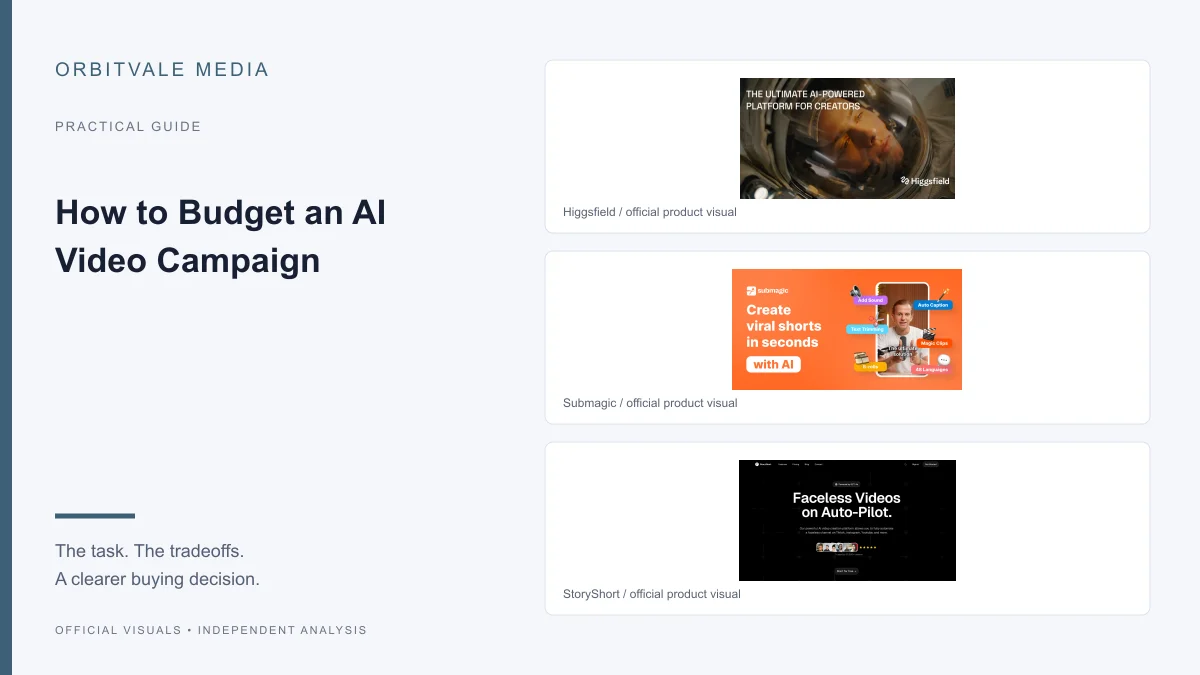
An AI video budget should begin with the output a person can approve. Credits, generated seconds and candidate clips are intermediate units. A small commerce team needs to know what it will spend to publish a useful, accurate campaign variant and revise it later.
This guide uses a hypothetical product campaign to connect generation, editing, voice and review. The numbers are assumptions for a worksheet, not observations about any vendor. Replace them with your own account charges and production results.
Table of Contents
A completed planning example
| Line | Assumption | Illustrative work |
|---|---|---|
| Final campaign | Six approved 20-second variants | 120 final seconds |
| Generation | Four attempts per accepted variant | 24 attempts |
| Creative selection | Three minutes per attempt | 72 minutes |
| Factual and visual review | Eight minutes per final variant | 48 minutes |
| Final finishing | Twelve minutes per accepted variant | 72 minutes |
| One later revision | Fifteen minutes on each of two variants | 30 minutes |
The example contains 222 minutes of human work before source research and publishing. If the team values that time at an assumed $30 per hour, the time component is $111. Add subscription allocation and the actual cost of the 24 generation attempts. An attractive low-cost individual generation is not the whole campaign budget.
If only three variants survive review, the same initial selection work is spread over fewer accepted outputs. That is why acceptance rate matters. Track rejection reasons: a weak brief, wrong product detail and unsuitable camera movement point to different improvements.
Choose the stage before the tool
| Bottleneck | Relevant shortlist | Keep in the estimate |
|---|---|---|
| Generated campaign scenes | Higgsfield and Runway | Rejected attempts, continuity and compositing |
| Narrative from a script | StoryShort, Pictory and invideo | Script adaptation and scene corrections |
| Existing recorded footage | Submagic, OpusClip and Descript | Context, captions and framing repair |
| Narration or presenter | ElevenLabs and HeyGen | Pronunciation, identity and language review |
Write acceptance before seeing a beautiful frame
A production brief should state what must remain stable: the object’s identity, the action, duration, framing and forbidden details. Separate a mood reference from a factual product reference. A scene can be aesthetically successful yet commercially unusable because the logo, count or mechanism changes.
Use explicit rejection codes such as identity drift, temporal artefact, unsuitable movement or unsupported claim. This makes an attempt log useful for learning. Without a rule, teams often choose the most attractive frame and discover only in the edit that the shot cannot perform its intended role.
Use an attempt budget and a stopping rule
Decide how many experiments the brief justifies and what each will vary. Keeping the reference and changing one control gives more useful information than rewriting the entire prompt after every result. The aim is to narrow uncertainty, not to continue until a favourite appears.
Set a fallback before spending the full allowance. A simpler real shot, static graphic or shorter transition may serve the audience better than a complex generation that consumes the week. A useful stopping rule says when the team will simplify the concept or change the production method.
Inspect the final sequence, not isolated clips
Motion continuity, colour, scale and rhythm become visible when shots sit together. A generated insert may look excellent alone but pull attention away from the real product demonstration. Test the cut with the intended titles, narration and music.
Review the exported file at normal speed and on pause. Look at contact with surfaces, repeated objects, small lettering and changes near the clip boundary. If a shot is only acceptable when viewed quickly at low resolution, it may not be robust enough for a campaign that customers will replay.
Maintain a production recipe
Keep the accepted file, source assets, permission record, model, settings, prompt and selection notes. Different tools expose different parts of this history, so retain what the team can reasonably capture. A vendor update can change the behaviour of the same prompt.
The archive should support a real revision: change the colour direction, replace a product or adapt the ratio. If the exact result cannot be regenerated, the retained export is still useful. Do not confuse a saved prompt with a guaranteed reproducible source project.
Build a caption quality hierarchy
Review factual accuracy first, timing second and visual styling third. A caption that changes “does not fit” into “does fit” is a more serious failure than a slightly awkward line break. Product names, quantities, prices and qualifications deserve deliberate inspection. The transcript should remain connected to the source recording so a later correction has a reference.
Next, check reading time and placement. A viewer needs enough time to read and see the action. Place the demonstration, face and platform interface in the frame before choosing a text zone. A preset that works for a talking head may hide the important part of an assembly video.
Judge the beginning and ending separately
Clipping errors often sit at the boundaries. A segment may begin after the subject was named or end before a condition was explained. Watch the original context around the proposed cut. A standalone short should communicate one complete idea without inviting a broader inference than the source supports.
Review the publishing title and hook as part of the same message. If the title promises a guaranteed result and the speaker described a conditional example, the clip is misleading even when the captions are exact. Editing needs an owner for meaning as well as timing.
Measure useful yield from the source
Create three counts: candidates, editor-approved clips and published clips. Candidate volume reflects the tool’s suggestions; approved yield reflects actual production usefulness; publication adds channel scheduling and audience judgment. Keep those denominators separate.
For a hypothetical source hour yielding four approved clips, record how much correction each needs. A second recording may yield only one complete idea. The difference may come from source quality rather than software performance. A fair trial uses more than one type of recording and reports the limitation instead of presenting the best source as typical.
Keep the correction path short
A late price or compatibility update should be traceable from the source statement to every affected output. Maintain a simple register containing source, clip ID, approved title, export and publication destination. This is especially useful when several editors work on derivatives.
Save the approved caption text and an editable project where available. A final compressed file is useful for publishing but can be expensive to repair. Before adopting a new tool, test one ordinary revision and estimate the time it would take across a month’s clips.
A three-case cost forecast
Use a normal case, a difficult case and a revision case. The normal case should resemble the material the team handles most often, not a carefully selected showcase. The difficult case should contain a real source of cost such as fine product lettering or a second language. The revision case should change something the business is likely to update.
Record the actual current billing unit for each tool. Do not equate execution credits, generation credits and video minutes. Keep external services and staff time separate so the team can see where a change affects the total. Revisit the model after the first small production batch.
Sources, image credits and scope
OrbitVale’s analysis combines official product information with proposed operating exercises. We have not represented these exercises as hands-on tests, measured vendor results or customer case studies. Calculations use stated assumptions. Product and plan sources were reviewed on November 4, 2026.
Higgsfield: Official overview · Current pricing · Supporting official source 1 · Supporting official source 2 · Supporting official source 3.
Submagic: Official overview · Current pricing.
StoryShort: Official overview · Current pricing.
ElevenLabs: Official overview · Current pricing.
Official visuals are credited beside each figure; they are vendor-published material, not independent test screenshots. Interactive plan displays and account-specific terms can differ. Confirm checkout, region and required entitlements before purchasing. See our editorial method and commercial disclosure.