Research-based product review · 7 min read · Source check: November 4, 2026
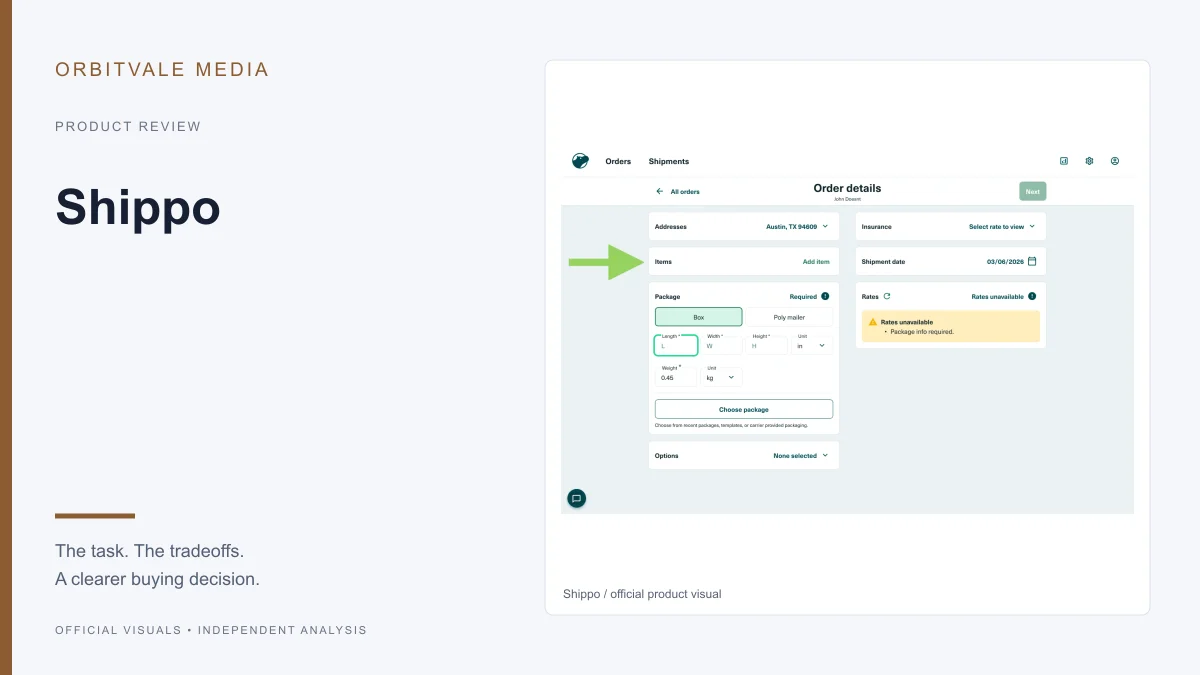
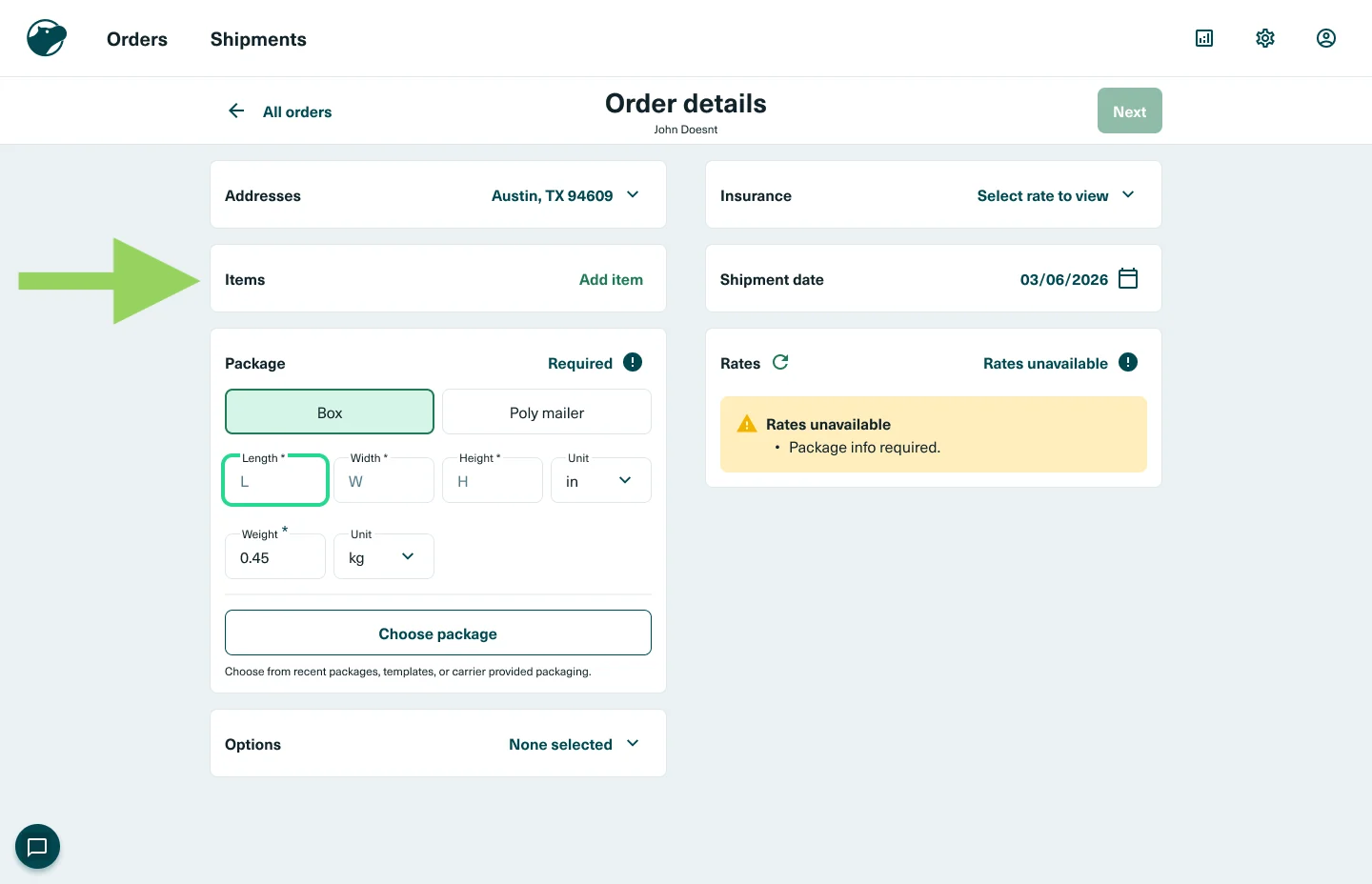
Shippo fits the practical shipping layer between an order and a parcel. Rate access, carrier connections and label workflows can simplify fulfilment for merchants that otherwise move between carrier sites. The complete decision includes address quality, package measurement, voids and customer exceptions after a label has been created.
We would begin with a representative basket of domestic and cross-border parcels. Compare the actual service eligibility, total charge and label workflow rather than assuming the lowest displayed rate is always the best choice. Postage is separate from the software subscription, and carrier-account connections or API use may follow different pricing routes.
Table of Contents
The buying decision
| Put it on the shortlist when | Choose another route when |
|---|---|
| A merchant needing a more coherent rate-and-label workflow with supported carriers and package types. | A business expecting a label tool to replace inventory control, solve every international tax question or guarantee a carrier’s delivery performance. |
A realistic job for Shippo
A stationery store ships flat mailers, small boxes and occasional wholesale cartons. The proposed trial includes a corrected address, a cancelled label and a destination requiring customs information. Staff should know which costs are software charges and which come from the carrier.
What the capabilities mean in practice
Labels and rates
Shippo offers carrier rates and shipping-label tools. Official product overview.
Use exact dimensions, weight and origin. A generic example cannot establish what your actual parcels will cost.
Carrier connections
The service supports multiple carrier routes. Official product overview.
Check the supported origin country, account type and service. An integration logo does not guarantee every negotiated rate is available.
Merchant and API paths
Shippo provides web and developer offerings. Official product overview.
Evaluate the route you intend to operate. The API requires its own implementation and usage estimate.
Pricing boundaries
The current Starter allowance includes up to 30 labels without a software subscription fee. Official product overview.
Postage remains payable. Read connected-carrier charges and the relevant paid tier before modelling a higher-volume month.
Current plan boundaries
App plans depend on monthly label volume and billing period. Starter lists up to 30 labels/month and one user; Pro includes branded tracking and up to five users. Postage, optional insurance and separately metered API operations are distinct costs. Official plan source.
- Connecting an own carrier account on Starter carries a per-label platform charge; Pro lists that connection as free.
- The displayed annual Pro starting price is not the total shipping bill. Rating, tracking or address-validation API calls not associated with Shippo labels can be billed separately.
The snapshot above is tied to the review date. Promotions, billing interval, location and account migration can change the payable amount. The decision below uses the cost drivers rather than pretending a headline fee describes every configuration.
A practical evaluation sequence
Use the following as a proposed pilot. Keep source inputs and accepted outputs so another person can review the result. The sequence is designed around the task above; it is not a claim that OrbitVale ran an account test.
1. Build a parcel sample
Include the common box, an awkward size and a remote or international destination. Use measured packed dimensions.
2. Compare equivalent service
Check delivery expectations, tracking and coverage before comparing price. A cheaper service with different eligibility is not the same purchase.
3. Validate the label
Inspect address, service and barcode from the printer used in fulfilment. Check that the order is marked correctly downstream.
4. Cancel a test shipment
Use a safe test case and learn the void/refund process. Distinguish a submitted request from a completed carrier credit.
5. Rehearse an exception
Correct an address or choose another service after a customer request. Ensure the original tracking does not remain the customer’s reference.
6. Reconcile the month
Compare labels, voids, postage and adjustments with the order ledger. Unexpected carrier charges belong in the cost model.
The operating details that decide the fit
Compare an equivalent parcel and service
Use packed weight, dimensions, origin and destination. Include the common parcel and a difficult case. A cheaper quote for a different service or ineligible route is not a like-for-like saving.
Separate software fees, postage, insurance and later adjustments. A label tool can expose choices, but the merchant still needs an accurate package profile and a reason for selecting the service.
Distinguish label, dispatch and delivery
A label being created does not prove carrier acceptance. A carrier scan does not prove the customer received an undamaged item. Keep these stages separate in the customer message and internal ledger.
Test what happens after an address correction, void or replacement label. The customer should not be left tracking an obsolete reference, and staff should know whether a postage refund is requested or completed.
Make the exception path visible
Define the response to a delayed parcel, failed delivery and missing tracking update. Give support the order, service and relevant event history without requiring several disconnected searches.
For returns, distinguish parcel receipt, item inspection, refund decision and restoration to sellable stock. An exchange can create a new shipment while the original order remains part of the case.
Reconcile the carrier bill
Use a sample period to compare purchased labels, voids, adjustments and carrier charges. Measurement errors often surface later than the original rate selection. Review the packed parcel process when adjustments recur.
The appropriate platform depends on supported origins, contracts, rules and post-purchase needs. A broad carrier list should lead to a route-specific trial, not an assumption that every service is available everywhere.
Tradeoffs and reasons to reject the fit
Measurement errors
Wrong dimensions can produce later adjustments. Measure the packed parcel, not the product alone.
Coverage assumptions
Service and carrier availability vary by origin and account. Validate the actual route.
Label mistaken for shipment
A created label does not prove a parcel was handed over. Keep dispatch confirmation distinct.
Pricing the complete job
Software, postage and adjustments
For 450 monthly parcels, split software fees, purchased postage, carrier-account charges, insurance and adjustments. If improved measurement prevents an assumed $2 adjustment on 30 parcels, the illustrative benefit is $60. Validate that assumption from real invoices rather than claiming every shipment receives a discount.
| Cost line | Include in the estimate |
|---|---|
| Required subscription | Use the tier that contains the actual workflow and record currency, billing interval and team size. |
| Variable services | Count the real billing unit and separately priced carrier, payment, communication or model services. |
| Setup and change | Include source cleanup, integration, training and the first meaningful revision. |
| Review and exceptions | Budget the people who approve outputs, investigate discrepancies and complete customer follow-up. |
| What disappears | Only count a saving when the old subscription or manual task can actually be retired. |
Keep a normal-month estimate and a busy-month estimate. Use the same accepted outcome in both. If the tool produces an intermediate draft, alert, record or label, include the remaining work needed to complete the customer or publishing task. Replace the example assumptions with your own observed figures after the pilot.
Alternatives and the boundary between jobs
Sendcloud
Read the Sendcloud review. A merchant in supported markets needing structured shipping, carrier and post-purchase workflows.
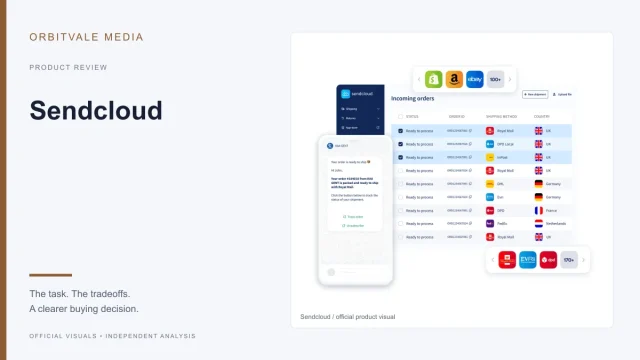
Sendcloud is worth evaluating when a merchant’s shipping job includes operational rules, several carriers and a more deliberate post-purchase experience. The relevant comparison extends beyond printing labels to service selection, tracking and returns. Country and carrier coverage should be checked against the business’s origin markets before comparing features.
Goflow
Read the Goflow review. A multichannel merchant coordinating marketplace orders, stock and shipping across several operating steps.
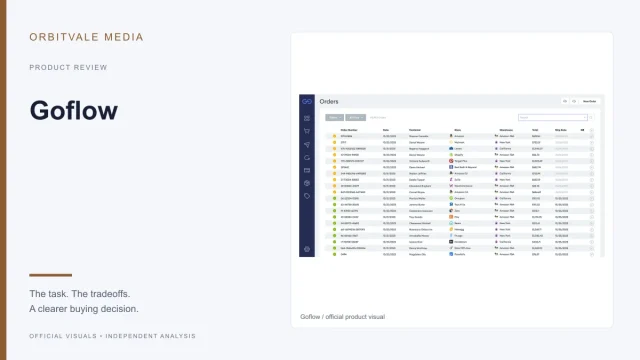
Goflow is relevant when a business’s operational problem crosses marketplaces, inventory and fulfilment. Bringing order activity into a coherent workflow can reduce repeated data entry and unclear handoffs. The harder issue is deciding which system owns stock and how the team recovers when a marketplace or carrier update arrives late.
Finale Inventory
Read the Finale Inventory review. A multichannel seller needing a maintained stock ledger and clearer warehouse or order-related operations.
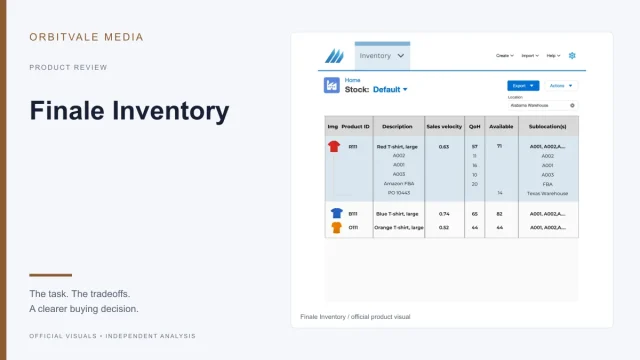
Finale Inventory is worth investigating when a merchant’s stock movements have outgrown a spreadsheet or disconnected channel counts. Multi-location inventory and operational workflows matter most when receiving, picking and adjustments need to agree on the same physical reality. The purchase should begin with a stock accuracy problem, not a desire for another dashboard.
A decision record to keep
For Shippo, record the selected account and plan, the specific job, the accepted output and the unresolved limitation. The acceptance decision should explain whether “measurement errors” is manageable for this business. Name the owner of the next review and preserve the result of the changed-case exercise, not only the easiest first pass.
Our recommendation
Shippo is worth a deliberate trial when this describes your business: A merchant needing a more coherent rate-and-label workflow with supported carriers and package types. The case is weaker when this remains true: A business expecting a label tool to replace inventory control, solve every international tax question or guarantee a carrier’s delivery performance. Start with the bounded scenario, price the complete job and expand after the team can explain the exceptions. Open the official Shippo website.
Sources, image credits and scope
OrbitVale’s analysis combines official product information with proposed operating exercises. We have not represented these exercises as hands-on tests, measured vendor results or customer case studies. Calculations use stated assumptions. Product and plan sources were reviewed on November 4, 2026.
Shippo: Official overview · Current pricing.
Official visuals are credited beside each figure; they are vendor-published material, not independent test screenshots. Interactive plan displays and account-specific terms can differ. Confirm checkout, region and required entitlements before purchasing. See our editorial method and commercial disclosure.